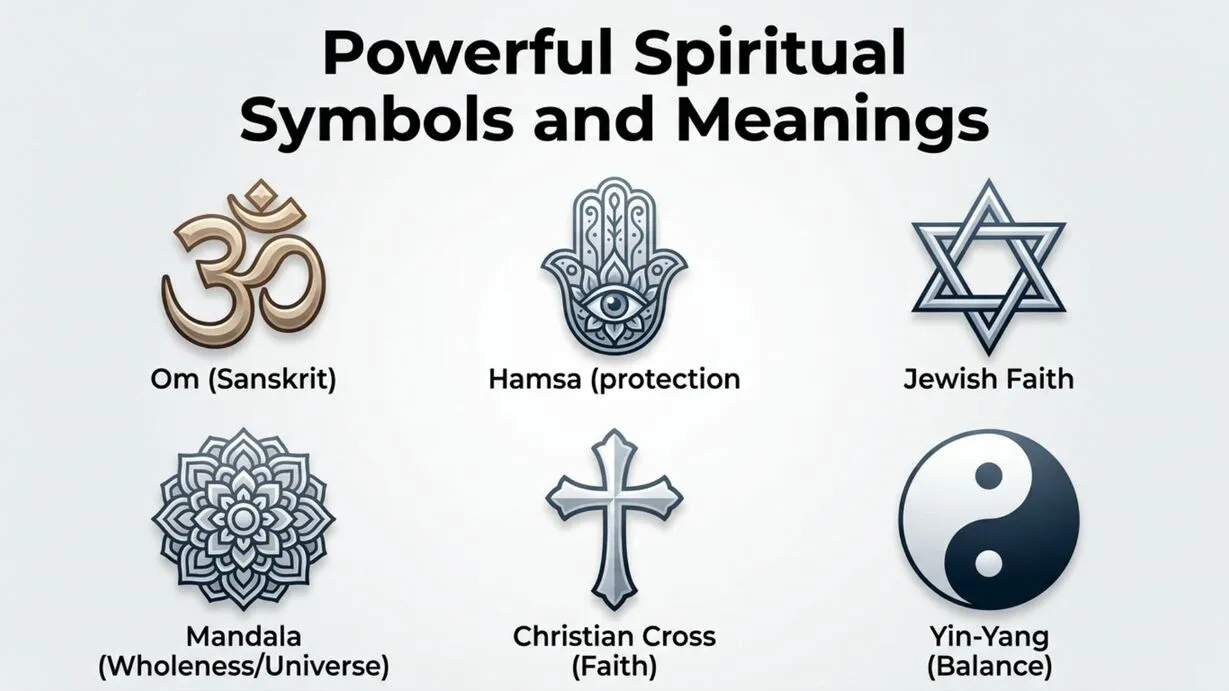
Powerful spiritual symbols have been used across cultures and religions for thousands of years to express beliefs, represent divine concepts, and inspire personal growth. From ancient civilizations to modern spiritual practices, these symbols serve as visual representations of hope, protection, wisdom, transformation, and the connection between humanity and the divine.
Whether carved into stone temples, painted in sacred manuscripts, worn as jewelry, or displayed in homes, spiritual symbols carry layers of meaning that extend beyond their appearance. While some are rooted in specific religious traditions, others have become universal signs recognized around the world.
Understanding powerful spiritual symbols and meanings helps you appreciate their historical symbolism, cultural meaning, and symbolic significance without confusing mythology, religion, or folklore. This guide explores their origins, interpretations, common uses, and the reasons they continue to resonate in today’s world.
Powerful Spiritual Symbols and Meanings (Meaning and Overview)
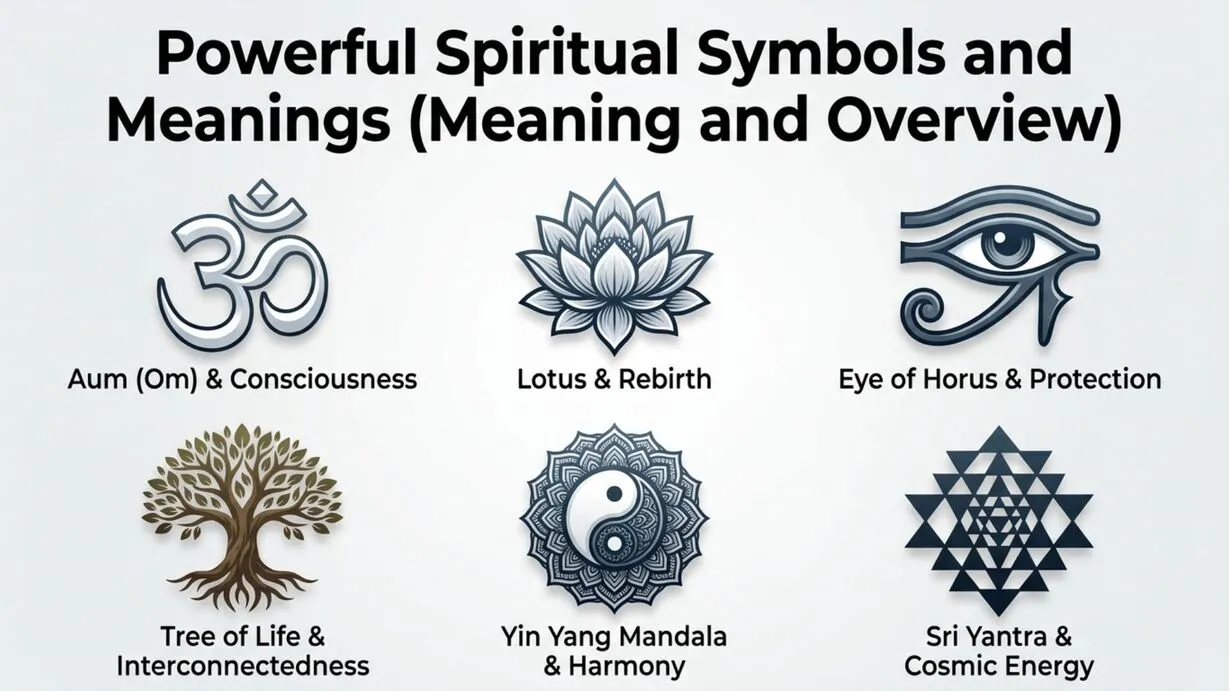
A spiritual symbol is a visual representation of a spiritual idea, belief, virtue, or divine principle. Unlike ordinary signs or decorative symbols, these sacred images communicate deeper meanings that often transcend language and culture.
Throughout history, spiritual symbols have been used to teach religious truths, encourage meditation, strengthen faith, and remind people of important values such as love, peace, courage, compassion, and renewal.
Although many symbols originated within particular faiths or civilizations, their influence has spread worldwide. Today, they appear in artwork, architecture, books, jewelry, meditation spaces, digital communication, and educational materials.
Some symbols represent protection, while others symbolize enlightenment, eternal life, balance, or spiritual awakening. Their meaning often depends on historical context, cultural traditions, and the beliefs of the communities that use them.
History and Origin
The history of spiritual symbols dates back to prehistoric civilizations. Long before written language became widespread, people relied on symbolic representation to communicate religious beliefs and explain natural phenomena.
Ancient Egyptians carved sacred icons into temples to honor their gods. Early Mesopotamian civilizations created symbolic signs representing divine authority and cosmic order. Indigenous cultures around the world developed their own sacred visual traditions connected to nature, ancestors, and spiritual ceremonies.
In Asia, Hinduism and Buddhism introduced symbols representing karma, enlightenment, and inner peace. Judaism and Christianity developed symbols expressing covenant, faith, redemption, and hope. Islam also embraces beautiful symbolic art, particularly through geometric designs and calligraphy rather than figurative imagery.
Over centuries, these sacred symbols influenced art, literature, architecture, and philosophy. Today, they remain meaningful in both traditional religious settings and modern spiritual practices.
Types of Powerful Spiritual Symbols
Religious Symbols
These symbols originate within established faith traditions.
Examples include:
- Cross (Christianity)
- Star of David (Judaism)
- Om (Hinduism)
- Dharma Wheel (Buddhism)
- Crescent Moon and Star (Islamic cultural symbol)
Each represents foundational beliefs while serving as an instantly recognizable icon of faith.
Nature-Based Symbols
Many cultures view nature as a reflection of spiritual truth.
Common examples include:
- Tree of Life
- Lotus Flower
- Sun
- Moon
- Water
- Mountain
- Feather
These symbols often represent growth, renewal, purity, wisdom, or life’s interconnectedness.
Geometric Sacred Symbols
Geometry has long been associated with harmony and universal order.
Popular sacred geometric symbols include:
- Flower of Life
- Seed of Life
- Sri Yantra
- Hexagram
- Spiral
Their balanced patterns symbolize creation, unity, and cosmic structure.
Protective Symbols
Many civilizations created symbols believed to provide protection or ward off negative influences.
Examples include:
- Hamsa Hand
- Eye of Providence
- Evil Eye
- Celtic Shield Knot
- Protective Crosses
Today, these symbols are commonly worn as jewelry or displayed in homes as decorative symbols with spiritual significance.
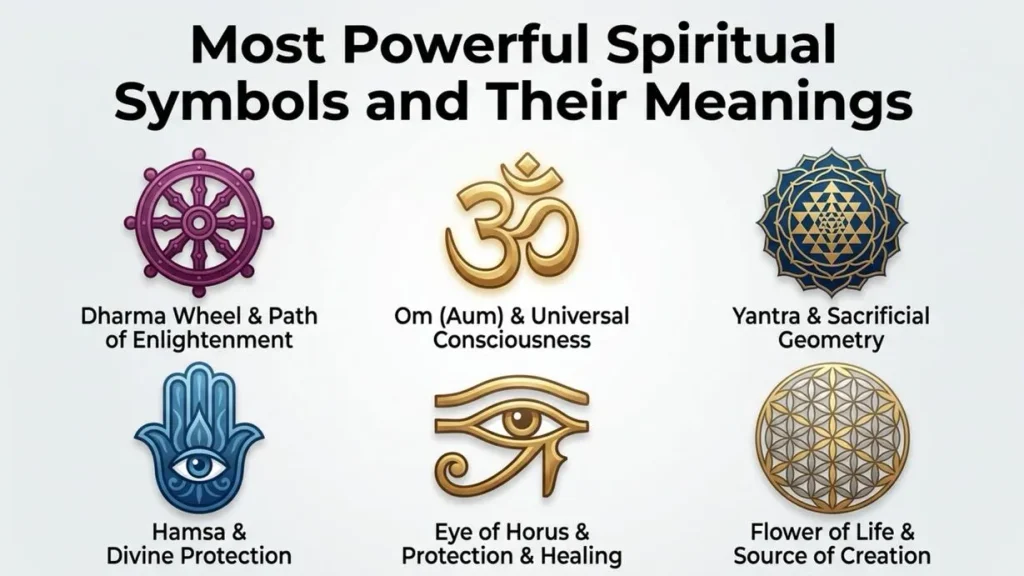
Most Powerful Spiritual Symbols and Their Meanings
Tree of Life
The Tree of Life is one of history’s oldest spiritual symbols.
It represents:
- Eternal life
- Wisdom
- Growth
- Strength
- Connection between heaven and earth
Appearing in Christianity, Judaism, Norse mythology, and many ancient cultures, it remains one of the world’s most universal spiritual signs.
Lotus Flower
The lotus grows from muddy water yet blooms beautifully above the surface.
Its symbolic meaning includes:
- Spiritual awakening
- Purity
- Enlightenment
- Inner peace
- Personal transformation
The lotus is especially important in Buddhism and Hinduism.
Om (Aum)
Om is considered the sacred sound of the universe in Hindu traditions.
Its visual representation symbolizes:
- Divine consciousness
- Unity
- Creation
- Universal energy
- Spiritual awareness
Although often seen as a typography symbol or Unicode symbol in digital text, its deeper significance lies in meditation and prayer.
Hamsa Hand
The Hamsa is an open hand believed to symbolize:
- Protection
- Blessings
- Good fortune
- Peace
- Divine guidance
It has historical roots in Middle Eastern, Jewish, Islamic, and North African traditions.
Yin and Yang
Originating in ancient Chinese philosophy, Yin and Yang represent balance between complementary forces.
It symbolizes:
- Harmony
- Light and darkness
- Masculine and feminine energy
- Change
- Unity through opposites
Rather than representing conflict, the symbol teaches that balance creates harmony.
Cross
The cross is among Christianity’s most recognized spiritual symbols.
It represents:
- Faith
- Salvation
- Sacrifice
- Hope
- Eternal life
Its influence extends into art, architecture, jewelry, and modern communication symbols worldwide.
Star of David
The Star of David symbolizes:
- Divine protection
- Jewish identity
- Spiritual unity
- God’s relationship with humanity
Today it appears on synagogues, religious items, and Israel’s national flag.
Feather
Across many Indigenous cultures, feathers symbolize:
- Honor
- Truth
- Wisdom
- Freedom
- Spiritual connection
They are often associated with prayer and communication between humanity and the spiritual realm.
Phoenix
The mythical phoenix represents:
- Rebirth
- Renewal
- Hope
- Perseverance
- Victory over adversity
Although originating in mythology rather than Scripture, it has become a popular symbol of transformation.
Mandala
A mandala is a circular geometric design representing:
- Unity
- Wholeness
- Meditation
- Inner balance
- Spiritual journey
Many Buddhist and Hindu traditions use mandalas during meditation practices.
Spiritual Symbols Across Different Cultures
Ancient Egyptian Symbols
Egyptian civilization contributed numerous sacred symbols, including:
- Ankh (life)
- Eye of Horus (protection)
- Scarab Beetle (renewal)
- Djed Pillar (stability)
These symbols remain influential in art and historical studies.
Celtic Symbols
Celtic traditions emphasize interconnectedness and eternity.
Popular examples include:
- Trinity Knot
- Celtic Cross
- Spiral
- Shield Knot
These designs frequently appear in tattoos, jewelry, and decorative artwork.
Native American Symbols
Many Native American tribes developed unique spiritual symbols connected to nature.
Common examples include:
- Medicine Wheel
- Eagle
- Dreamcatcher
- Bear
- Turtle
Their meanings vary among tribes, emphasizing respect for cultural traditions.
Eastern Spiritual Symbols
Eastern philosophies introduced symbols focused on mindfulness and enlightenment.
Examples include:
- Lotus
- Om
- Dharma Wheel
- Endless Knot
- Bodhi Tree
These symbols continue influencing meditation and wellness practices globally.
Common Uses and Applications
Powerful spiritual symbols remain relevant in everyday life.
Many people wear them as necklaces, bracelets, rings, or pendants to express personal beliefs or remind themselves of important values.
Religious institutions incorporate sacred icons into architecture, stained glass, sculptures, altars, and ceremonial objects.
Artists use spiritual symbols as visual representation in paintings, illustrations, and modern graphic design.
Books, educational resources, and museums use these symbols to explain history, theology, and cultural traditions.
In digital communication, Unicode symbols, text symbols, and digital characters sometimes represent crosses, stars, peace signs, and other recognizable spiritual icons, although they rarely capture the complete symbolic significance of the original designs.
Symbolism and Spiritual Significance
The enduring appeal of spiritual symbols lies in their ability to communicate profound ideas through simple images.
Unlike ordinary signs, spiritual symbols invite contemplation. A single visual representation may remind someone of compassion, resilience, divine love, or inner peace without using words.
These symbols also strengthen cultural identity, preserve historical traditions, and connect modern generations with ancient wisdom.
Their symbolic significance extends beyond religion into psychology, philosophy, literature, and art, where they continue inspiring creativity and reflection.
How to Use Spiritual Symbols Respectfully
Understanding a symbol’s origin is the first step toward respectful use.
Learn its historical background before displaying it in artwork, tattoos, jewelry, or home décor.
Avoid combining unrelated sacred symbols without understanding their meanings, as doing so may unintentionally misrepresent cultural or religious traditions.
Use spiritual symbols to encourage learning, reflection, or personal inspiration rather than treating them as magical objects with guaranteed powers.
Respect cultural ownership and recognize that some sacred signs hold deep ceremonial importance within specific communities.
Interesting Facts
- The Tree of Life appears in dozens of cultures across every inhabited continent.
- The lotus flower can bloom even after growing through muddy water, making it a universal symbol of resilience.
- The Om character is among the world’s oldest continuously used spiritual symbols.
- Sacred geometry has influenced architecture from ancient temples to modern cathedrals.
- Many early religious manuscripts included elaborate symbolic illustrations alongside written text.
- Several spiritual symbols are now available as Unicode characters for modern digital communication.
- The peace symbol, though modern, has become one of the world’s most recognized communication symbols promoting nonviolence.
- Some ancient spiritual symbols have remained virtually unchanged for more than 3,000 years.
Common Mistakes or Misconceptions
One common misconception is believing every ancient symbol has supernatural power. In reality, most traditions view symbols as reminders of spiritual truths rather than sources of power themselves.
Another mistake is assuming all cultures assign identical meanings to the same symbol. Context matters greatly, and interpretations may vary across religions and regions.
People also sometimes confuse mythology with historical religious teachings. While symbols such as the phoenix carry meaningful lessons, they originate from mythological traditions rather than sacred scripture.
Finally, using sacred symbols purely as fashion accessories without understanding their cultural meaning may unintentionally offend communities that hold them sacred.
Frequently Asked Questions
What are powerful spiritual symbols?
Powerful spiritual symbols are visual representations that express sacred ideas such as protection, wisdom, faith, enlightenment, peace, renewal, and divine connection.
Which spiritual symbol represents protection?
The Hamsa Hand, Eye of Horus, Shield Knot, and various crosses are widely recognized as symbols associated with protection in different traditions.
What does the Tree of Life symbolize?
The Tree of Life symbolizes growth, wisdom, eternal life, interconnectedness, strength, and humanity’s relationship with the divine.
Is the lotus flower a religious symbol?
Yes. The lotus is an important symbol in Hinduism and Buddhism, representing purity, enlightenment, spiritual awakening, and personal transformation.
Can spiritual symbols have different meanings?
Yes. The meaning often depends on religious tradition, historical context, geographic region, and cultural interpretation.
Are spiritual symbols still relevant today?
Absolutely. They continue to influence religion, meditation, education, architecture, jewelry, literature, art, and digital communication around the world.
Is it respectful to wear spiritual symbols?
Yes, provided you understand their origin, traditional meaning, and cultural significance, and wear them with respect rather than treating them as mere fashion accessories.
Conclusion
Powerful spiritual symbols have shaped human history for thousands of years, serving as enduring reminders of faith, hope, wisdom, protection, transformation, and unity. From the Tree of Life and lotus flower to the cross, Om, Hamsa, and Yin and Yang, these sacred signs continue to inspire millions across cultures and generations.
By understanding their origins, historical symbolism, symbolic significance, and traditional meanings, we gain a deeper appreciation for the beliefs and values they represent. Whether encountered in sacred architecture, religious texts, artwork, jewelry, or modern digital communication, spiritual symbols remain timeless visual representations that connect humanity with enduring spiritual truths and cultural heritage.

Ryan Mitchell is an independent writer with a strong interest in symbols, visual communication, and the meanings behind different signs and icons. His writing focuses on providing clear, accurate, and useful information that helps readers quickly understand unfamiliar symbols. Ethan covers a wide range of topics, from everyday and cultural symbols to technical and professional symbol systems.
His books include The World of Symbols, Symbols Explained Simply, and The Essential Symbol Reference Guide.