
Mini Cooper symbols are an essential part of owning and driving one of the world’s most recognizable compact cars. From dashboard warning lights to control panel icons and feature indicators, these symbols communicate valuable information about your vehicle’s condition, safety systems, and performance. Understanding what each symbol means can help you respond quickly to potential problems, improve vehicle maintenance, and ensure a safer driving experience.
Whether you own a classic Mini, a modern MINI Hardtop, Clubman, Countryman, Convertible, or Electric MINI, you’ll encounter dozens of dashboard icons designed to keep you informed. Some simply indicate that a feature is active, while others warn of mechanical issues requiring immediate attention.
This complete guide explains the meaning of Mini Cooper symbols, their history, categories, common warning lights, practical uses, and frequently asked questions. By the end, you’ll confidently recognize the most important dashboard symbols and know how to respond when they appear.
Mini Cooper Symbols (Meaning and Overview)
Mini Cooper symbols are visual communication symbols displayed on the dashboard, infotainment screen, steering controls, and climate control panel. Each icon serves as a quick visual representation of your vehicle’s status without requiring long text messages.
These symbols fall into several categories, including:
- Warning symbols
- Information indicators
- Safety system icons
- Engine monitoring signs
- Lighting indicators
- Driver assistance symbols
- Maintenance reminders
- Comfort and convenience icons
Most dashboard symbols use internationally recognized automotive standards, making them familiar across many vehicle brands.
Their primary purpose is to improve communication between the vehicle and driver through universally recognizable icons.
Mini Cooper Symbols (History and Origin)
Dashboard symbols have evolved alongside automotive technology.
Early Dashboard Indicators
Classic cars relied on simple gauges for oil pressure, fuel level, engine temperature, and battery charging. Drivers had to monitor these instruments continuously.
Introduction of Warning Lights
As electronics became common during the 1970s and 1980s, manufacturers introduced illuminated warning lights to alert drivers automatically.
MINI’s Modern Dashboard
After MINI became part of the BMW Group in 2001, its vehicles adopted advanced electronic monitoring systems capable of detecting hundreds of vehicle conditions.
Today’s Mini Cooper dashboard combines traditional warning lights with digital displays, animated graphics, and onboard diagnostic messages.
The result is an intuitive communication system that helps drivers understand both routine information and critical vehicle problems.
Types and Categories of Mini Cooper Symbols
Mini Cooper symbols can generally be divided into four main groups.
Red Warning Symbols
Red symbols indicate serious problems that require immediate attention.
Examples include:
- Brake system warning
- Engine overheating
- Low oil pressure
- Seat belt reminder
- Airbag system warning
- Parking brake indicator
Ignoring red symbols could result in vehicle damage or compromised safety.
Yellow or Amber Warning Symbols
Amber lights indicate caution rather than immediate danger.
Common examples include:
- Check Engine Light
- ABS warning
- Tire Pressure Monitoring System (TPMS)
- Stability Control warning
- Engine management system
- Service reminder
Drivers should investigate these warnings as soon as practical.
Green Symbols
Green icons indicate that a system is currently active.
Examples include:
- Headlights
- Cruise control
- ECO mode
- Lane assist
- Turn signals
These are informational rather than warning indicators.
Blue Symbols
Blue dashboard icons usually indicate that high-beam headlights are turned on.
Some MINI models also use blue symbols for certain driver-assistance features.
Common Mini Cooper Dashboard Warning Symbols
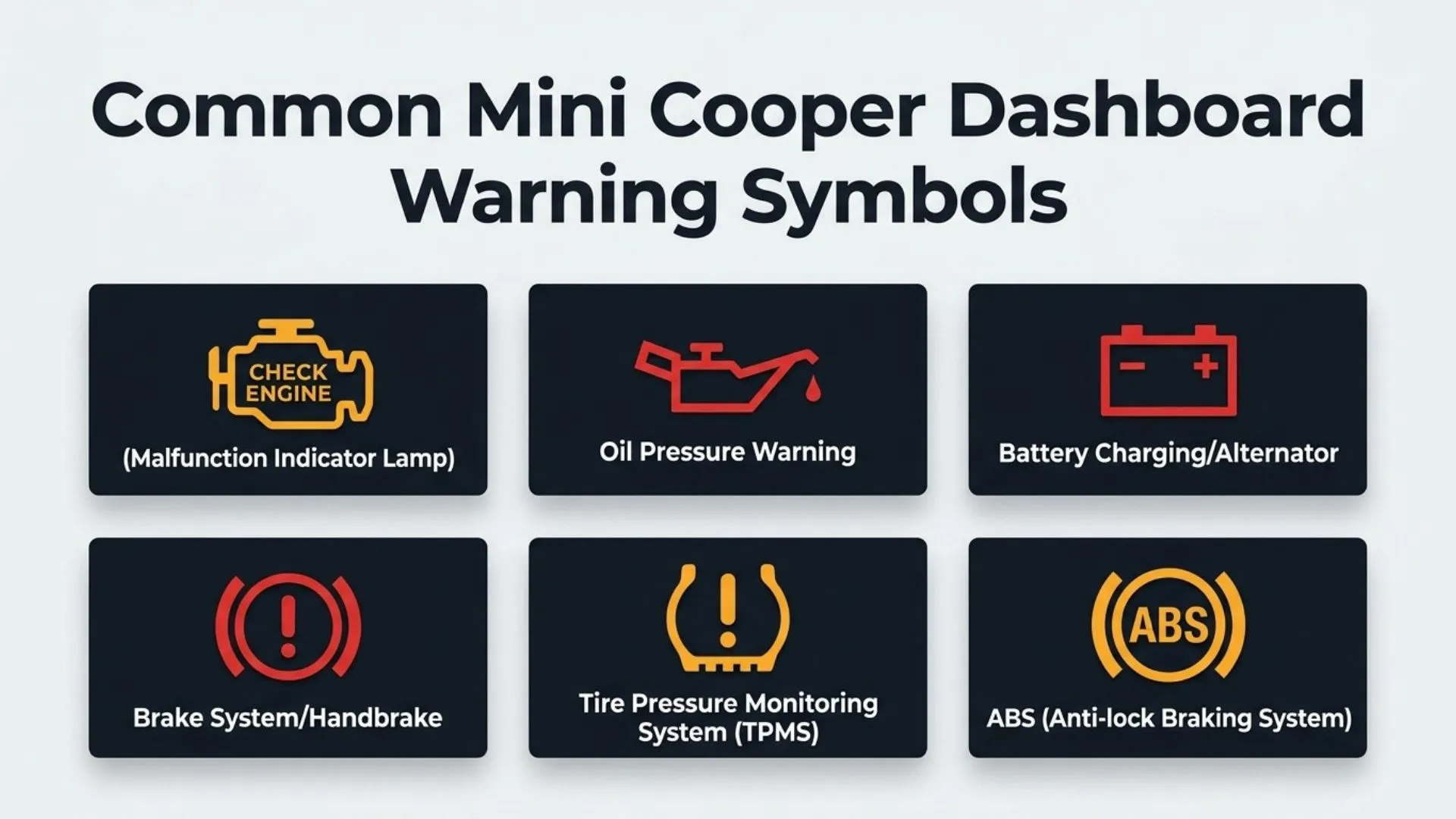
Understanding the most common dashboard icons can help prevent expensive repairs.
Check Engine Light
The engine-shaped icon is one of the most recognized automotive symbols.
Possible causes include:
- Loose fuel cap
- Oxygen sensor issues
- Ignition problems
- Fuel system faults
- Emissions system malfunction
A flashing engine light requires immediate attention.
Oil Pressure Warning
The oil can symbol indicates low engine oil pressure.
If this light appears while driving:
- Stop safely.
- Turn off the engine.
- Check oil levels.
- Do not continue driving if the light remains on.
Ignoring this warning can seriously damage the engine.
Battery Charging Symbol
The battery icon indicates that the charging system is not operating correctly.
Potential causes include:
- Faulty alternator
- Weak battery
- Damaged charging cables
- Loose connections
Brake Warning Symbol
This symbol may indicate:
- Parking brake engaged
- Low brake fluid
- Brake system malfunction
Never ignore brake-related warnings.
Tire Pressure Monitoring System (TPMS)
The horseshoe-shaped icon with an exclamation mark alerts drivers to low tire pressure.
Driving with improperly inflated tires reduces handling, fuel economy, and safety.
Coolant Temperature Warning
A thermometer above water waves indicates engine overheating.
Safely stop the vehicle if this warning appears and allow the engine to cool before opening the coolant reservoir.
Driver Assistance Symbols
Modern MINI models include numerous advanced safety technologies.
Lane Departure Warning
This icon indicates lane monitoring is active or has detected unintended lane drifting.
Adaptive Cruise Control
The cruise control symbol appears when adaptive speed control is enabled.
Some versions display a vehicle ahead to indicate distance monitoring.
Collision Warning
A red vehicle icon may appear when forward collision detection identifies a potential impact.
Drivers should respond immediately.
Parking Sensors
Parking assist symbols show the location of nearby obstacles using visual graphics.
Many MINI models combine these with audible alerts.
Comfort and Convenience Symbols
Not every dashboard icon signals a problem.
Many simply indicate active features.
Examples include:
- Heated seats
- Air conditioning
- Rear defroster
- Automatic headlights
- Fog lights
- Start/Stop system
- Keyless entry
- Auto Hold brake
These symbols improve usability by providing quick visual confirmation.
Maintenance and Service Symbols
MINI vehicles monitor service intervals automatically.
Service Reminder
The wrench icon reminds owners that scheduled maintenance is approaching.
Routine servicing typically includes:
- Oil changes
- Brake inspections
- Cabin air filter replacement
- Vehicle inspection
- Fluid checks
Brake Pad Wear Indicator
Certain MINI models monitor brake pad thickness electronically.
When replacement is needed, the dashboard displays a brake service warning.
Oil Service Symbol
The oil service reminder differs from the oil pressure warning.
It simply indicates that an oil change is due based on mileage or driving conditions.
Symbolism and Importance of Mini Cooper Symbols
Mini Cooper symbols serve as more than decorative dashboard graphics.
They provide:
Instant Communication
Icons eliminate language barriers by using universally recognized visual representations.
Improved Safety
Warning symbols alert drivers before minor issues become serious mechanical failures.
Preventive Maintenance
Service reminders encourage timely maintenance, extending vehicle lifespan.
Driver Confidence
Understanding dashboard signs helps reduce uncertainty during unexpected situations.
Efficient Troubleshooting
Technicians use dashboard indicators alongside onboard diagnostics to identify problems more quickly.
How to Use Mini Cooper Symbols Correctly
When a dashboard symbol appears:
Identify the Symbol
Consult your owner’s manual or the digital information display to determine its exact meaning.
Observe the Color
- Green: Information
- Blue: Feature active
- Yellow: Exercise caution
- Red: Stop safely and investigate immediately
Avoid Guessing
Never assume two similar icons have identical meanings.
For example, an oil service reminder differs significantly from an oil pressure warning.
Schedule Maintenance
If a warning remains illuminated, arrange professional diagnosis rather than ignoring it.
Prompt repairs often prevent larger mechanical issues.
Interesting Facts
MINI Uses International Automotive Icons
Many dashboard symbols follow standards used by manufacturers worldwide, making them easy to recognize.
Over 100 Symbols May Appear
Depending on the model and equipment package, a Mini Cooper can display well over 100 different dashboard indicators.
Digital Displays Continue to Expand
Newer MINI vehicles replace many traditional gauges with digital screens capable of showing animated warning messages.
Some Symbols Change Color
Certain indicators transition from green to amber or red depending on system status and urgency.
Self-Check Occurs at Startup
Most dashboard lights briefly illuminate when starting the vehicle. This confirms the warning light system is functioning correctly.
Common Mistakes and Misconceptions
Ignoring Yellow Warning Lights
Although less urgent than red warnings, amber symbols should still be addressed promptly.
Confusing Service Reminders With Mechanical Failures
A maintenance reminder does not necessarily indicate something is broken.
Assuming a Restart Fixes Everything
Some drivers restart the engine hoping the warning disappears. Persistent symbols require proper diagnosis.
Driving With a Flashing Check Engine Light
A flashing engine light usually signals a serious engine misfire that can damage the catalytic converter.
Forgetting to Check the Owner’s Manual
The owner’s manual remains the most reliable source for model-specific dashboard symbols.
Frequently Asked Questions
What is the most important Mini Cooper dashboard symbol?
The oil pressure warning and engine temperature warning are among the most critical because they can indicate conditions capable of causing severe engine damage.
Why is my Check Engine Light on?
Possible causes include emissions problems, faulty sensors, ignition issues, loose fuel caps, or engine management faults. Professional diagnostics can identify the exact cause.
Can I drive with a yellow warning light?
Many amber warnings allow short-distance driving, but they should be inspected as soon as possible. Always follow the guidance in your owner’s manual.
Why do all dashboard symbols light up when I start the car?
This is a normal self-test that verifies the dashboard warning system is working correctly.
What does the tire pressure symbol mean?
It indicates that one or more tires have low air pressure or that the Tire Pressure Monitoring System has detected a fault.
Are dashboard symbols the same on every Mini Cooper?
Most symbols are similar across models, but newer vehicles with advanced driver-assistance systems include additional icons not found on older models.
Is there a Unicode symbol for Mini Cooper dashboard icons?
No. Dashboard warning lights are proprietary automotive icons rather than Unicode symbols, text symbols, or standard typography symbols used in digital text.
Conclusion
Mini Cooper symbols are a vital communication system that helps drivers monitor vehicle health, safety features, and maintenance requirements. From simple information indicators to critical warning lights, each icon is designed to communicate important information quickly and clearly. Learning the meaning of these dashboard symbols allows drivers to react appropriately, prevent costly repairs, and maintain the reliability and performance of their MINI.
Whether you’re driving a classic MINI or the latest electric model, understanding dashboard icons is an essential part of responsible vehicle ownership. Familiarity with these symbols not only improves safety but also gives you greater confidence every time you get behind the wheel.

Daniel Carter is a writer and researcher focused on symbols, their meanings, origins, and practical uses. He enjoys turning complex symbolic concepts into simple, easy-to-understand explanations for everyday readers. Through his work, Daniel explores cultural, technical, historical, and commonly used symbols, helping readers understand what they mean and where they are used.
His work includes The Complete Guide to Symbols, Understanding Symbols and Their Meanings, and A Visual Guide to Common Symbols.