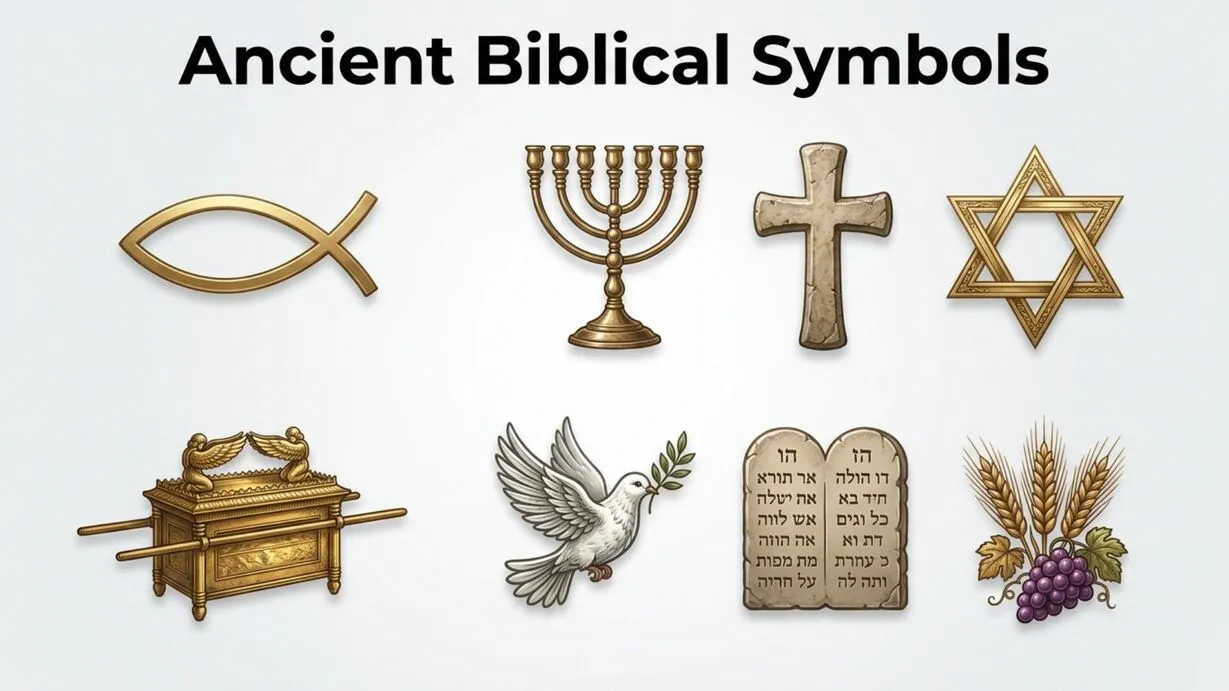
Ancient biblical symbols have been used for thousands of years to communicate spiritual truths, divine promises, and timeless moral lessons. Long before printed books became common, symbols served as a powerful visual representation of faith, allowing believers to understand complex religious ideas through familiar objects, animals, numbers, and natural elements.
Many of these ancient biblical symbols continue to appear in churches, artwork, jewelry, architecture, literature, and modern Christian traditions. They are far more than decorative symbols they carry deep theological meaning rooted in Scripture and historical symbolism. Understanding these sacred signs helps readers gain a richer appreciation of the Bible’s messages and the cultural world in which it was written.
In this guide, we’ll explore the meaning, history, categories, symbolism, practical uses, and fascinating facts about ancient biblical symbols while separating common misconceptions from biblical truth.
Ancient Biblical Symbols (Meaning and Overview)
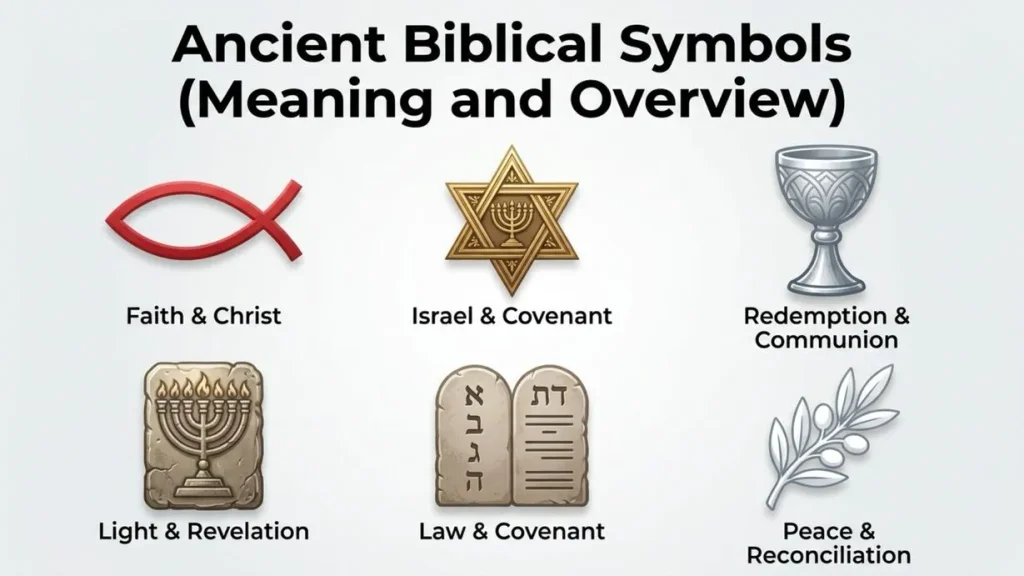
Ancient biblical symbols are objects, images, signs, or symbolic representations used throughout the Bible to communicate spiritual concepts. Rather than explaining every truth directly, Scripture often uses symbols to teach lessons about God, salvation, faith, judgment, hope, and eternal life.
Biblical symbols differ from ordinary icons or communication symbols because they derive their meaning from God’s revelation in Scripture rather than human invention alone. For example, a lamb represents innocence and sacrifice because of its repeated role in biblical worship and ultimately its connection to Jesus Christ.
These symbols appear throughout both the Old Testament and the New Testament. Some symbolize God’s covenant with humanity, while others point toward prophecy, redemption, or spiritual growth.
Although today’s readers may encounter these symbols as artwork, typography symbols, or digital characters in educational resources, their original purpose was to convey profound spiritual truths rather than simply serve as visual decoration.
History and Origin
The origins of ancient biblical symbols stretch back to the civilizations of the Ancient Near East, including Israel, Egypt, Mesopotamia, and Canaan. During biblical times, literacy rates were relatively low, making symbolic language especially effective for teaching entire communities.
God frequently used familiar elements from everyday life to communicate His message. Farmers understood seeds and vines, shepherds recognized sheep and staffs, fishermen related to nets and fish, while families appreciated symbols like bread, oil, and light.
The Hebrew Scriptures contain hundreds of symbolic references. Later, the New Testament expanded these meanings through the teachings of Jesus and the apostles. Early Christians also adopted certain biblical symbols as discreet signs of faith during periods of persecution.
Over centuries, these ancient signs evolved into recognizable Christian icons found in churches, manuscripts, stained glass windows, and sacred art across the world.
Types and Categories of Ancient Biblical Symbols
Animal Symbols
Animals frequently represent spiritual qualities, divine authority, or human characteristics.
The Lamb
Perhaps the best-known biblical symbol meaning is the lamb, representing innocence, sacrifice, and redemption. In the Old Testament, lambs were offered during religious sacrifices. In the New Testament, Jesus is called the “Lamb of God,” emphasizing His sacrificial role.
The Dove
The dove symbolizes peace, purity, hope, and the Holy Spirit. After the flood, Noah’s dove returned with an olive leaf, signaling God’s renewed covenant with humanity.
The Lion
The lion represents strength, kingship, courage, and divine authority. Jesus is referred to as the Lion of Judah, highlighting His royal lineage and victorious power.
The Serpent
Unlike many positive symbols, the serpent generally represents temptation, deception, and sin because of its appearance in the Garden of Eden. However, the bronze serpent raised by Moses also became a symbol of healing and salvation.
Plant and Nature Symbols
Nature plays a major role in biblical communication.
Olive Branch
The olive branch symbolizes peace, reconciliation, and new beginnings. It remains one of the world’s most recognized communication symbols for peace.
Vine
The vine represents spiritual life, fruitfulness, and believers’ relationship with God. Jesus described Himself as the true vine, emphasizing dependence on Him.
Mustard Seed
Though tiny, the mustard seed symbolizes faith capable of producing extraordinary results.
Tree of Life
Appearing in Genesis and Revelation, the Tree of Life symbolizes eternal life, God’s presence, and everlasting fellowship.
Object Symbols
Ordinary objects often carried extraordinary symbolic significance.
Cross
Although the cross became prominent after Christ’s crucifixion, it now symbolizes salvation, forgiveness, hope, and victory over death.
Crown
Crowns represent authority, righteousness, heavenly rewards, and eternal kingship.
Staff
A shepherd’s staff symbolizes guidance, leadership, protection, and God’s care for His people.
Lamp
A burning lamp symbolizes God’s truth, wisdom, and spiritual guidance. Psalm 119 describes God’s Word as a lamp to one’s feet.
Number Symbols
Biblical numbers frequently possess symbolic rather than mathematical significance.
- 3 symbolizes divine completeness and the Trinity.
- 7 represents perfection and completion.
- 12 signifies God’s people, including the twelve tribes of Israel and twelve apostles.
- 40 often represents testing, preparation, and transformation.
Major Ancient Biblical Symbols Explained
The Ark
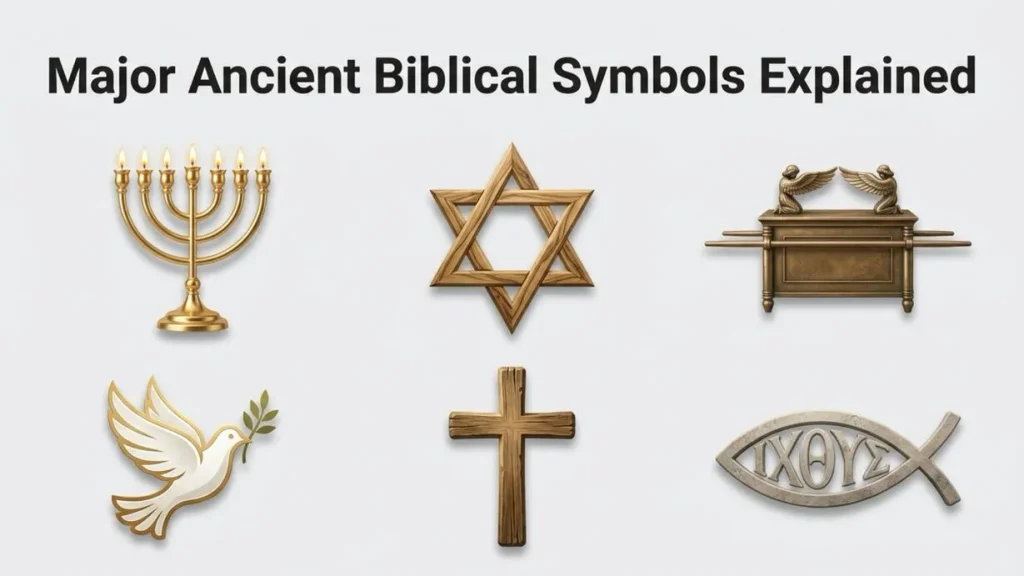
Noah’s Ark symbolizes God’s protection, mercy, and salvation during judgment. It also illustrates obedience and faith under difficult circumstances.
Rainbow
The rainbow serves as God’s covenant sign following the flood. It reminds believers of His faithfulness and promise never to destroy the earth again by floodwaters.
Bread
Bread symbolizes God’s provision, spiritual nourishment, and life itself. Jesus referred to Himself as the Bread of Life, emphasizing eternal sustenance.
Water
Water carries multiple symbolic meanings, including cleansing, renewal, baptism, eternal life, and spiritual transformation.
Fire
Fire represents God’s holiness, divine presence, purification, judgment, and spiritual refinement.
Colors and Their Symbolic Meaning
Color symbolism appears throughout Scripture.
White
White symbolizes holiness, purity, righteousness, and victory.
Purple
Purple signifies royalty, wealth, honor, and divine kingship.
Scarlet or Red
Red often represents sacrifice, redemption, sin, and the cleansing power of Christ’s blood.
Blue
Blue symbolizes heaven, obedience, truth, and God’s commandments.
Gold
Gold represents divine glory, purity, kingship, and eternal value.
Common Uses and Applications
Ancient biblical symbols remain relevant in many aspects of modern life.
Churches incorporate them into stained glass windows, architecture, banners, and communion vessels. Christian jewelry often features crosses, doves, fish, or crowns as visual representations of faith.
Religious educators use biblical symbols to simplify complex theological concepts for children and adults alike. Artists continue drawing inspiration from these timeless signs in paintings, sculptures, and decorative symbols.
Digital communication has also embraced biblical imagery. While Unicode symbols and text symbols cannot fully capture ancient sacred imagery, crosses, doves, olive branches, and related digital characters are commonly used in educational materials, presentations, and online discussions about Christianity.
Publishers frequently include biblical icons in study Bibles, devotionals, and historical resources to reinforce symbolic meaning.
Symbolism and Spiritual Significance
Ancient biblical symbols are significant because they communicate profound truths that words alone sometimes cannot express.
Many symbols foreshadow future events in God’s plan of redemption. For example, Old Testament sacrifices point toward Christ’s ultimate sacrifice.
These symbols also create continuity throughout Scripture. Readers notice recurring themes such as light overcoming darkness, water bringing new life, and shepherds caring for sheep.
Biblical symbolism strengthens memory and understanding by connecting spiritual truths with everyday experiences. Even modern readers who live in vastly different cultures can appreciate the universal symbolism of light, bread, trees, water, and family relationships.
The enduring value of these symbols demonstrates how visual representation can transcend generations while preserving timeless theological meaning.
How to Understand Ancient Biblical Symbols
Reading biblical symbols correctly requires careful interpretation.
Always examine the surrounding passage instead of isolating one symbol from its context. Many symbols carry slightly different meanings depending on the situation.
Consider historical and cultural background. Ancient Israelite customs often explain why certain objects became meaningful signs.
Compare similar passages across the Bible to understand how symbols develop over time.
Avoid assigning modern cultural meaning to ancient symbols without scriptural support.
Reliable Bible translations, study notes, historical commentaries, and archaeological research can help readers interpret difficult symbolic passages accurately.
Interesting Facts
- The fish became one of Christianity’s earliest identifying symbols during periods of persecution.
- The menorah, a seven-branched lampstand, symbolizes God’s light and presence.
- Ancient biblical symbols often appear in medieval manuscripts alongside elaborate illustrations.
- Many modern national flags and emblems include symbols influenced by biblical traditions.
- The rainbow remains one of the oldest covenant symbols still recognized worldwide.
- Olive trees mentioned in Scripture can live for hundreds of years, reinforcing their symbolic association with endurance and peace.
- The Bible contains hundreds of symbolic references, making symbolism one of its richest literary features.
- Many biblical symbols influenced Western art, literature, architecture, and cultural meaning for centuries.
Common Mistakes and Misconceptions
One common misunderstanding is believing every object mentioned in the Bible automatically carries symbolic significance. Many passages describe ordinary historical events without hidden meanings.
Another misconception is assuming every symbol has only one fixed interpretation. Biblical symbolism often develops throughout Scripture, with context determining its precise meaning.
Some readers also confuse cultural traditions with biblical teaching. Not every symbol found in Christian art originated directly from the Bible.
Others overanalyze symbolic language by searching for secret codes or hidden messages where none exist. Responsible interpretation focuses on the author’s intended message rather than speculation.
Finally, modern symbolic representation should never replace careful reading of the biblical text itself. Symbols enrich Scripture but do not substitute for its plain teachings.
Frequently Asked Questions
What are ancient biblical symbols?
Ancient biblical symbols are objects, animals, colors, numbers, and signs used throughout the Bible to communicate spiritual truths, divine promises, and moral lessons.
Why did the Bible use symbols?
Symbols helped communicate complex theological ideas in memorable ways, especially in cultures where oral teaching played a major role.
What is the most important biblical symbol?
Many Christians consider the cross the central biblical symbol because it represents Christ’s sacrifice, salvation, forgiveness, and hope.
What does the lamb symbolize in the Bible?
The lamb represents innocence, sacrifice, obedience, and ultimately Jesus Christ as the Lamb of God who takes away the sins of the world.
Are biblical numbers symbolic?
Yes. Numbers such as 3, 7, 12, and 40 frequently carry symbolic significance related to completeness, divine order, God’s people, and periods of testing.
Are biblical symbols still relevant today?
Absolutely. They continue to shape Christian worship, education, art, literature, architecture, jewelry, and personal faith while helping readers better understand Scripture.
How can I correctly interpret biblical symbols?
Study each symbol within its biblical context, compare related passages, consider historical background, and rely on trustworthy biblical scholarship rather than speculation.
Conclusion
Ancient biblical symbols remain some of the most meaningful visual representations in religious history. From the lamb and dove to the rainbow, vine, bread, and cross, these timeless signs communicate God’s character, His relationship with humanity, and His plan of redemption.
Understanding their historical symbolism, traditional meaning, and cultural meaning allows readers to appreciate Scripture more deeply while avoiding common misunderstandings. Rather than functioning as mere decorative symbols or simple icons, biblical symbols invite believers and students alike to explore the deeper truths woven throughout the Bible.
Whether encountered in sacred art, church architecture, educational resources, or personal Bible study, these ancient biblical symbols continue to inspire faith, encourage reflection, and reveal enduring spiritual wisdom that remains relevant across generations.

Daniel Carter is a writer and researcher focused on symbols, their meanings, origins, and practical uses. He enjoys turning complex symbolic concepts into simple, easy-to-understand explanations for everyday readers. Through his work, Daniel explores cultural, technical, historical, and commonly used symbols, helping readers understand what they mean and where they are used.
His work includes The Complete Guide to Symbols, Understanding Symbols and Their Meanings, and A Visual Guide to Common Symbols.