
Jeep vehicles are designed to tackle everything from city streets to rugged off-road trails. While their capability is impressive, understanding the various Jeep symbols displayed on the dashboard is just as important as knowing how to drive the vehicle.
These symbols act as a communication system between your Jeep and you, providing valuable information about the vehicle’s condition, safety systems, and performance.
Whether you own a Jeep Wrangler, Grand Cherokee, Compass, Gladiator, Cherokee, or Renegade, you’ll encounter dashboard icons, warning lights, and informational signs that help keep your vehicle operating safely. Some symbols simply indicate that a feature is active, while others warn of a mechanical issue that requires immediate attention.
This guide explains the meaning of common Jeep symbols, their historical development, different categories, practical applications, and how to respond when they appear. By the end, you’ll have a clear understanding of these visual representations and be better prepared to maintain your Jeep.
Jeep Symbols (Meaning and Overview)
Jeep symbols are dashboard icons, warning lights, indicators, and visual signs that communicate your vehicle’s operating status. Every symbol has a specific meaning and uses universally recognized graphic designs so drivers can quickly identify important information.
Unlike decorative symbols or typography symbols used in design, Jeep dashboard symbols are functional communication symbols developed according to international automotive standards. They help drivers recognize potential problems without reading lengthy messages.
Most Jeep dashboard symbols fall into one of three categories:
- Informational symbols
- Warning symbols
- Emergency warning symbols
The color of a symbol is often just as important as its design.
- Green or Blue: System is active or operating normally.
- Yellow or Amber: Warning that should be checked soon.
- Red: Serious issue requiring immediate attention.
These symbols function as a universal language, making it easier for drivers worldwide to understand their vehicle regardless of spoken language.
History and Origin
Dashboard symbols have evolved alongside the automotive industry. Early vehicles relied on simple gauges with little visual guidance. As technology advanced, manufacturers introduced standardized icons to improve driver awareness.
Jeep adopted these universal automotive symbols while also introducing model-specific indicators for its advanced four-wheel-drive systems, off-road capabilities, and terrain management technologies.
Modern Jeep vehicles use digital instrument clusters capable of displaying dozens of different icons. Many newer models also include text explanations alongside symbols, making them even easier to understand.
Today’s Jeep symbols follow internationally recognized automotive standards, allowing drivers familiar with one vehicle brand to recognize many symbols in another.
Types of Jeep Symbols
Warning Lights
Warning lights alert drivers to problems requiring attention. These symbols may indicate engine, brake, electrical, or safety issues.
Examples include:
- Check Engine Light
- Brake Warning Light
- Oil Pressure Warning
- Battery Charging System
- Engine Temperature Warning
These symbols should never be ignored, especially if they appear in red.
Indicator Symbols
Indicator symbols simply inform the driver that a feature is operating.
Examples include:
- Turn signals
- High beam indicator
- Cruise control
- Fog lights
- Parking lights
These icons are typically green or blue.
Information Symbols
Information symbols notify drivers about vehicle settings or maintenance reminders.
Examples include:
- Door open
- Low washer fluid
- Tire pressure monitoring
- Maintenance reminder
- Fuel level warning
They help drivers keep their Jeep operating efficiently.
Common Jeep Dashboard Symbols
Check Engine Symbol
The check engine icon resembles the outline of an engine.
Meaning:
This warning indicates that the engine management system has detected a fault.
Possible causes include:
- Loose fuel cap
- Faulty oxygen sensor
- Ignition problems
- Emissions system issues
- Sensor malfunction
If the light flashes continuously, reduce speed and seek service immediately.
Oil Pressure Warning
This symbol looks like an old-fashioned oil can.
Meaning:
Low engine oil pressure.
Possible causes:
- Low oil level
- Oil pump failure
- Blocked oil passages
- Internal engine wear
Driving with this warning illuminated can cause severe engine damage.
Battery Warning Symbol
This icon resembles a car battery.
It indicates charging system problems involving:
- Alternator
- Battery
- Electrical wiring
- Drive belt
Your Jeep may continue running temporarily but could eventually lose electrical power.
Engine Temperature Symbol
The temperature warning resembles a thermometer above waves.
This warning appears when the engine overheats.
Common reasons include:
- Coolant leak
- Failed radiator fan
- Low coolant
- Faulty thermostat
Stop driving safely and allow the engine to cool before checking coolant levels.
Tire Pressure Monitoring Symbol
This symbol appears as a horseshoe-shaped tire with an exclamation point.
It indicates one or more tires have low air pressure.
Driving with incorrect tire pressure affects:
- Fuel economy
- Tire wear
- Handling
- Braking performance
Always inflate tires according to Jeep’s recommended specifications.
ABS Warning Light
ABS stands for Anti-lock Braking System.
If this symbol appears, your normal brakes usually continue working, but anti-lock braking assistance may be unavailable until repairs are completed.
Airbag Warning Symbol
The airbag icon usually shows a seated person with a circle representing the deployed airbag.
If illuminated continuously, your supplemental restraint system may not function correctly during a collision.
Professional diagnosis is recommended.
Brake Warning Symbol
This red symbol often displays an exclamation mark inside a circle.
Possible causes include:
- Parking brake engaged
- Low brake fluid
- Brake system malfunction
Never ignore brake-related warnings.
Jeep Four-Wheel Drive Symbols
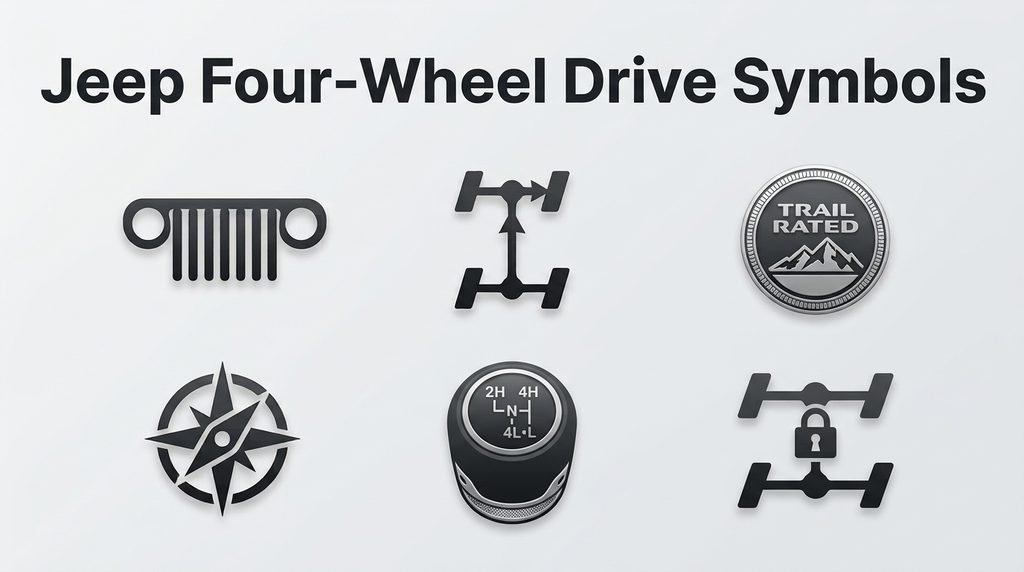
One feature that makes Jeep unique is its advanced four-wheel-drive system.
4WD Indicator
This symbol confirms that four-wheel drive is engaged.
Depending on your Jeep model, it may display:
- 4WD Auto
- 4WD High
- 4WD Low
Each mode is designed for different driving conditions.
Differential Lock Symbol
Some Jeep models include locking differentials for enhanced traction.
This icon indicates that the front, rear, or both differentials are locked.
It is primarily used during off-road driving.
Hill Descent Control
This symbol represents hill descent assist.
When activated, it automatically controls vehicle speed while descending steep hills, allowing the driver to focus on steering.
Selec-Terrain Symbol
Many Jeep SUVs feature Selec-Terrain modes such as:
- Snow
- Sand
- Mud
- Rock
- Auto
Each mode adjusts traction control, throttle response, and transmission behavior.
Jeep Safety System Symbols
Modern Jeeps include advanced driver-assistance technologies.
Common safety icons include:
Lane Departure Warning
Appears when the vehicle unintentionally leaves its lane.
Forward Collision Warning
Alerts drivers to potential front-end collisions.
Adaptive Cruise Control
Shows that adaptive cruise control is maintaining distance from vehicles ahead.
Blind Spot Monitoring
Warns of vehicles in adjacent lanes.
Parking Assist
Indicates parking sensors or automated parking features are active.
These digital characters help improve driving safety and reduce accident risk.
Jeep Maintenance Symbols
Several dashboard icons remind owners about regular maintenance.
Examples include:
- Oil change reminder
- Service required message
- Air filter replacement
- Low washer fluid
- Fuel filter warning (diesel models)
Following these reminders improves reliability and extends vehicle life.
Symbolism and Importance of Jeep Symbols
Although Jeep dashboard icons are not cultural symbols in the traditional sense, they carry significant symbolic representation within automotive design.
Each symbol serves as a universal sign that quickly communicates complex mechanical information.
Their symbolic significance includes:
- Improving road safety
- Preventing expensive repairs
- Reducing diagnostic confusion
- Supporting preventive maintenance
- Enhancing driver confidence
Because many symbols are standardized globally, they transcend language barriers and provide consistent communication across different markets.
How to Use Jeep Symbols Correctly
Understanding Jeep dashboard symbols helps you respond appropriately when they appear.
Follow these guidelines:
Learn Your Owner’s Manual
Every Jeep model includes a dashboard reference explaining each icon.
Pay Attention to Colors
Green usually means active.
Yellow indicates caution.
Red requires immediate action.
Don’t Ignore Warning Lights
Small problems often become expensive repairs if ignored.
Use Diagnostic Tools
OBD-II scanners can identify fault codes associated with many dashboard warnings.
Schedule Maintenance Promptly
Routine servicing prevents many warning symbols from appearing unexpectedly.
Interesting Facts About Jeep Symbols
- More than 100 dashboard symbols can appear in modern Jeep vehicles.
- Many Jeep dashboard icons are standardized across the global automotive industry.
- Digital instrument clusters can display animated warning graphics.
- Some warning lights disappear automatically once the issue is resolved.
- Jeep off-road symbols are unique compared to many passenger vehicles.
- Dashboard icons are designed for quick recognition without distracting drivers.
- Modern software updates occasionally introduce new digital icons for additional vehicle features.
Common Mistakes and Misconceptions
Assuming Every Warning Is an Emergency
Not every yellow symbol requires immediate roadside assistance, but all should be investigated soon.
Ignoring Flashing Lights
A flashing warning usually indicates a more serious issue than a steady light.
Resetting Lights Without Fixing Problems
Clearing warning codes does not repair the underlying mechanical issue.
Confusing Similar Icons
Some symbols look alike, such as brake warnings and tire pressure indicators. Always verify their meaning before taking action.
Forgetting Routine Maintenance
Maintenance reminders are preventive tools rather than signs of failure.
Frequently Asked Questions
What is the most important Jeep dashboard warning light?
The oil pressure warning, brake warning, and engine temperature symbols are among the most critical because they can indicate problems that may cause severe engine damage or compromise safety.
Why is my Jeep check engine light on?
Common causes include a loose gas cap, emissions system problems, faulty sensors, ignition issues, or engine performance faults. A diagnostic scan is the best way to determine the exact cause.
Can I drive with a yellow Jeep warning light?
Many yellow warnings allow limited driving, but you should schedule service as soon as possible. Ignoring them can lead to more expensive repairs.
What does the Jeep tire symbol mean?
The tire pressure monitoring system (TPMS) icon indicates one or more tires are underinflated or that the monitoring system requires inspection.
Are Jeep dashboard symbols the same on every model?
Most core warning lights are standardized, but certain symbols differ depending on the model, trim level, drivetrain, and available technology.
Why do dashboard lights come on briefly when starting the Jeep?
This is a normal system self-test. Most lights should turn off after the engine starts. If one remains illuminated, further inspection may be necessary.
What should I do if a red warning light appears?
Safely stop the vehicle as soon as possible and determine the cause. Continuing to drive with a red warning may result in severe mechanical damage or unsafe driving conditions.
Conclusion
Jeep symbols are much more than simple dashboard graphics they are an essential communication system that keeps drivers informed about their vehicle’s health, safety, and performance. From the familiar check engine light to advanced four-wheel-drive indicators and modern driver-assistance icons, every symbol has a specific purpose designed to enhance both convenience and safety.
Understanding the meaning of these visual signs allows you to respond appropriately, avoid costly repairs, and maintain your Jeep in peak condition. Whether you’re navigating city traffic or exploring off-road trails, recognizing these dashboard symbols ensures you’re always aware of what your vehicle is trying to tell you. Taking the time to learn these icons is one of the simplest ways to become a more confident and responsible Jeep owner.

Daniel Carter is a writer and researcher focused on symbols, their meanings, origins, and practical uses. He enjoys turning complex symbolic concepts into simple, easy-to-understand explanations for everyday readers. Through his work, Daniel explores cultural, technical, historical, and commonly used symbols, helping readers understand what they mean and where they are used.
His work includes The Complete Guide to Symbols, Understanding Symbols and Their Meanings, and A Visual Guide to Common Symbols.