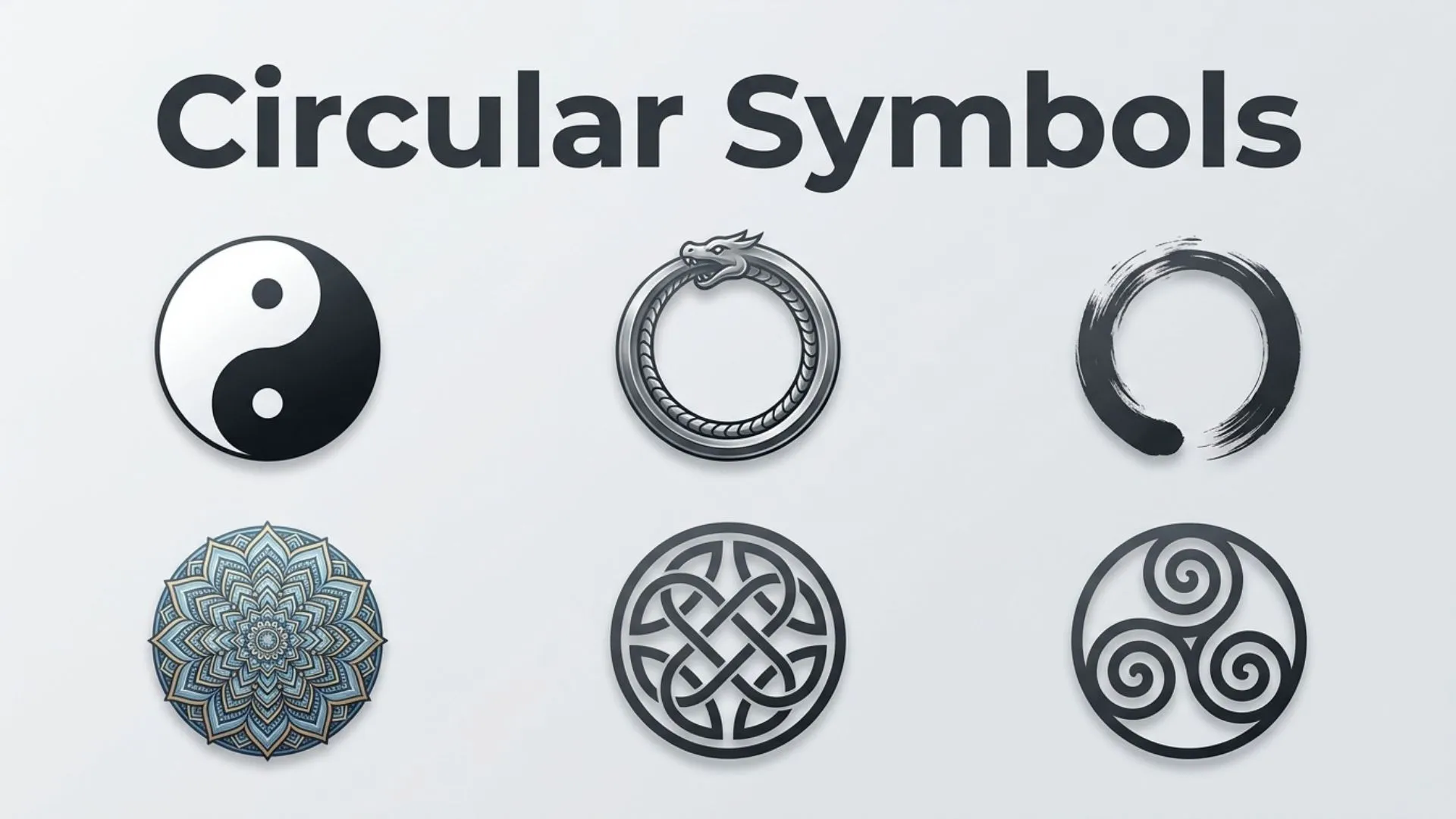
Circular symbols are among the oldest and most recognizable visual representations in human history. From ancient religious icons and national emblems to traffic signs, digital interfaces, and corporate logos, the circle has long been used to communicate powerful ideas through a simple yet meaningful shape. Unlike many geometric forms, a circle has no beginning or end, making it a universal symbol of eternity, unity, completeness, and balance.
Today, circular symbols appear in nearly every aspect of modern life. They are found in mathematics, science, technology, architecture, transportation, religion, branding, and graphic design. Some are standardized communication symbols, while others carry deep cultural meaning or spiritual significance.
This comprehensive guide explores circular symbols, their meanings, history, major categories, symbolism, and practical applications, helping you understand why the circle remains one of the world’s most influential visual designs.
Meaning and Overview of Circular Symbols
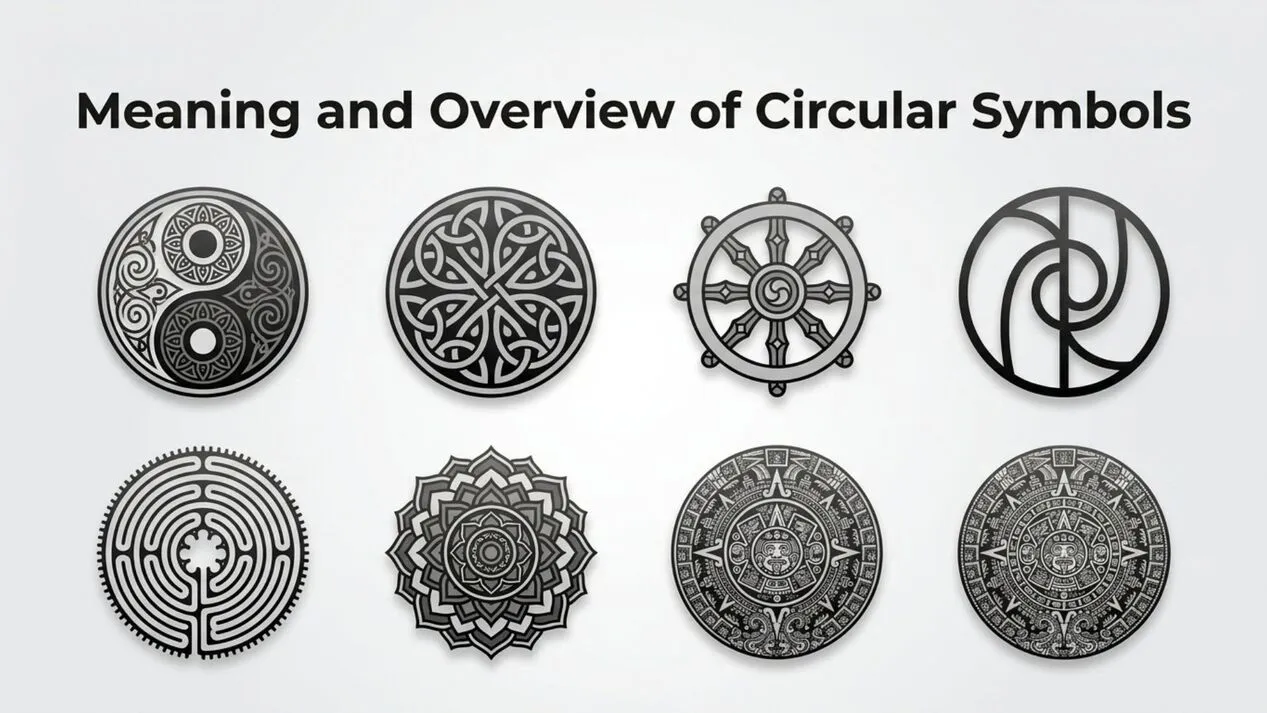
Circular symbols are signs, icons, or graphical representations built around a circular shape or enclosed within a circle. Their symbol meaning often depends on context, but circles generally represent ideas that are continuous, complete, balanced, or unified.
Because the circle has no sharp edges or visible endpoint, many cultures associate it with:
- Infinity
- Unity
- Perfection
- Harmony
- Protection
- Wholeness
- Equality
- Cycles of life
- The universe
- Eternal existence
As a symbolic representation, the circle communicates concepts that are easy to recognize across different languages and cultures. This universal appeal explains why circular symbols are widely used in both traditional and modern communication.
History and Origin of Circular Symbols
The circle is one of humanity’s earliest geometric symbols. Archaeological discoveries reveal circular carvings, stone engravings, pottery decorations, and sacred artwork dating back thousands of years.
Ancient civilizations observed natural circles everywhere:
- The Sun
- The Moon
- Tree rings
- Water ripples
- Eyes
- Seeds
- Planets
These observations inspired circular motifs in religion, astronomy, architecture, and mythology.
Over time, circles became powerful visual representations of divine order, cosmic balance, and natural cycles. As writing systems evolved, circular signs also became important typography symbols, decorative symbols, and mathematical characters.
Today, modern graphic design continues to rely heavily on circular symbols because they are visually balanced, easy to recognize, and highly versatile.
Types of Circular Symbols
Religious Circular Symbols
Many religions use circular symbols to express spiritual beliefs.
Common examples include:
- Halo
- Dharma Wheel
- Mandala
- Celtic Circle
- Yin and Yang
- Ouroboros
- Prayer Wheels
These symbols often represent eternity, enlightenment, spiritual balance, or the interconnectedness of life.
Mathematical Circular Symbols
Mathematics uses several circle-based characters.
Examples include:
- Degree symbol (°)
- Empty set (∅)
- Composition operator (∘)
- Circle operator (○)
- Large circle (◯)
- Ring operator (⊚)
These Unicode symbols and special characters simplify mathematical notation worldwide.
Traffic and Safety Symbols
Many traffic signs use circular designs because they quickly attract attention.
Examples include:
- Speed limit signs
- No entry signs
- Prohibition symbols
- Mandatory instruction signs
- Railway warning circles
Their standardized visual representation allows drivers to recognize instructions instantly.
Technology and Digital Symbols
Modern technology frequently uses circular icons.
Common examples include:
- Power button
- Loading indicator
- Refresh icon
- Record button
- Profile picture frame
- Status indicator
- Camera shutter icon
These communication symbols improve user experience across digital devices and software.
Scientific Symbols
Circular shapes appear throughout science.
Examples include:
- Atomic models
- Planetary orbits
- Electron shells
- Biological cell diagrams
- Astronomy charts
Although simplified, these visual representations help explain complex scientific concepts.
Popular Circular Symbols and Their Meanings
Circle
A plain circle is one of the strongest universal symbols.
It commonly represents:
- Unity
- Completion
- Infinity
- Equality
- Totality
Many organizations use circles to communicate inclusiveness and cooperation.
Yin and Yang
The Yin and Yang symbol features two interconnected halves within a circle.
It symbolizes:
- Balance
- Opposite forces
- Harmony
- Interdependence
Rather than conflict, the design illustrates how opposing energies complement each other.
Mandala
Mandalas are intricate circular designs used in several spiritual traditions.
They represent:
- Meditation
- Cosmic order
- Personal growth
- Spiritual awareness
Their symmetrical patterns encourage mindfulness and reflection.
Ouroboros
The Ouroboros depicts a serpent or dragon consuming its own tail.
Its symbolic significance includes:
- Eternal cycles
- Renewal
- Transformation
- Infinity
The image has appeared in ancient Egyptian, Greek, and alchemical traditions.
Power Symbol
The modern power icon combines a broken circle with a vertical line.
It has become the universal sign for turning electronic devices on or off.
Although relatively new, it is among today’s most recognized digital characters.
Circular Symbols in Different Cultures
Eastern Traditions
Eastern philosophies often associate circles with enlightenment, harmony, and the universe.
Examples include:
- Zen Circle (Ensō)
- Yin and Yang
- Dharma Wheel
Western Traditions
Western symbolism frequently connects circles with:
- Unity
- Marriage
- Eternity
- Protection
- Divine perfection
Wedding rings are perhaps the best-known circular symbols in Western culture.
Indigenous Cultures
Many Indigenous traditions use circular designs to symbolize:
- Nature
- Community
- Sacred space
- Life cycles
Medicine Wheels and ceremonial circles remain important cultural symbols in many Indigenous communities.
Common Uses and Applications
Circular symbols appear almost everywhere.
Common applications include:
- Road signs
- Mobile apps
- Website interfaces
- Company logos
- Religious artwork
- Government seals
- Currency designs
- Sports emblems
- Educational diagrams
- Maps
- Industrial labels
- Medical illustrations
- Jewelry
- Architecture
- Decorative artwork
Many Unicode symbols and text symbols based on circles are also used in documents, coding, typography, and digital communication.
Symbolism and Importance
The symbolic significance of circles extends across cultures and historical periods.
They commonly represent:
- Balance
- Protection
- Continuity
- Equality
- Harmony
- Completion
- Infinity
- Unity
- Perfection
- Life cycles
- Cosmic order
- Timelessness
Their simple geometry makes them effective communication symbols in both traditional and modern settings.
Unlike more complex icons, circles can be understood quickly regardless of language.
How to Use Circular Symbols
Understand the Context
The same circular symbol may have different meanings depending on where it appears.
For example, a red circle on a road sign indicates regulation, while a circle in spiritual artwork may symbolize eternity.
Use Standard Symbols
When creating educational materials or technical documents, choose standardized icons and Unicode symbols whenever possible.
Match the Audience
Businesses often use circular logos because they appear welcoming and balanced, while technical documents may require precise typography symbols.
Respect Cultural Meaning
Some circular symbols hold deep religious or cultural significance. Learn their traditional meaning before using them in artwork, branding, or merchandise.
Interesting Facts About Circular Symbols
- The circle is one of the oldest geometric symbols used by humans.
- Many national flags include circular emblems.
- The Olympic rings are among the world’s most recognizable circular symbols.
- Wedding rings symbolize eternal commitment because they have no beginning or end.
- Most digital loading indicators use rotating circles because they visually communicate ongoing activity.
- Numerous Unicode special characters are based on circular shapes.
- The Sun and Moon inspired many ancient circle symbols.
Common Mistakes and Misconceptions
Assuming Every Circle Means the Same Thing
Different cultures assign different meanings to circular symbols.
Confusing Religious and Decorative Symbols
Some circular designs have sacred origins and should not be treated as simple decorations.
Ignoring Cultural Context
Understanding historical symbolism helps prevent misunderstandings.
Believing All Circular Signs Are Universal
Although many circle-based symbols are internationally recognized, some are specific to particular countries, industries, or organizations.
Using Similar Unicode Characters Incorrectly
Several circular Unicode symbols appear nearly identical but represent different mathematical, technical, or typographic functions.
Frequently Asked Questions
What are circular symbols?
Circular symbols are visual representations based on a circular shape that communicate meanings such as unity, eternity, balance, protection, or specific technical functions.
Why are circles used in symbols?
Circles naturally represent completeness, continuity, harmony, and infinity, making them effective communication symbols across cultures.
What is the most famous circular symbol?
Some of the best-known examples include the Yin and Yang symbol, the Olympic rings, the Dharma Wheel, the power button icon, and wedding rings.
Are circular symbols used in technology?
Yes. Modern technology relies heavily on circular icons for power controls, loading indicators, profile images, recording functions, and user interface elements.
Do circular symbols exist in Unicode?
Yes. Unicode includes numerous circle-based text symbols, special characters, mathematical operators, and typography symbols used in digital communication.
What does a plain circle symbolize?
A plain circle commonly represents wholeness, eternity, unity, equality, completeness, and the endless cycle of life.
Why are many traffic signs circular?
Circular traffic signs are highly visible and are internationally recognized for communicating regulations, prohibitions, and mandatory instructions.
Conclusion
Circular symbols have remained relevant for thousands of years because they communicate powerful ideas through one of the simplest geometric shapes. Whether representing spiritual beliefs, mathematical concepts, digital functions, traffic regulations, or cultural traditions, circles continue to serve as universal symbols of unity, balance, continuity, and harmony. Their timeless design and broad symbolic significance make them an essential part of visual communication across cultures and industries. By understanding the meanings and applications of circular symbols, readers can better interpret the signs, icons, and visual representations they encounter every day.

Daniel Carter is a writer and researcher focused on symbols, their meanings, origins, and practical uses. He enjoys turning complex symbolic concepts into simple, easy-to-understand explanations for everyday readers. Through his work, Daniel explores cultural, technical, historical, and commonly used symbols, helping readers understand what they mean and where they are used.
His work includes The Complete Guide to Symbols, Understanding Symbols and Their Meanings, and A Visual Guide to Common Symbols.