Amun symbols are among the most recognizable and meaningful visual elements in ancient Egyptian religion. As one of Egypt’s most powerful deities, Amun was revered as the “Hidden One,” representing invisibility, creation, kingship, fertility, and divine power.
His symbols were more than artistic decorations they served as sacred signs that communicated religious beliefs, royal authority, and spiritual protection throughout Egyptian civilization.
From the iconic double-plumed crown to the ram, the goose, and the ankh, each symbol associated with Amun carried a unique meaning rooted in mythology and temple worship. These symbolic representations appeared on temple walls, statues, jewelry, monuments, tombs, and ceremonial objects, helping worshippers recognize the god’s presence and influence.
This comprehensive guide explores Amun symbols, their meanings, historical origins, major categories, cultural significance, and modern interpretations. Whether you’re interested in Egyptian mythology, archaeology, symbolism, or ancient art, this article provides everything you need to understand the sacred signs associated with Amun.
Amun Symbols (Meaning and Overview)
Amun symbols are visual representations connected to Amun, one of the chief gods of ancient Egypt. Originally worshipped as a local deity in Thebes, Amun eventually became the supreme god of the Egyptian pantheon during the New Kingdom. After merging with the sun god Ra, he became known as Amun-Ra, symbolizing both hidden spiritual power and visible solar energy.
Unlike ordinary decorative symbols, Amun’s icons communicated complex religious ideas through recognizable imagery. Every sign associated with the deity reflected an aspect of his divine nature, including creation, protection, kingship, wisdom, fertility, and eternal life.
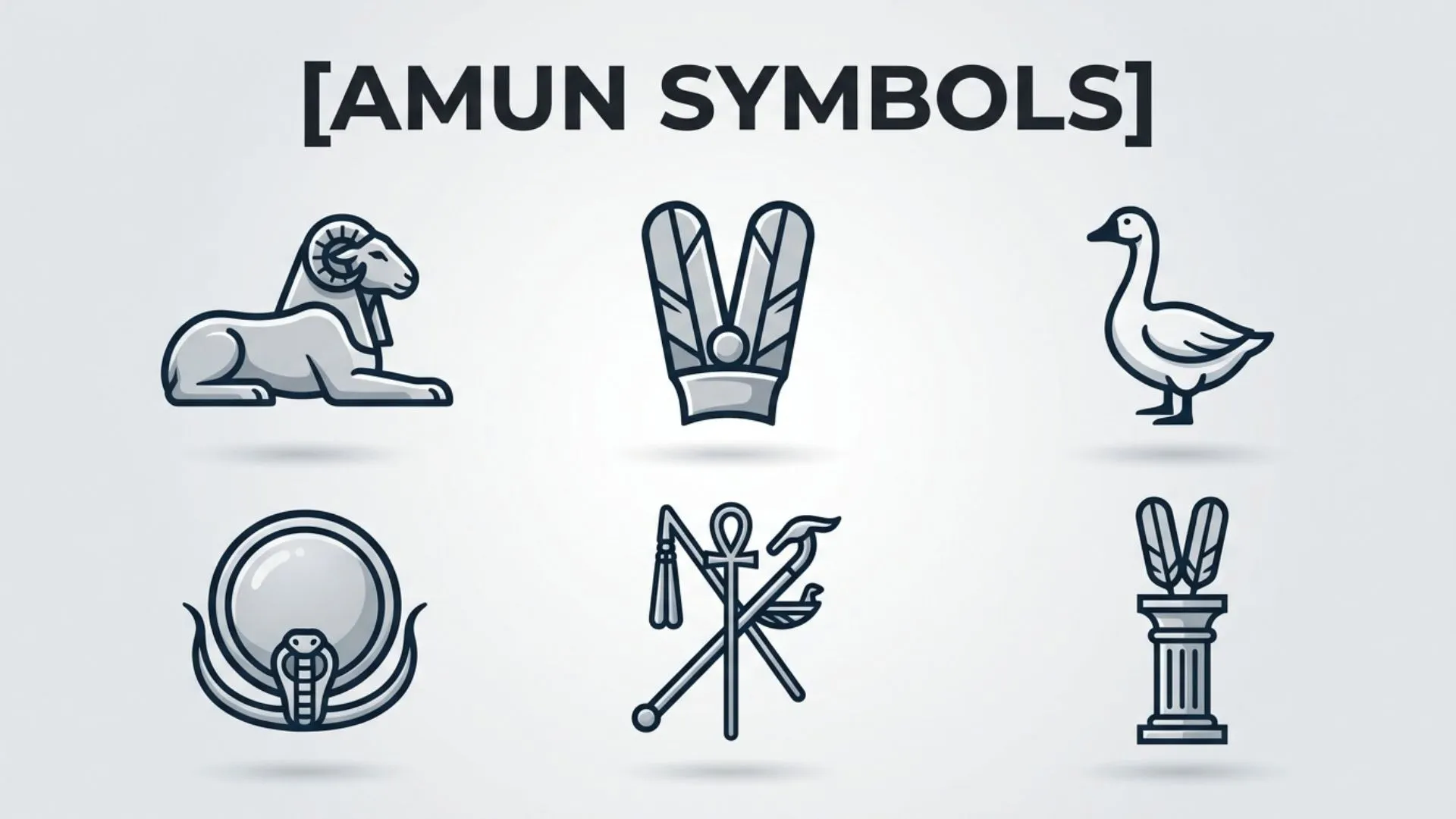
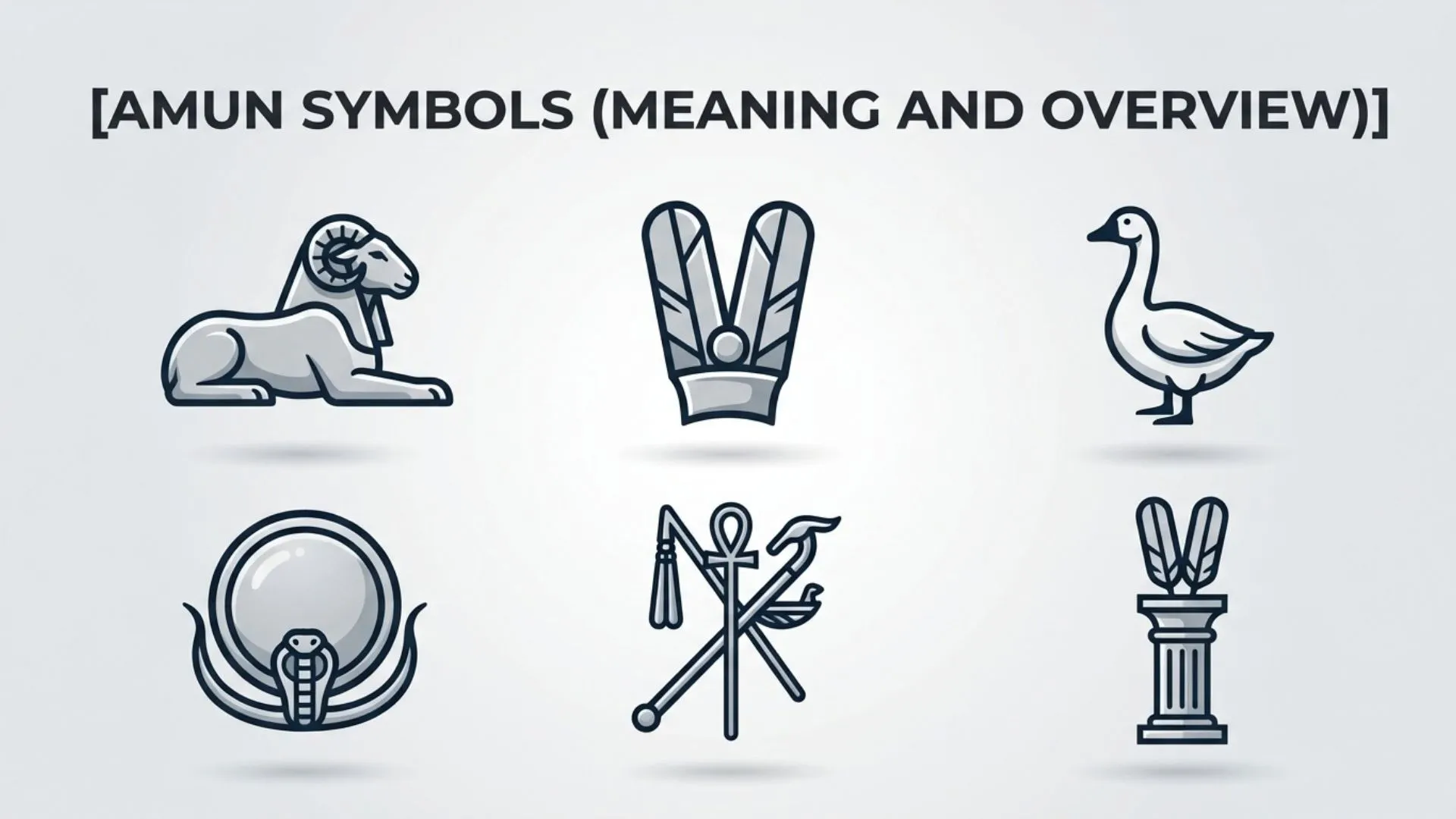
Some of the most famous Amun symbols include:
- The double-plumed crown
- The ram
- The goose
- The ankh
- The was scepter
- The djed pillar
- The solar disk
- Temple columns dedicated to Amun
These symbols appeared throughout Egypt and became powerful communication symbols within religious ceremonies, royal inscriptions, and sacred architecture.
Amun Symbols(History and Origin)
The worship of Amun dates back to Egypt’s Middle Kingdom, around 2000 BCE, when he served as the patron deity of Thebes. As Theban rulers gained political power, Amun’s influence expanded across Egypt.
Following the reunification of Egypt, pharaohs credited Amun with granting them victory and divine authority. During the New Kingdom (approximately 1550–1070 BCE), Amun became the kingdom’s supreme deity. His temples grew into some of the largest religious complexes ever constructed, especially at Karnak and Luxor.
Eventually, Amun merged with Ra, the sun god, creating the combined deity Amun-Ra. This union strengthened his status as both an invisible creator and the visible source of life.
Throughout this period, artists developed standardized symbolic representations so worshippers could easily identify Amun in temple carvings, painted reliefs, statues, and sacred texts.
Types, Variations, or Categories
Amun symbols generally fall into several categories based on what they represent.
Divine Symbols
These directly identify Amun himself.
Examples include:
- Double-plumed crown
- Ram’s horns
- Solar disk
- Blue skin in artwork
These visual elements distinguish Amun from other Egyptian gods.
Sacred Animal Symbols
Several animals represented different aspects of Amun’s divine character.
Common sacred animals include:
- Ram
- Goose
Each animal reflected unique spiritual qualities.
Royal Symbols
Because Egyptian pharaohs believed Amun granted them authority, royal imagery often incorporated his sacred symbols.
These included:
- Crowns
- Scepters
- Ankhs
- Temple inscriptions
These signs reinforced the connection between divine power and kingship.
The Most Important Amun Symbols
Understanding Amun’s most recognizable symbols reveals much about ancient Egyptian beliefs.
The Double-Plumed Crown
The double-plumed crown is perhaps Amun’s most distinctive symbol.
It features:
- Two tall feathers
- A flat headdress
- Occasionally a solar disk
The feathers symbolize:
- Divine authority
- Spiritual elevation
- Universal rule
- Heavenly connection
Ancient Egyptian artwork almost always depicts Amun wearing this crown, making it one of his defining visual representations.
The Ram
The ram is among Amun’s most famous sacred animals.
Unlike the aggressive symbolism associated with rams in some cultures, Egyptian mythology viewed the ram as a symbol of:
- Strength
- Fertility
- Protection
- Creative power
- Leadership
Many temples featured rows of ram-headed sphinxes guarding sacred entrances.
The ram became so closely associated with Amun that some statues portrayed the god entirely with a ram’s head.
The Goose
Before the ram became Amun’s primary animal symbol, the goose represented the god during earlier periods.
The goose symbolized:
- Creation
- Fertility
- Birth
- Cosmic beginnings
Ancient Egyptian texts sometimes referred to Amun as the “Great Cackler,” describing the divine goose whose call initiated creation.
The Ankh
Although the ankh represents life throughout Egyptian religion, it frequently appears in depictions of Amun.
Its symbolic significance includes:
- Eternal life
- Divine blessing
- Immortality
- Spiritual vitality
Artists often show Amun presenting the ankh to pharaohs, symbolizing his gift of life and protection.
The Was Scepter
The was scepter represents:
- Authority
- Dominion
- Stability
- Divine power
Many statues portray Amun holding this ceremonial staff alongside the ankh.
Together, they symbolize power balanced with life.
The Solar Disk
Following Amun’s union with Ra, the solar disk became one of his important symbols.
It represents:
- Light
- Creation
- Universal order
- Life-giving energy
This connection reinforced Amun’s role as both hidden creator and visible sun god.
The Djed Pillar
Although traditionally linked with Osiris, the djed pillar occasionally appears alongside Amun.
It symbolizes:
- Stability
- Endurance
- Strength
- Eternal order
Its presence emphasizes the lasting nature of divine authority.
Relevant Subsection: Amun-Ra Symbolism
The fusion of Amun and Ra transformed Egyptian religion.
As Amun-Ra, the deity represented both:
- Hidden spiritual existence
- Visible solar energy
This combination symbolized that unseen forces govern the universe while revealing themselves through nature.
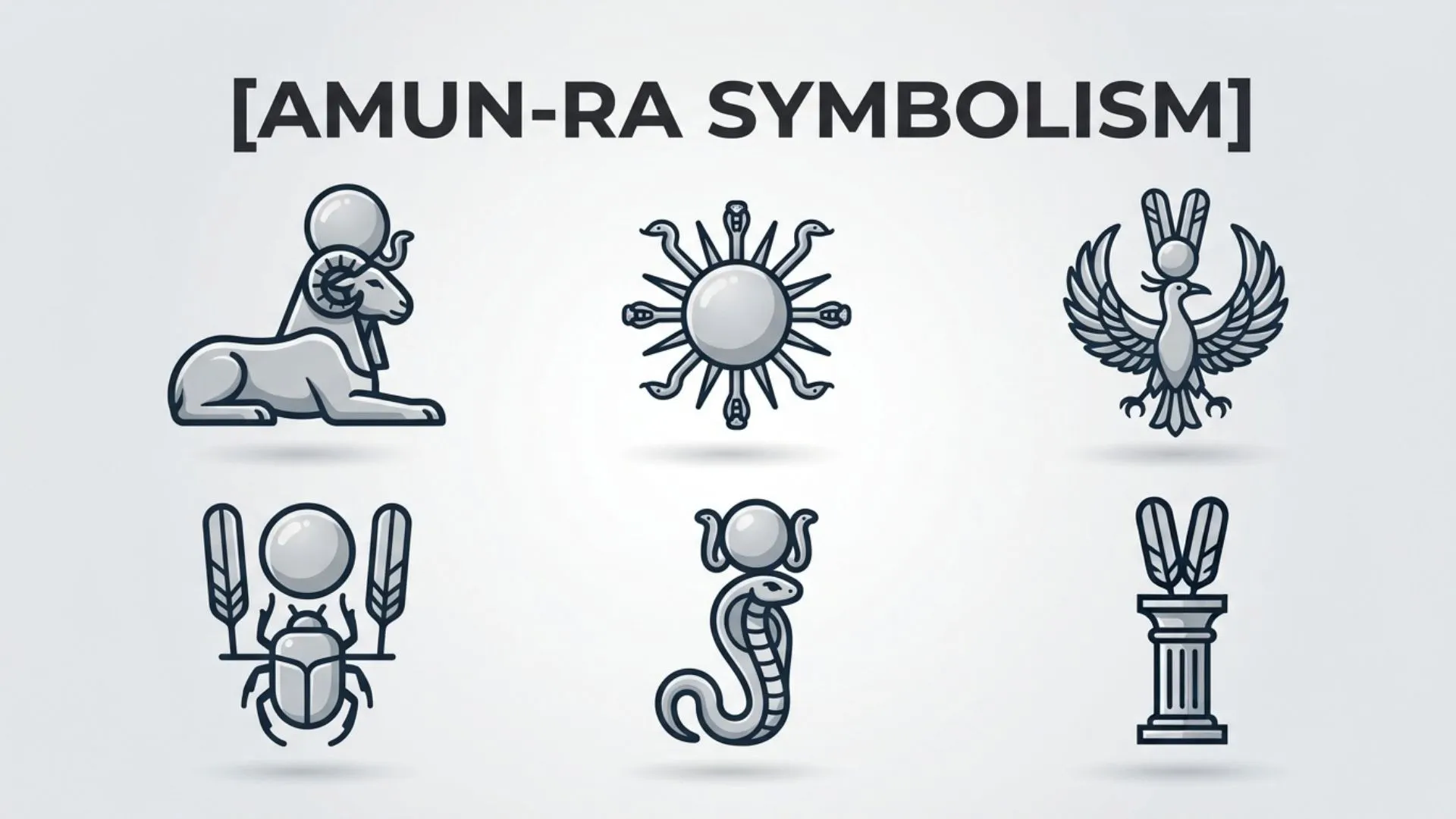
Artwork depicting Amun-Ra often combines:
- Double feathers
- Solar disk
- Royal regalia
The merged imagery reflects one of ancient Egypt’s most influential religious developments.
Relevant Subsection: Symbols in Egyptian Temples
Amun’s symbols dominate many surviving temples.
Notable locations include:
- Karnak Temple
- Luxor Temple
- Medinet Habu
- Temple reliefs throughout Upper Egypt
Temple walls display countless carvings featuring:
- Rams
- Ankhs
- Scepters
- Crowns
- Hieroglyphic inscriptions
These visual representations guided worshippers through sacred rituals and reinforced religious teachings.
Relevant Subsection: Hieroglyphs Associated with Amun
Ancient Egyptian writing frequently included hieroglyphic signs connected to Amun.
These hieroglyphs represented:
- His name
- Divine titles
- Religious prayers
- Royal offerings
Unlike modern Unicode symbols or digital characters, hieroglyphs functioned as both written language and sacred artistic symbols.
Many inscriptions combined text with symbolic imagery to strengthen their religious message.
Common Uses and Applications
Amun symbols appeared throughout ancient Egyptian society.
Common uses included:
Temple Decoration
Columns, walls, gateways, and statues prominently displayed Amun’s sacred signs.
Royal Inscriptions
Pharaohs frequently included Amun’s symbols in monuments to emphasize divine legitimacy.
Jewelry
Priests, nobles, and royalty wore amulets featuring:
- Ankhs
- Rams
- Crowns
- Sacred animals
These served as protective charms.
Tomb Art
Burial chambers featured Amun’s imagery to guide and protect the deceased in the afterlife.
Religious Ceremonies
Priests carried ceremonial objects displaying Amun’s symbols during festivals and temple rituals.
Symbolism, Significance, or Importance
Amun symbols represented much more than artistic decoration.
Their symbolic significance included:
- Hidden wisdom
- Creation
- Divine authority
- Protection
- Fertility
- Eternal life
- Cosmic balance
- Royal legitimacy
Each icon communicated important religious ideas without requiring written explanation.
Their visual representation allowed worshippers to recognize sacred concepts instantly, regardless of literacy.
Even today, these symbols remain among the most recognizable images from ancient Egyptian civilization.
How to Identify Amun Symbols
Recognizing Amun’s symbols becomes easier once you know his distinctive attributes.
Look for:
Double Feathers
This is the clearest identifier of Amun.
Ram Imagery
Ram-headed statues often represent either Amun or his sacred animal.
Combined Symbols
Many artworks combine:
- Double crown
- Ankh
- Was scepter
- Solar disk
Together, these elements almost always indicate Amun or Amun-Ra.
Temple Context
Many carvings found in Karnak and Luxor prominently feature Amun’s sacred iconography.
Interesting Facts
- Amun’s temple at Karnak remains one of the largest religious complexes ever built.
- The ram-lined avenue at Karnak contains dozens of stone ram statues honoring Amun.
- Amun became so influential that foreign rulers also honored him after conquering Egypt.
- Alexander the Great visited the Oracle of Amun to strengthen his claim as Egypt’s rightful ruler.
- The double-plumed crown is unique enough to identify Amun instantly in most Egyptian artwork.
- Ancient Egyptian priests considered Amun both invisible and present everywhere.
- Many surviving statues depict Amun with blue skin, symbolizing the heavens and creation.
Common Mistakes or Misconceptions
Confusing Amun with Ra
Although they later merged into Amun-Ra, they originally existed as separate deities with distinct roles.
Assuming Every Ram Represents Amun
Rams appear in other religious contexts, although they most commonly symbolize Amun in Egyptian art.
Thinking the Ankh Belongs Only to Amun
The ankh represents life throughout Egyptian mythology and appears with many gods.
Overlooking Historical Changes
Amun’s symbols evolved over centuries as Egyptian religion developed.
Different periods sometimes emphasized different sacred animals and artistic styles.
Treating Symbols as Decorative Only
Every symbol associated with Amun carried deep religious meaning rather than serving as simple ornamentation.
Frequently Asked Questions
Who was Amun in ancient Egyptian mythology?
Amun was one of ancient Egypt’s most important gods, associated with creation, kingship, protection, and hidden divine power. He later merged with Ra to become Amun-Ra.
What is the most famous Amun symbol?
The double-plumed crown is widely considered Amun’s most recognizable symbol, often paired with the ram and the solar disk.
Why is the ram associated with Amun?
The ram symbolizes strength, fertility, leadership, and creative power, qualities closely connected to Amun’s divine role.
What does Amun’s double-feather crown represent?
It represents divine authority, heavenly rule, spiritual elevation, and universal sovereignty.
Did Amun always have a ram symbol?
No. Earlier traditions associated Amun with the goose before the ram became his primary sacred animal.
What is the difference between Amun and Amun-Ra?
Amun was originally a local Theban deity, while Amun-Ra combines Amun with the sun god Ra, representing both hidden and visible aspects of creation.
Are Amun symbols still used today?
Today, Amun symbols appear primarily in historical research, museums, educational materials, jewelry inspired by Egyptian art, and modern tattoo designs influenced by ancient mythology.
Conclusion
Amun symbols remain among the most powerful and enduring visual representations of ancient Egyptian religion. From the majestic double-plumed crown and sacred ram to the ankh, scepter, and solar disk, each symbol reveals an important aspect of Amun’s identity as the hidden creator, protector, and king of the gods. Together, these sacred signs formed a sophisticated visual language that expressed complex spiritual beliefs, reinforced royal authority, and inspired generations of worshippers.
Today, Amun’s symbols continue to captivate historians, archaeologists, artists, and mythology enthusiasts. By understanding their meanings and historical context, we gain a deeper appreciation for one of the world’s most influential ancient civilizations and the timeless symbolism that continues to inspire modern culture.

Ryan Mitchell is an independent writer with a strong interest in symbols, visual communication, and the meanings behind different signs and icons. His writing focuses on providing clear, accurate, and useful information that helps readers quickly understand unfamiliar symbols. Ethan covers a wide range of topics, from everyday and cultural symbols to technical and professional symbol systems.
His books include The World of Symbols, Symbols Explained Simply, and The Essential Symbol Reference Guide.