
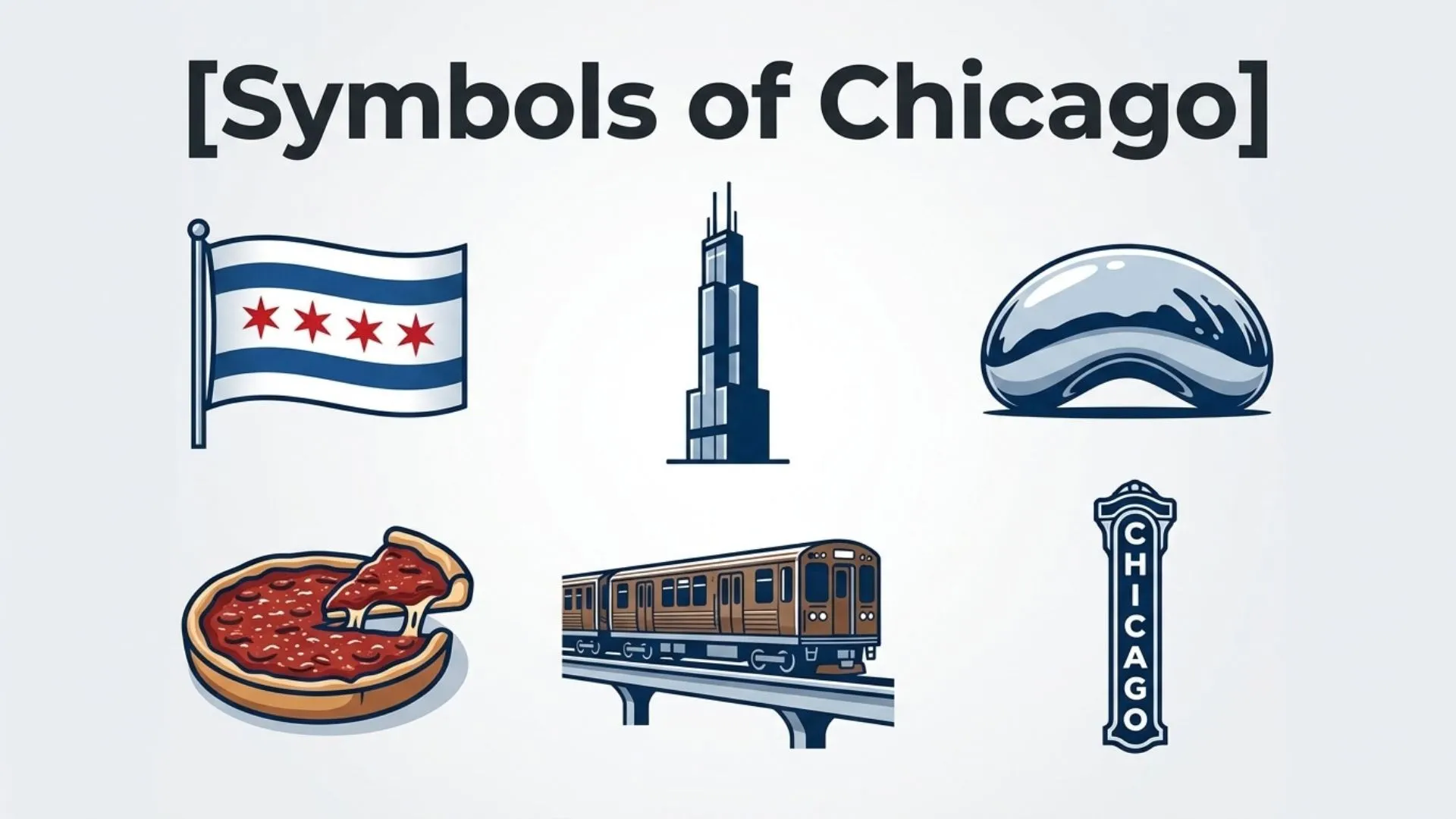
Chicago is one of America’s most recognizable cities, known for its remarkable skyline, deep-rooted history, vibrant culture, and influential architecture. Beyond its famous landmarks, Chicago is represented by a collection of powerful symbols that reflect its identity, achievements, and civic pride.
From the unmistakable four red stars on the city flag to the Chicago River, the Municipal Device, and the resilient phoenix, these symbols tell the story of a city that has continually reinvented itself.
Whether you’re a resident, traveler, student, or history enthusiast, understanding the symbols of Chicago offers valuable insight into the city’s heritage and values. Many of these symbols appear on public buildings, artwork, souvenirs, sports apparel, tattoos, and official documents, making them an important part of Chicago’s visual identity.
This comprehensive guide explores the official and unofficial symbols of Chicago, their meanings, historical origins, cultural significance, and modern-day uses.
Symbols of Chicago (Meaning and Overview)
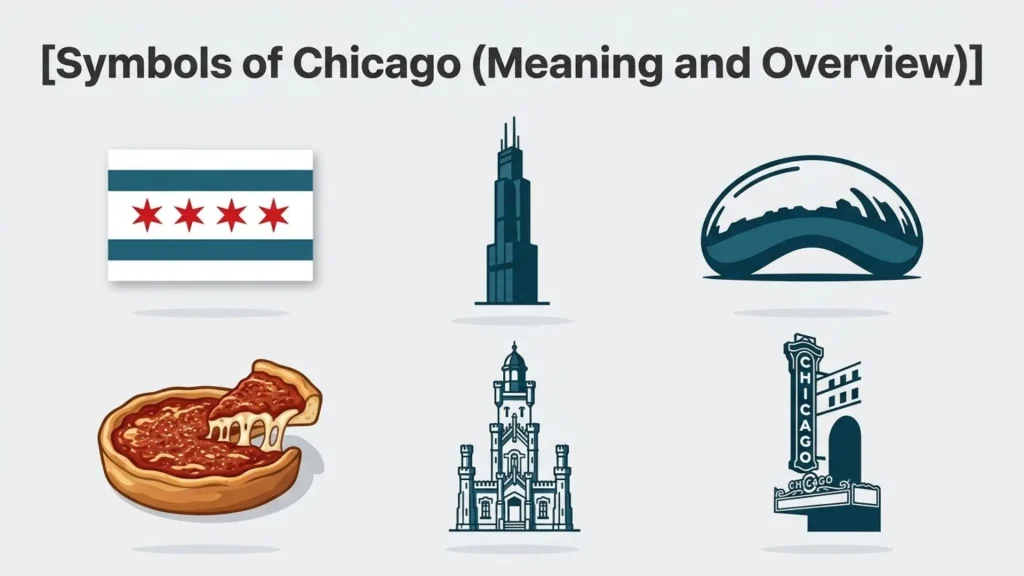
The symbols of Chicago are visual representations that communicate the city’s history, culture, geography, resilience, and civic identity. Some are officially recognized by the City of Chicago, while others have become unofficial icons through public recognition and cultural importance.
These communication symbols help residents and visitors instantly identify the city. They appear in government seals, public monuments, flags, architecture, branding, tourism materials, and local artwork.
Some of Chicago’s best-known symbols include:
- The Chicago Flag
- The Four Red Stars
- The Municipal Device (Y-shaped symbol)
- The Chicago River
- The Phoenix
- The Water Tower
- Cloud Gate (“The Bean”)
- The Skyline
- Lake Michigan
- The Chicago Theatre Sign
Each symbol has its own story and contributes to Chicago’s unique identity.
History and Origin
Chicago’s symbolic identity has evolved alongside the city’s remarkable history. Founded in 1837, Chicago quickly became a major transportation and commercial hub due to its strategic location between the Great Lakes and the Mississippi River watershed.
The city’s symbols became even more meaningful after the Great Chicago Fire of 1871. Rather than allowing the disaster to define its future, Chicago rebuilt with determination, becoming a global center for architecture, innovation, and commerce.
During the early twentieth century, city leaders developed official civic symbols such as the Chicago Flag and the Municipal Device to create a recognizable visual identity. Over time, additional landmarks and cultural icons naturally became symbols representing Chicago around the world.
Today, these symbols appear everywhere—from city parks and government buildings to clothing, murals, digital media, and sports merchandise.
Types, Variations, or Categories
Chicago’s symbols generally fall into several categories.
Official Civic Symbols
These are formally adopted by the City of Chicago.
Examples include:
- Chicago Flag
- Municipal Device
- City Seal
They represent government, public services, and municipal identity.
Architectural Symbols
Many buildings have become visual icons of the city.
Examples include:
- Willis Tower
- Water Tower
- Chicago Theatre
- Marina City
- Cloud Gate
These landmarks symbolize Chicago’s architectural innovation.
Cultural Symbols
Some symbols reflect Chicago’s traditions and local culture.
Examples include:
- Deep-dish pizza
- Blues and jazz music
- Elevated “L” trains
- Sports teams
- Lakefront skyline
Although unofficial, they are widely recognized around the world.
The Chicago Flag
The Chicago Flag is one of the most celebrated city flags in the United States.
Designed in 1917, it features:
- Two horizontal blue stripes
- Three white stripes
- Four red six-pointed stars
The blue stripes represent:
- Lake Michigan
- The North Branch, South Branch, and Main Branch of the Chicago River
The white stripes symbolize:
- The city’s North, West, and South Sides.
Its clean design makes it one of the most recognizable civic flags in the world.
The Four Red Stars
The four red stars are arguably Chicago’s most famous visual representation.
Each six-pointed star commemorates a major historical event:
First Star
Represents Fort Dearborn, established in 1803.
Second Star
Honors the Great Chicago Fire of 1871, which transformed the city’s future.
Third Star
Recognizes the World’s Columbian Exposition of 1893, showcasing Chicago’s emergence as a global city.
Fourth Star
Commemorates the Century of Progress International Exposition of 1933–1934, celebrating scientific and industrial achievement.
Each point on every star also carries symbolic significance, representing ideals such as transportation, labor, commerce, finance, population, health, and culture.
The Municipal Device
One of Chicago’s oldest official symbols is the Municipal Device.
This Y-shaped symbol represents the point where:
- The North Branch
- South Branch
- Main Branch
of the Chicago River meet.
The Municipal Device appears throughout the city on:
- Bridges
- Manhole covers
- Public buildings
- Decorative ironwork
- Street furniture
It remains one of the most distinctive communication symbols of Chicago’s civic identity.
The Chicago River

The Chicago River is both a geographical landmark and a symbolic representation of the city’s development.
Historically, it served as:
- A transportation corridor
- A commercial route
- A center for trade
The river also symbolizes engineering innovation because its flow was famously reversed in 1900 to improve sanitation.
Every year, it is dyed green for St. Patrick’s Day, creating one of Chicago’s most recognizable traditions.
The Phoenix
The phoenix represents Chicago’s resilience after the Great Chicago Fire.
Like the mythical bird rising from its ashes, Chicago rebuilt stronger than before.
The phoenix appears on monuments, sculptures, civic artwork, and educational materials celebrating the city’s remarkable recovery.
Its symbolic significance extends beyond the fire, representing renewal, perseverance, and hope.
The Historic Water Tower
The Chicago Water Tower survived the Great Chicago Fire and became a symbol of endurance.
Completed in 1869, it is one of the city’s oldest surviving structures.
Today, it represents:
- Preservation
- Strength
- Historical continuity
The Water Tower remains one of Chicago’s most photographed landmarks.
Cloud Gate (“The Bean”)
Cloud Gate, affectionately known as “The Bean,” has become one of Chicago’s most recognizable modern icons.
Located in Millennium Park, its reflective stainless-steel surface mirrors the skyline and visitors alike.
It symbolizes:
- Innovation
- Public art
- Creativity
- Community interaction
Although unofficial, it has become synonymous with Chicago in the twenty-first century.
The Skyline
Chicago’s skyline is a powerful architectural symbol.
Featuring landmarks such as:
- Willis Tower
- John Hancock Center (875 North Michigan Avenue)
- Aon Center
- Tribune Tower
it represents:
- Engineering excellence
- Economic strength
- Urban innovation
The skyline frequently appears in logos, tourism campaigns, artwork, and photography.
Relevant Subsection: Sports Symbols
Chicago’s sports culture contributes several unofficial city symbols.
Popular examples include:
- Chicago Cubs’ “W” flag
- Chicago Bulls’ bull logo
- Chicago Bears’ “C”
- Chicago Blackhawks emblem
- Chicago White Sox logo
While these represent individual teams rather than the city itself, they have become important elements of Chicago’s cultural identity.
Relevant Subsection: Architectural Heritage
Chicago is widely regarded as the birthplace of the modern skyscraper.
Architectural symbols include:
- Steel-frame buildings
- Historic bridges
- Art Deco skyscrapers
- Elevated train tracks
- Riverwalk structures
These landmarks reinforce Chicago’s global reputation for architectural innovation.
Relevant Subsection: Cultural Icons
Several cultural elements have become symbolic of Chicago.
These include:
- Deep-dish pizza
- Chicago-style hot dogs
- Blues music
- Jazz clubs
- Neighborhood murals
- Lakefront parks
Together, they showcase the city’s diverse traditions and community spirit.
Common Uses and Applications
Chicago’s symbols appear in numerous settings.
Examples include:
Government
Official documents, vehicles, uniforms, and public buildings feature the city flag, seal, and Municipal Device.
Tourism
Visitors encounter these symbols on:
- Souvenirs
- Visitor guides
- Maps
- Museum exhibits
Fashion
The four red stars and Municipal Device frequently appear on:
- T-shirts
- Hats
- Hoodies
- Jewelry
- Tattoos
Public Art
Murals, sculptures, and installations often incorporate Chicago’s most recognizable symbols.
Symbolism, Significance, or Importance
Chicago’s symbols collectively express the city’s identity.
Their symbolic significance includes:
- Resilience
- Innovation
- Community
- Diversity
- Progress
- Civic pride
- Architectural excellence
- Historical remembrance
Each visual representation tells part of Chicago’s story while strengthening the city’s shared cultural identity.
Unlike decorative symbols used purely for design, these icons preserve history and communicate values across generations.
How to Recognize Chicago Symbols
If you’re visiting Chicago, you’ll encounter its symbols throughout the city.
Look for:
The Municipal Device
Notice the distinctive Y-shaped sign on bridges, sidewalks, and public infrastructure.
Four Red Stars
The stars appear on:
- Flags
- Clothing
- Murals
- Stickers
- Tattoos
- Sports merchandise
Historic Buildings
Visit landmarks like:
- Water Tower
- Chicago Theatre
- Cloud Gate
- Riverwalk
These locations showcase many of the city’s defining symbols.
Interesting Facts
- Chicago’s flag is frequently ranked among the best-designed city flags in the world.
- The Municipal Device predates many of Chicago’s modern landmarks.
- The Chicago River is one of the few major rivers in the world whose flow was intentionally reversed.
- The four red stars are among the city’s most popular tattoo designs.
- Cloud Gate weighs approximately 110 tons and consists of polished stainless steel.
- The Water Tower survived the Great Chicago Fire while much of the surrounding city was destroyed.
- Chicago’s skyline helped pioneer modern skyscraper architecture.
Common Mistakes or Misconceptions
Assuming the Four Stars Represent States
They actually commemorate major historical events in Chicago’s history.
Confusing the Municipal Device with a Letter “Y”
Although it resembles the letter, it specifically symbolizes the branches of the Chicago River.
Believing Cloud Gate Is an Official City Symbol
It is an unofficial cultural icon rather than an officially adopted civic emblem.
Thinking Every Landmark Is an Official Symbol
Many famous buildings represent Chicago culturally but are not designated as official city symbols.
Overlooking Historical Context
Understanding the history behind each symbol provides a deeper appreciation of Chicago’s development and identity.
Frequently Asked Questions
What is the most famous symbol of Chicago?
The four red stars on the Chicago Flag are widely considered the city’s most recognizable symbol.
What does the Municipal Device represent?
It symbolizes the meeting point of the North Branch, South Branch, and Main Branch of the Chicago River.
Why does Chicago have four red stars?
Each star commemorates a major event in the city’s history: Fort Dearborn, the Great Chicago Fire, the World’s Columbian Exposition, and the Century of Progress Exposition.
Is Cloud Gate an official symbol of Chicago?
No. Although Cloud Gate is one of Chicago’s most famous landmarks, it is an unofficial cultural symbol.
Why is the phoenix associated with Chicago?
The phoenix represents the city’s remarkable recovery and rebuilding after the Great Chicago Fire of 1871.
What do the blue stripes on the Chicago Flag mean?
The blue stripes represent Lake Michigan and the branches of the Chicago River.
Why are Chicago symbols popular in tattoos?
Many residents choose symbols like the four red stars, Municipal Device, or skyline to express civic pride and a lifelong connection to the city.
Conclusion
The symbols of Chicago represent far more than recognizable images they tell the story of a city defined by resilience, innovation, diversity, and civic pride. From the elegant simplicity of the Chicago Flag and its four iconic stars to the historic Municipal Device, the enduring Water Tower, the majestic skyline, and the modern appeal of Cloud Gate, each symbol reflects an important chapter in Chicago’s history and culture.
Whether you’re exploring the city for the first time or celebrating your hometown, understanding these symbols provides a deeper appreciation of what makes Chicago unique. Together, they create a powerful visual language that continues to unite residents, inspire visitors, and preserve the legacy of one of America’s greatest cities.

Daniel Carter is a writer and researcher focused on symbols, their meanings, origins, and practical uses. He enjoys turning complex symbolic concepts into simple, easy-to-understand explanations for everyday readers. Through his work, Daniel explores cultural, technical, historical, and commonly used symbols, helping readers understand what they mean and where they are used.
His work includes The Complete Guide to Symbols, Understanding Symbols and Their Meanings, and A Visual Guide to Common Symbols.