Musical note symbols are the foundation of written music. They allow composers, musicians, and students to communicate rhythm, pitch, timing, and expression through a standardized system that has evolved over centuries. Whether you’re reading sheet music for the first time or studying advanced music theory, understanding musical note symbols is essential for interpreting and performing music accurately.
From the familiar quarter note and eighth note to rests, clefs, accidentals, and dynamic markings, each symbol has a specific purpose. Together, these visual representations form the universal language of music, enabling performers around the world to play the same composition regardless of their native language.
In today’s digital world, musical note symbols are also used as Unicode symbols, text symbols, decorative icons, emojis, and typography characters in apps, websites, and social media. This guide explores their meanings, history, categories, practical applications, and cultural significance.
Meaning and Overview of Musical Note Symbols
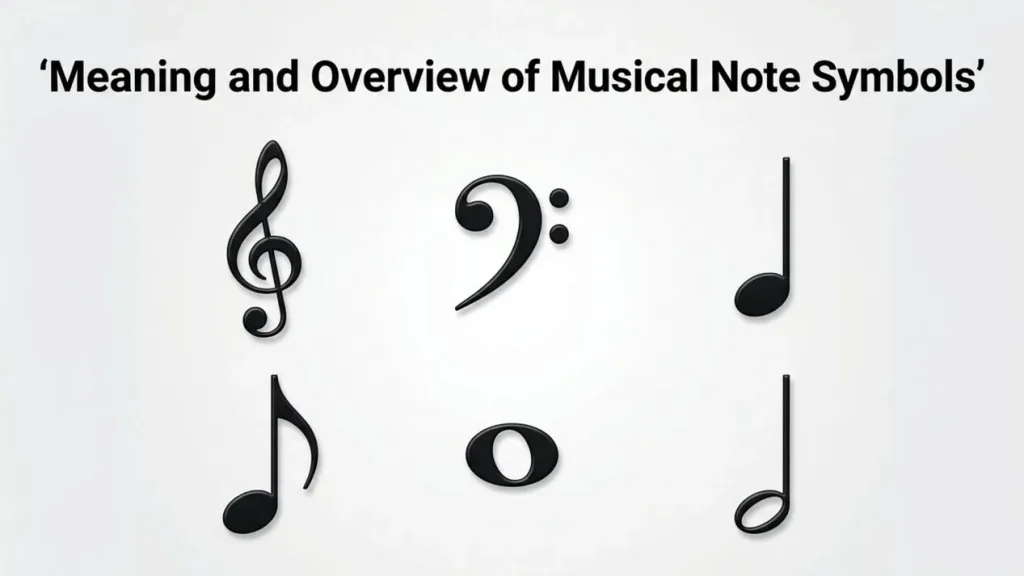
Musical note symbols are standardized graphical characters used to represent musical sounds, rhythms, pauses, and performance instructions in written notation. Instead of describing music with words, composers use these symbols to communicate exactly how a piece should be played or sung.
Each symbol provides information such as:
- Pitch
- Note duration
- Rhythm
- Tempo
- Volume
- Articulation
- Expression
- Musical structure
Together, these symbols create a complete musical score that performers can interpret consistently.
Unlike decorative icons, musical notation symbols have precise meanings recognized by musicians worldwide.
History and Origin of Musical Note Symbols
The history of musical notation dates back more than one thousand years. Early forms of notation appeared in medieval Europe, where simple markings called neumes helped singers remember melodies during religious chants.
As music became more complex, composers required a more accurate system. During the 11th century, the Italian music theorist Guido of Arezzo introduced a staff-based notation system that laid the foundation for modern sheet music.
Over the centuries, additional symbols were introduced to represent note values, rhythm, dynamics, key signatures, tempo changes, and articulation. By the Baroque and Classical periods, the notation system closely resembled what musicians use today.
Modern notation remains remarkably consistent across genres, including classical, jazz, pop, film music, and educational materials.
Types of Musical Note Symbols
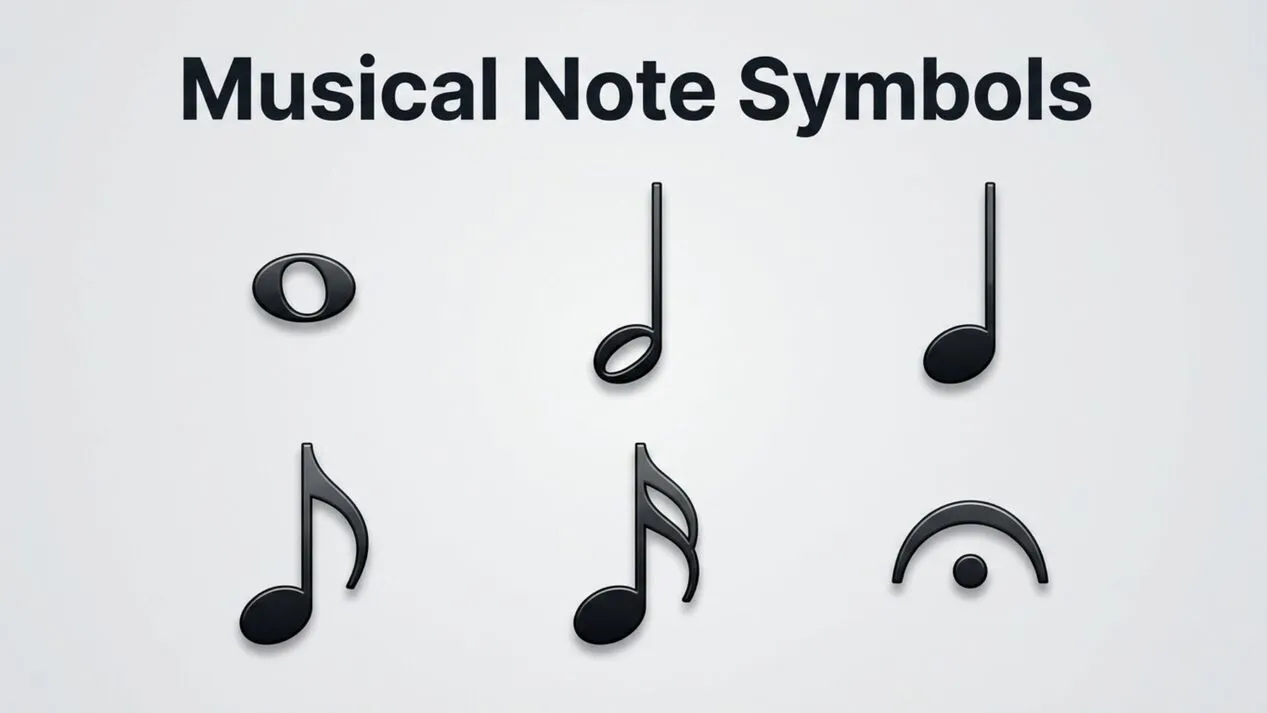
Note Value Symbols
These symbols indicate how long a note should be held.
Whole Note (Semibreve)
The whole note is an open oval without a stem.
It typically lasts four beats in common time and represents the longest standard note value in basic music notation.
Half Note (Minim)
The half note has an open oval with a stem.
It usually receives two beats.
Quarter Note (Crotchet)
The quarter note is one of the most common musical symbols.
Its filled note head and stem represent one beat in common time.
Eighth Note (Quaver)
An eighth note includes one flag attached to the stem.
Two eighth notes are often connected by a beam.
Sixteenth Note (Semiquaver)
The sixteenth note contains two flags or beams.
It represents half the duration of an eighth note.
Thirty-Second Note
This note features three flags and is commonly found in fast musical passages.
Rest Symbols
Rests indicate silence rather than sound.
Common rest symbols include:
Whole Rest
Represents four beats of silence.
Half Rest
Represents two beats of silence.
Quarter Rest
Represents one beat of silence.
Eighth Rest
Represents half a beat.
Sixteenth Rest
Represents one-quarter of a beat.
Understanding rests is just as important as understanding notes because silence is an essential part of rhythm.
Clef Symbols
Clefs determine the pitch range shown on the staff.
Treble Clef
The Treble Clef is used for higher-pitched instruments and voices.
Examples include:
- Violin
- Flute
- Trumpet
- Piano right hand
Bass Clef
The Bass Clef represents lower pitches.
It commonly appears in music for:
- Bass guitar
- Cello
- Tuba
- Piano left hand
Alto and Tenor Clefs
These specialized clefs are primarily used for instruments such as the viola, bassoon, and trombone.
Accidental Symbols
Accidentals temporarily change a note’s pitch.
Sharp (♯)
Raises a note by one semitone.
Flat (♭)
Lowers a note by one semitone.
Natural (♮)
Cancels a previous sharp or flat.
Double Sharp and Double Flat
Raise or lower a note by two semitones.
These symbols are essential for understanding key changes and chromatic passages.
Time Signature Symbols
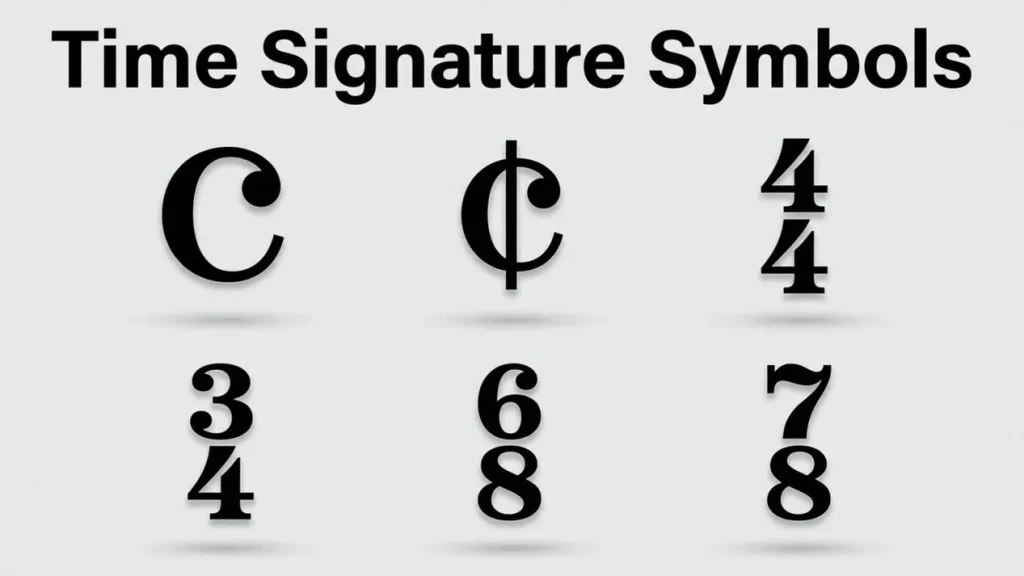
Time signatures define the rhythmic structure of music.
Examples include:
- 4/4 (Common Time)
- 3/4 (Waltz Time)
- 2/4
- 6/8
- 12/8
The top number indicates beats per measure, while the bottom number identifies which note value receives one beat.
Dynamic Symbols
Dynamic markings indicate volume.
Common examples include:
- pp – Very soft
- p – Soft
- mp – Moderately soft
- mf – Moderately loud
- f – Loud
- ff – Very loud
Additional symbols such as crescendos and diminuendos show gradual changes in volume.
Articulation Symbols
Articulation affects how notes are performed.
Examples include:
- Staccato
- Accent
- Tenuto
- Fermata
- Marcato
These markings add expression and character to a musical performance.
Common Uses and Applications
Musical note symbols are used in numerous settings.
Common applications include:
- Sheet music
- Music education
- Piano lessons
- Choir music
- Orchestra scores
- Band arrangements
- Film scoring
- Music software
- Mobile apps
- Digital notation programs
- Music theory textbooks
- Educational posters
Outside formal notation, musical note icons are widely used as decorative symbols in logos, greeting cards, clothing, websites, and social media.
Unicode also includes several musical note characters, allowing them to be displayed consistently across digital platforms.
Symbolism and Cultural Significance
Musical note symbols extend beyond technical notation and often carry symbolic meaning.
They commonly represent:
- Creativity
- Joy
- Artistic expression
- Harmony
- Celebration
- Passion
- Inspiration
- Entertainment
- Cultural identity
- Emotional connection
Because music is a universal language, these symbols have become instantly recognizable worldwide.
A simple eighth note or beamed pair of notes often serves as a visual representation of music itself.
How to Read Musical Note Symbols
Learn the Staff First
Understanding the five-line staff makes it easier to identify note positions and pitches.
Memorize Basic Note Values
Begin with whole, half, quarter, and eighth notes before studying more advanced rhythms.
Practice Reading Clefs
Treble and Bass Clefs are the most commonly used.
Learning both greatly expands the range of music you can read.
Understand Rhythm
Combine note values and rests to recognize rhythmic patterns.
Practicing with a metronome improves timing and accuracy.
Study Dynamic and Expression Marks
Performance symbols help transform written notes into expressive music rather than mechanical sounds.
Interesting Facts
- Modern musical notation evolved over nearly 1,000 years.
- Guido of Arezzo’s staff notation revolutionized music education.
- Unicode includes several musical note symbols, including ♪, ♫, ♩, ♬, and ♭.
- The Treble Clef originated from the letter “G.”
- The Bass Clef developed from the letter “F.”
- Music notation is used in virtually every country.
- Computer notation software can automatically generate professional-quality sheet music using standardized symbols.
Common Mistakes and Misconceptions
Confusing Note Names With Note Values
A note’s letter name (A–G) identifies its pitch, while its symbol determines its duration.
Ignoring Rest Symbols
Silence is an important part of rhythm and should be counted carefully.
Assuming Every Sharp or Flat Applies Forever
Accidentals generally apply only within the current measure unless modified by the key signature or another accidental.
Believing Musical Symbols Are Universal Emojis
Musical note emojis are decorative and should not be confused with formal notation used in sheet music.
Overlooking Dynamics
Playing every note at the same volume ignores the composer’s expressive intentions.
Frequently Asked Questions
What are musical note symbols?
Musical note symbols are standardized graphical characters that represent pitch, rhythm, duration, silence, and musical expression in written notation.
What is the most common musical note symbol?
The quarter note is among the most frequently used symbols because it forms the basis of many rhythms in common time.
What do the black and white note heads mean?
Open note heads usually indicate longer durations, while filled note heads represent shorter note values.
What is the difference between a note and a rest?
A note produces sound, while a rest indicates a measured period of silence.
Are musical note symbols available in Unicode?
Yes. Unicode includes several musical note symbols, accidentals, and other music-related text characters used in digital communication.
Why are there different clef symbols?
Different clefs make it easier to read music written for instruments and voices with different pitch ranges.
Can beginners learn musical notation easily?
Yes. Starting with basic note values, rests, clefs, and rhythms provides a solid foundation for reading sheet music and developing musical skills.
Conclusion
Musical note symbols are the building blocks of written music, allowing composers and performers to communicate complex musical ideas through a standardized visual system. From whole notes and rests to clefs, accidentals, and dynamic markings, every symbol plays a specific role in shaping melody, rhythm, and expression. Beyond sheet music, these symbols have become universal icons representing creativity, culture, and artistic expression in both traditional and digital settings. Whether you’re learning music for the first time or expanding your theory knowledge, understanding musical note symbols opens the door to a richer appreciation of music in all its forms.

Daniel Carter is a writer and researcher focused on symbols, their meanings, origins, and practical uses. He enjoys turning complex symbolic concepts into simple, easy-to-understand explanations for everyday readers. Through his work, Daniel explores cultural, technical, historical, and commonly used symbols, helping readers understand what they mean and where they are used.
His work includes The Complete Guide to Symbols, Understanding Symbols and Their Meanings, and A Visual Guide to Common Symbols.