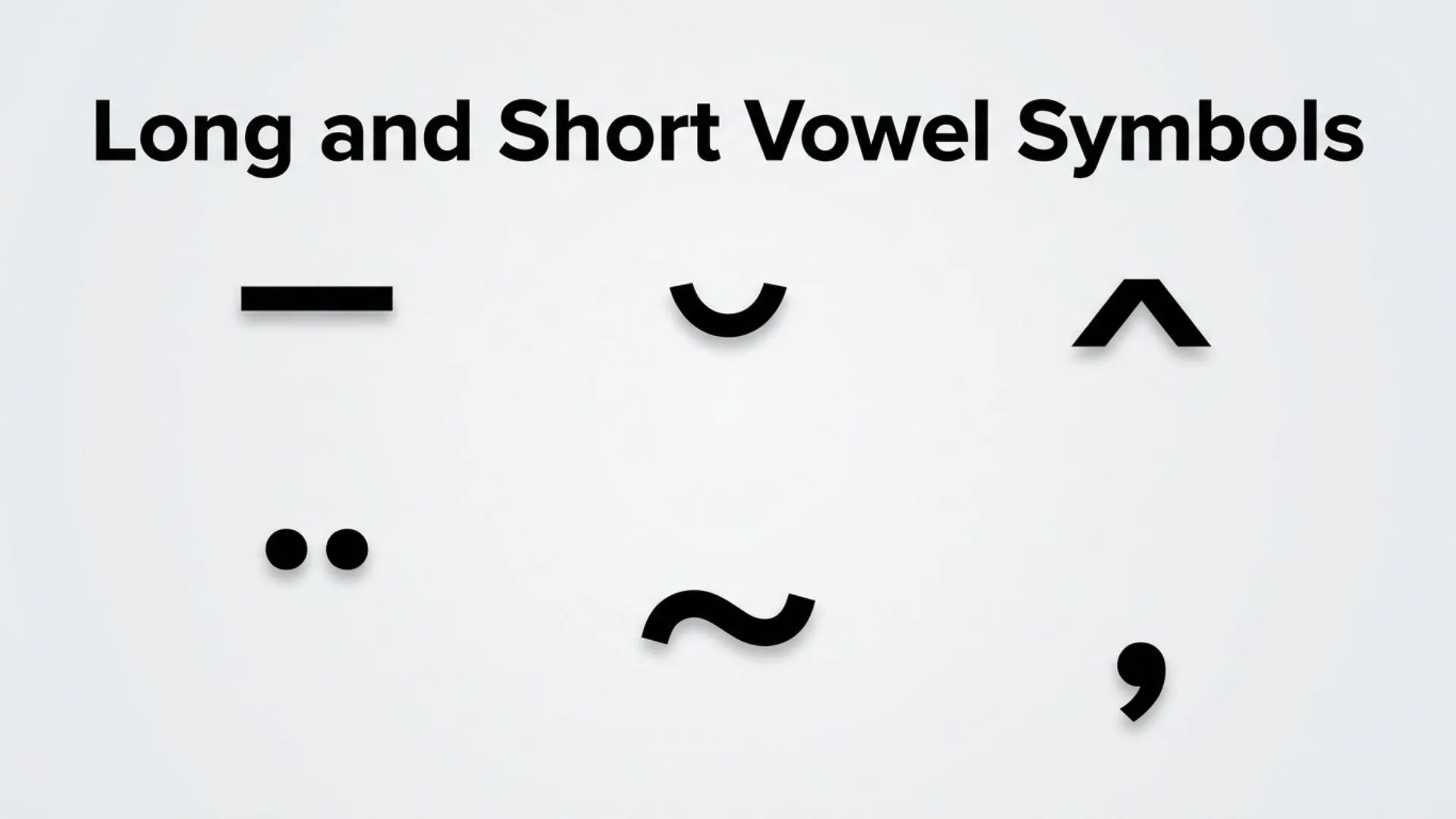
Long and short vowel symbols are essential tools for understanding pronunciation in English and many other languages. While the English alphabet contains only five vowel letters A, E, I, O, and U it actually represents around 20 different vowel sounds. To accurately describe these sounds, linguists and language teachers use standardized phonetic symbols, primarily from the International Phonetic Alphabet (IPA).
Whether you’re learning English as a second language, teaching phonics, studying linguistics, or improving your pronunciation, understanding long and short vowel symbols can make a significant difference. These symbols provide a universal way to represent speech sounds regardless of spelling, making pronunciation clearer and more consistent.
This comprehensive guide explains the meaning of long and short vowel symbols, their history, IPA representations, pronunciation rules, practical applications, and common mistakes. By the end, you’ll have a strong foundation for reading and using vowel symbols with confidence.
Long and Short Vowel Symbols (Meaning and Overview)
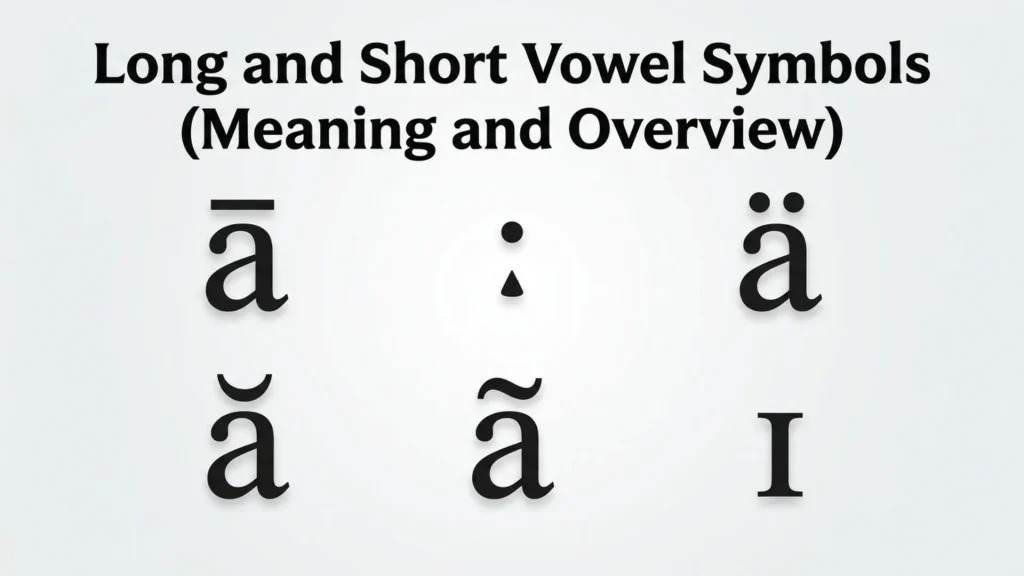
Long and short vowel symbols are phonetic characters used to represent the different vowel sounds found in spoken language. These symbols are most commonly associated with the International Phonetic Alphabet (IPA), an internationally recognized system developed to accurately represent speech sounds.
Unlike ordinary alphabet letters, vowel symbols represent sounds rather than spelling. This distinction is important because English spelling is not always phonetic. For example, the letter A sounds different in the words cat, cake, father, and about.
Phonetic vowel symbols solve this problem by assigning one symbol to one specific sound. This makes them valuable communication symbols in dictionaries, pronunciation guides, language textbooks, and linguistic research.
Long and Short Vowel Symbols (History and Origin)
Early Phonetic Writing
For centuries, scholars searched for ways to record spoken language accurately. Ancient Greek and Roman grammarians recognized that pronunciation varied, but they lacked a universal system for describing speech sounds.
Development of the International Phonetic Alphabet
The International Phonetic Alphabet was introduced in 1888 by the International Phonetic Association. Its goal was to create a standardized system that could represent the sounds of every spoken language.
The IPA introduced unique vowel symbols that eliminated confusion caused by irregular spelling patterns.
Modern Usage
Today, long and short vowel symbols are used worldwide by:
- Language teachers
- Students
- Linguists
- Speech therapists
- Dictionary publishers
- Voice coaches
- Language-learning apps
Because the IPA is internationally standardized, the same symbol has the same pronunciation regardless of country.
Types, Variations, or Categories
English vowel sounds are generally grouped into short vowels, long vowels, diphthongs, and other vowel categories.
Short Vowel Symbols
Short vowels are pronounced quickly without extending the sound.
The five primary short vowel IPA symbols include:
| Sound | IPA Symbol | Example |
| Short A | /æ/ | cat |
| Short E | /ɛ/ | bed |
| Short I | /ɪ/ | sit |
| Short O | /ɒ/ (British) or /ɑ/ (American) | hot |
| Short U | /ʌ/ | cup |
Although called “short,” these vowels are identified more by pronunciation quality than by duration.
Long Vowel Symbols
Long vowels are typically held slightly longer and often sound similar to the names of the vowel letters.
Common long vowel IPA symbols include:
| Sound | IPA Symbol | Example |
| Long A | /eɪ/ | cake |
| Long E | /iː/ | see |
| Long I | /aɪ/ | bike |
| Long O | /oʊ/ (American) or /əʊ/ (British) | home |
| Long U | /juː/ or /uː/ | use, blue |
Notice that several long vowels are actually diphthongs rather than single sounds.
Diphthongs
A diphthong combines two vowel sounds into one syllable.
Examples include:
- /aɪ/ — my
- /eɪ/ — day
- /ɔɪ/ — boy
- /aʊ/ — house
- /oʊ/ — go
These sounds glide smoothly from one vowel position to another.
IPA Symbols for Long and Short Vowels
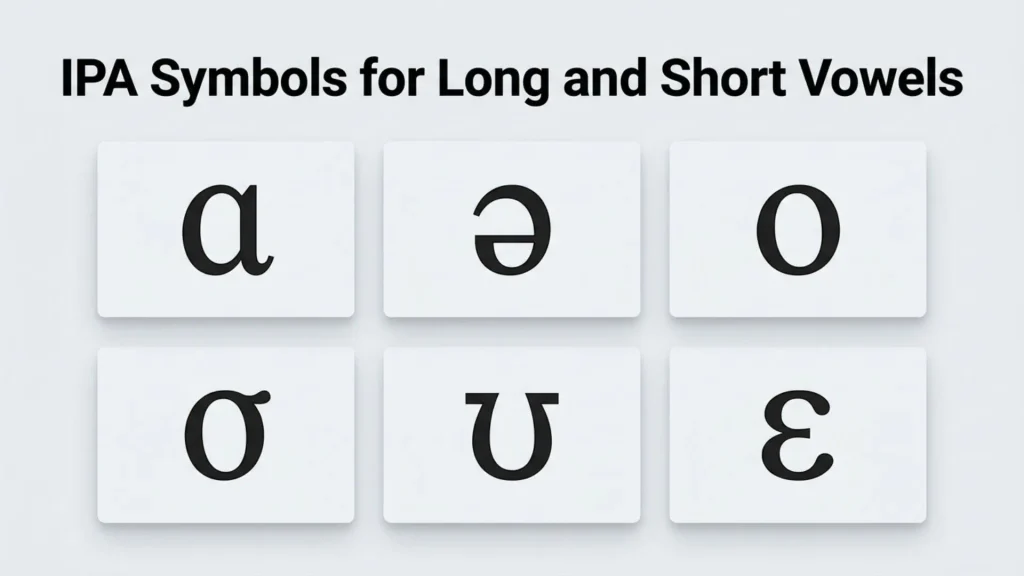
The IPA provides precise symbols for English vowel sounds.
Short Vowel IPA Symbols
/æ/ – cat
/ɛ/ – pen
/ɪ/ – fish
/ɒ/ – dog (British English)
/ɑ/ – hot (American English)
/ʌ/ – sun
/ʊ/ – book
Long Vowel IPA Symbols
/iː/ – tree
/uː/ – moon
/ɑː/ – father
/ɔː/ – law
Some long vowels use a colon-like symbol (ː) after the IPA character. This mark indicates a longer vowel duration.
Long vs. Short Vowel Sounds
Understanding the difference between long and short vowels is essential for accurate pronunciation.
Short Vowel Example
The word bit uses the short vowel /ɪ/.
The sound is brief and relaxed.
Long Vowel Example
The word beat uses the long vowel /iː/.
The vowel is held longer and pronounced with a tenser mouth position.
Another comparison:
- hat /hæt/
- hate /heɪt/
Although the spelling changes by only one letter, the vowel sound changes completely.
Pronunciation Tips
Learning vowel symbols becomes easier with regular practice.
Listen Before Reading
Hear native speakers pronounce words while following the IPA transcription.
Learn Mouth Position
Different vowel sounds require different tongue and lip positions.
For example:
- /iː/ requires a high front tongue position.
- /ɑː/ requires a low open mouth.
Practice Minimal Pairs
Minimal pairs help distinguish similar vowel sounds.
Examples:
- ship /ʃɪp/
- sheep /ʃiːp/
- full /fʊl/
- fool /fuːl/
These exercises improve listening and speaking accuracy.
Common Uses and Applications
Long and short vowel symbols appear in many educational and professional settings.
Dictionaries
Most English dictionaries include IPA symbols beside each word.
This allows readers to pronounce unfamiliar vocabulary correctly.
Language Learning
Teachers use phonetic symbols to explain pronunciation independently of spelling.
Speech Therapy
Speech-language pathologists use IPA notation when assessing pronunciation disorders.
Linguistics
Researchers analyze speech sounds using standardized vowel symbols.
Accent Training
Actors and public speakers often study vowel symbols to improve pronunciation or adopt new accents.
Language Apps
Many pronunciation apps display IPA transcriptions alongside audio recordings.
Symbolism, Significance, or Importance
Although vowel symbols are scientific rather than decorative, they have important symbolic significance.
They represent:
- Accurate pronunciation
- Universal communication
- Language learning
- Standardized speech description
- Cross-cultural understanding
Unlike ordinary alphabet letters, IPA symbols provide a precise visual representation of spoken sounds.
They eliminate ambiguity and create a common pronunciation standard used around the world.
How to Use Long and Short Vowel Symbols
Read Dictionary Entries
Whenever you encounter a new word, check its IPA pronunciation.
Learn Symbols Gradually
Master a few vowel symbols at a time rather than memorizing the entire IPA chart immediately.
Combine Audio with IPA
Listening while reading phonetic symbols strengthens pronunciation skills.
Practice Daily
Reading IPA transcriptions aloud helps build confidence and accuracy.
Use Educational Resources
Language-learning books, pronunciation websites, and dictionaries provide reliable IPA examples.
Interesting Facts
- English has around 20 vowel sounds but only five vowel letters.
- The International Phonetic Alphabet is used in more than 100 countries.
- IPA symbols represent sounds rather than spelling.
- The length mark (ː) indicates that a vowel should be pronounced longer.
- Many English dictionaries include IPA transcriptions for every entry.
- Different English accents may use slightly different vowel symbols.
- Some languages have more vowel sounds than English, while others have fewer.
- Professional singers often study IPA to pronounce lyrics in multiple languages accurately.
Common Mistakes or Misconceptions
Assuming Long Means Louder
Long vowels are generally longer in duration, not necessarily louder.
Confusing Letters with Sounds
The letter “A” can represent several different IPA vowel symbols depending on the word.
Ignoring Accent Differences
British and American English sometimes use different IPA symbols for the same word.
Memorizing Without Listening
IPA symbols become meaningful only when paired with spoken pronunciation.
Thinking Every Long Vowel Uses the Length Mark
Some long English vowel sounds, such as /eɪ/ and /aɪ/, are diphthongs rather than vowels marked with /ː/.
Frequently Asked Questions
What are long and short vowel symbols?
Long and short vowel symbols are phonetic characters used in the International Phonetic Alphabet (IPA) to represent different vowel sounds accurately.
Why are IPA vowel symbols important?
They provide a universal system for showing pronunciation regardless of spelling, making language learning more accurate and consistent.
How many vowel sounds are there in English?
English has approximately 20 vowel sounds, including short vowels, long vowels, diphthongs, and other vowel variations, depending on the accent.
What does the symbol ː mean?
The symbol ː indicates that the preceding vowel is pronounced with a longer duration.
Are long vowels always spelled with silent E?
No. Long vowel sounds can be spelled in many ways, including vowel teams, silent E patterns, and other spelling combinations.
Do British and American English use the same vowel symbols?
They share most IPA symbols, but some vowel pronunciations differ, leading to slightly different transcriptions.
Where can I learn IPA pronunciation?
IPA symbols are taught in dictionaries, pronunciation guides, language-learning textbooks, university linguistics courses, and many online educational platforms.
Conclusion
Long and short vowel symbols are essential tools for anyone who wants to understand English pronunciation more deeply. By using the International Phonetic Alphabet, these symbols provide a clear and consistent way to represent spoken sounds, overcoming the irregularities of English spelling.
Whether you’re a student, teacher, language learner, speech therapist, or linguist, mastering vowel symbols can improve pronunciation, listening skills, and overall language confidence. With regular practice and exposure to IPA transcriptions, you’ll find it much easier to pronounce unfamiliar words accurately and communicate more effectively across different varieties of English.

Daniel Carter is a writer and researcher focused on symbols, their meanings, origins, and practical uses. He enjoys turning complex symbolic concepts into simple, easy-to-understand explanations for everyday readers. Through his work, Daniel explores cultural, technical, historical, and commonly used symbols, helping readers understand what they mean and where they are used.
His work includes The Complete Guide to Symbols, Understanding Symbols and Their Meanings, and A Visual Guide to Common Symbols.