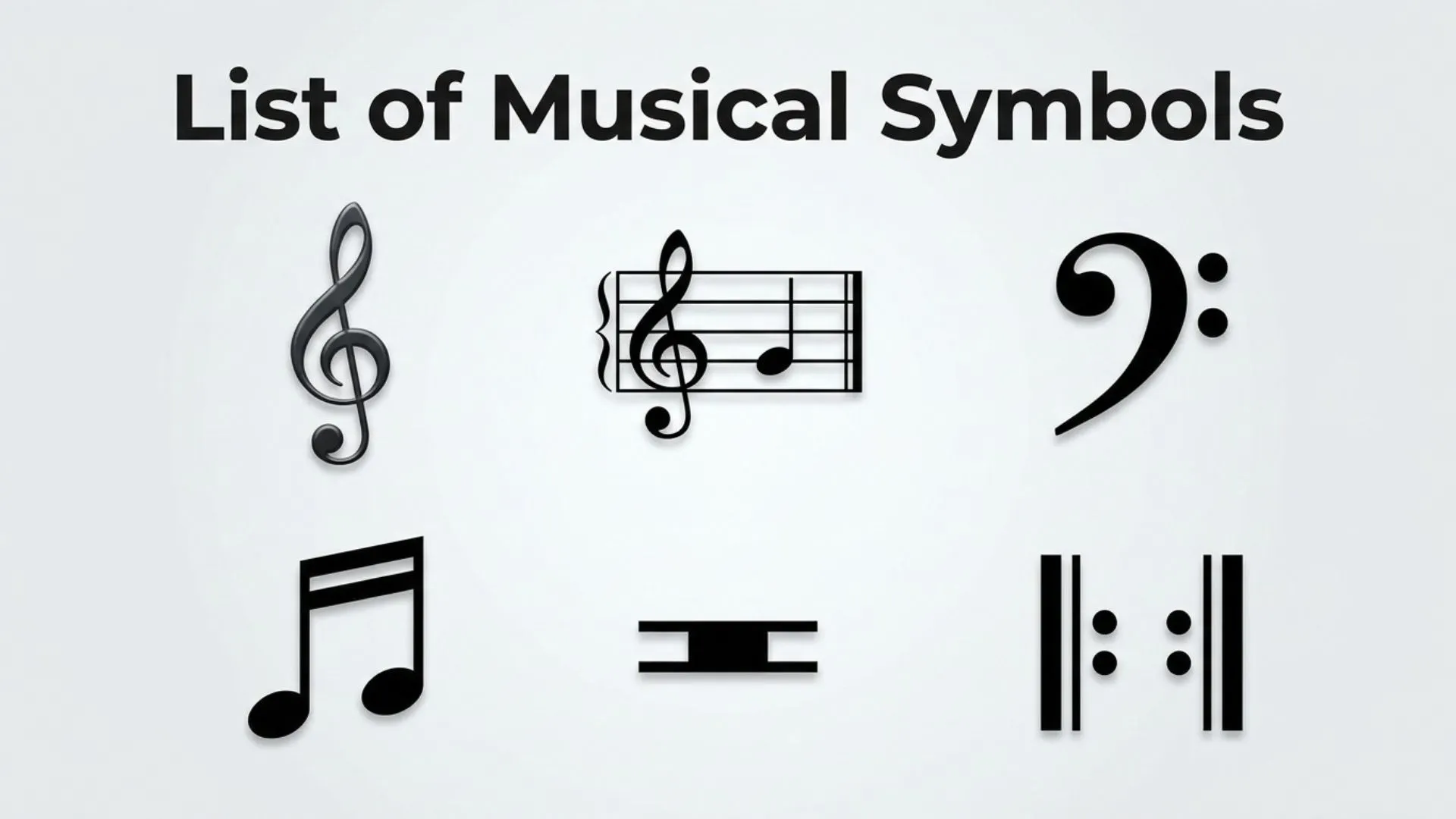
Music is often called a universal language, but written music requires its own system of communication. Before a musician plays a single note, a composer can use a collection of marks, signs, and characters to explain pitch, rhythm, volume, expression, and timing. These visual elements are known as musical symbols.
A list of musical symbols helps musicians, students, composers, and music enthusiasts understand how written scores communicate ideas. From basic notes and rests to advanced symbols for dynamics, articulation, and performance techniques, each mark has a specific purpose. These symbols act as a bridge between a composer’s imagination and a performer’s interpretation.
Musical symbols have developed over centuries, evolving from simple handwritten marks into a standardized notation system used worldwide. Today, they appear in printed sheet music, digital music software, educational tools, and even online communication. Understanding their meanings makes reading music easier and improves appreciation for the structure behind every composition.
This complete guide explores the most important musical symbols, their meanings, history, categories, and practical uses.
Meaning and Overview of Musical Symbols
Musical symbols are visual signs used to represent different elements of music. They provide instructions about how music should be performed, including which notes to play, how long to hold them, how loudly or softly to perform, and how to express emotion.
Unlike ordinary text symbols or decorative symbols, musical symbols have precise meanings within the language of music. A single character can completely change how a piece sounds.
For example:
- A treble clef symbol tells musicians the pitch range of the notes.
- A sharp symbol (#) raises a note by one half step.
- A flat symbol (♭) lowers a note by one half step.
- A rest symbol indicates silence.
- A crescendo symbol shows that the music should gradually become louder.
These symbols are a form of communication symbol that allows musicians from different cultures and languages to understand the same musical instructions.
History and Origin of Musical Symbols
The history of musical symbols dates back thousands of years. Ancient civilizations used various methods to record music, but modern musical notation developed mainly in medieval Europe.
Early Greek musicians used letters and signs to describe musical pitches. However, these systems were limited and difficult to interpret. During the Middle Ages, monks developed a system called neumes, which used small marks above religious texts to indicate melodic movement.
A major advancement came through Guido of Arezzo, an Italian monk and music educator from the 11th century. He introduced methods that helped musicians learn and remember musical notes more easily, including the development of the staff system.
Over time, musical notation became more detailed. Composers added symbols for rhythm, dynamics, tempo, and expression. By the Classical and Romantic periods, composers relied on a sophisticated collection of symbols to communicate complex musical ideas.
Today, musical symbols exist both in traditional sheet music and digital formats. Many are included as Unicode symbols, allowing musicians and technology platforms to display them electronically.
Note Symbols
Notes are the foundation of written music. They represent musical sounds and show pitch and duration.
Whole Note (𝅝)
A whole note represents a long sound. In common time, it usually lasts for four beats.
Half Note (𝅗𝅥)
A half note lasts for two beats. It is often used to create longer melodic phrases.
Quarter Note (♩)
The quarter note is one of the most common musical symbols. It usually receives one beat in standard time signatures.
Eighth Note (♪)
An eighth note lasts for half a beat in common time. It is often used in faster musical passages.
Sixteenth Note (𝅘𝅥𝅯)
A sixteenth note represents a shorter duration and allows musicians to create detailed rhythms.
These symbols are essential for understanding rhythm and timing in a musical composition.
Rest Symbols
Rests represent moments of silence in music. Silence is just as important as sound because it creates rhythm, emotion, and structure.
Common rest symbols include:
- Whole rest: Four beats of silence
- Half rest: Two beats of silence
- Quarter rest: One beat of silence
- Eighth rest: Half a beat of silence
- Sixteenth rest: A shorter silent duration
Rest symbols help musicians understand when not to play and maintain proper timing.
Clef Symbols
Clefs are symbols placed at the beginning of a musical staff. They identify the pitch range of the notes that follow.
Treble Clef (𝄞)
The treble clef is one of the most recognized musical symbols. It is commonly used for higher-pitched instruments and voices, such as:
- Violin
- Flute
- Trumpet
- Female vocal parts
Bass Clef (𝄢)
The bass clef represents lower musical ranges. It is commonly used for:
- Piano left-hand parts
- Cello
- Bass guitar
- Tuba
Alto Clef
The alto clef is mainly used by instruments such as the viola. It places middle C at the center line of the staff.
Accidentals and Pitch Symbols
Accidentals modify the pitch of notes. They are among the most important symbols in music theory.
Sharp Symbol (♯)
A sharp raises a note by one semitone. For example, C becomes C sharp.
Flat Symbol (♭)
A flat lowers a note by one semitone. For example, B becomes B flat.
Natural Symbol (♮)
A natural cancels a previous sharp or flat and returns the note to its original pitch.
Double Sharp (𝄪)
A double sharp raises a note by two semitones.
Double Flat (𝄫)
A double flat lowers a note by two semitones.
These symbols control the tonal character of music and are essential in scales and key signatures.
Dynamic Symbols
Dynamic symbols tell musicians how loudly or softly to play.
Common dynamic markings include:
- pp (pianissimo): Very soft
- p (piano): Soft
- mp (mezzo piano): Moderately soft
- mf (mezzo forte): Moderately loud
- f (forte): Loud
- ff (fortissimo): Very loud
Other important dynamic symbols include:
Crescendo (<)
A crescendo means the music should gradually become louder.
Decrescendo or Diminuendo (>)
These symbols indicate that the music should gradually become softer.
Dynamics add emotional depth and expressive meaning to a performance.
Tempo Symbols
Tempo symbols describe the speed of a musical piece.
Common tempo terms include:
- Largo: Very slow
- Adagio: Slow and expressive
- Andante: Walking pace
- Moderato: Moderate speed
- Allegro: Fast and lively
- Presto: Very fast
Modern music often uses beats per minute (BPM) numbers alongside tempo markings for greater accuracy.
Articulation Symbols
Articulation symbols explain how notes should be played.
Staccato (•)
A small dot above or below a note means it should be played briefly and separately.
Legato (⌒)
A curved line called a slur indicates that notes should flow smoothly together.
Accent (>)
An accent shows that a note should receive extra emphasis.
Fermata (𝄐)
The fermata symbol means a note or rest should be held longer than its normal value.
Common Uses and Applications of Musical Symbols
Musical symbols are used in many areas of music creation and education.
Sheet Music and Performance
The primary use of musical symbols is in sheet music. Performers rely on these symbols to understand exactly how a composition should sound.
Music Education
Teachers use musical notation symbols to help students learn rhythm, melody, harmony, and musical expression.
Digital Music Production
Modern music software uses digital versions of musical symbols. Programs for composing, recording, and editing music display these characters electronically.
Online Communication
Musicians sometimes use Unicode musical symbols in messages, social media posts, and educational content. These digital characters provide a quick visual representation of musical ideas.
Symbolism and Importance of Musical Symbols
Musical symbols have both practical and artistic significance. They are not simply marks on paper; they represent creativity, emotion, and human expression.
A composer uses symbols to preserve musical ideas across generations. A performer interprets those symbols to bring a composition to life.
The symbolic significance of musical notation lies in its ability to communicate feelings without spoken language. A simple dynamic marking can suggest excitement, sadness, tension, or calmness.
Musical symbols also have cultural meaning. Different musical traditions may use unique notation systems, but the purpose remains the same: preserving and sharing musical expression.
How to Use Musical Symbols Effectively
Learning musical symbols requires practice and familiarity.
Beginners should start with basic elements:
- Learn note names and durations.
- Understand the staff and clef symbols.
- Practice reading rhythm patterns.
- Study dynamics and tempo markings.
- Apply symbols while playing an instrument.
Using music theory books, digital learning platforms, and regular practice can improve symbol recognition.
Musicians should also remember that symbols provide instructions but leave room for interpretation. Great performers combine technical accuracy with personal expression.
Interesting Facts About Musical Symbols
- The modern musical staff uses five horizontal lines to organize pitch.
- The treble clef originally developed from a stylized letter “G.”
- Musical notation allows compositions to survive for hundreds of years.
- Some musical symbols have their own Unicode characters for digital use.
- Silence symbols are considered equally important because they shape rhythm and emotion.
- Many professional musicians can read complex scores instantly because of years of symbol practice.
Common Mistakes and Misconceptions About Musical Symbols
Confusing Sharps and Flats
Many beginners confuse sharp and flat symbols because both modify pitch. The difference is that sharps raise notes while flats lower them.
Ignoring Dynamics
Some learners focus only on notes and rhythms but overlook dynamic markings. This can make performances sound flat or emotionless.
Assuming Symbols Have Universal Meanings Everywhere
While many musical symbols are internationally recognized, some traditions use different notation systems.
Treating Notation as Exact Sound
Musical symbols provide instructions, but interpretation plays an important role. Two musicians can perform the same piece differently while following the same symbols.
Frequently Asked Questions
What are musical symbols?
Musical symbols are visual marks used in written music to represent notes, rhythm, pitch, expression, tempo, and performance instructions.
What is the most common musical symbol?
The note symbol is one of the most common musical symbols because it represents the sounds that create melodies and rhythms.
What does the sharp symbol mean in music?
The sharp symbol (♯) raises a musical note by one semitone.
Why are musical symbols important?
Musical symbols allow composers and performers to communicate musical ideas accurately across languages, cultures, and generations.
Are musical symbols available as Unicode characters?
Yes, many musical symbols are available as Unicode symbols and can be used in digital documents, websites, and applications.
What is the difference between a note and a rest symbol?
A note represents sound, while a rest represents silence for a specific amount of time.
How can beginners learn musical symbols?
Beginners can learn musical symbols through music lessons, practice exercises, reading sheet music, and studying basic music theory.
Conclusion
Musical symbols are the foundation of written music. They transform creative ideas into a universal visual language that musicians around the world can understand. From simple notes and rests to advanced expression markings, every symbol has a role in shaping how music is performed.
Understanding a list of musical symbols helps students develop stronger musical skills, allows performers to interpret compositions accurately, and gives listeners a deeper appreciation of the structure behind music. Whether used in traditional sheet music or modern digital platforms, these symbols continue to preserve and communicate the power of musical expression.

Ryan Mitchell is an independent writer with a strong interest in symbols, visual communication, and the meanings behind different signs and icons. His writing focuses on providing clear, accurate, and useful information that helps readers quickly understand unfamiliar symbols. Ethan covers a wide range of topics, from everyday and cultural symbols to technical and professional symbol systems.
His books include The World of Symbols, Symbols Explained Simply, and The Essential Symbol Reference Guide.