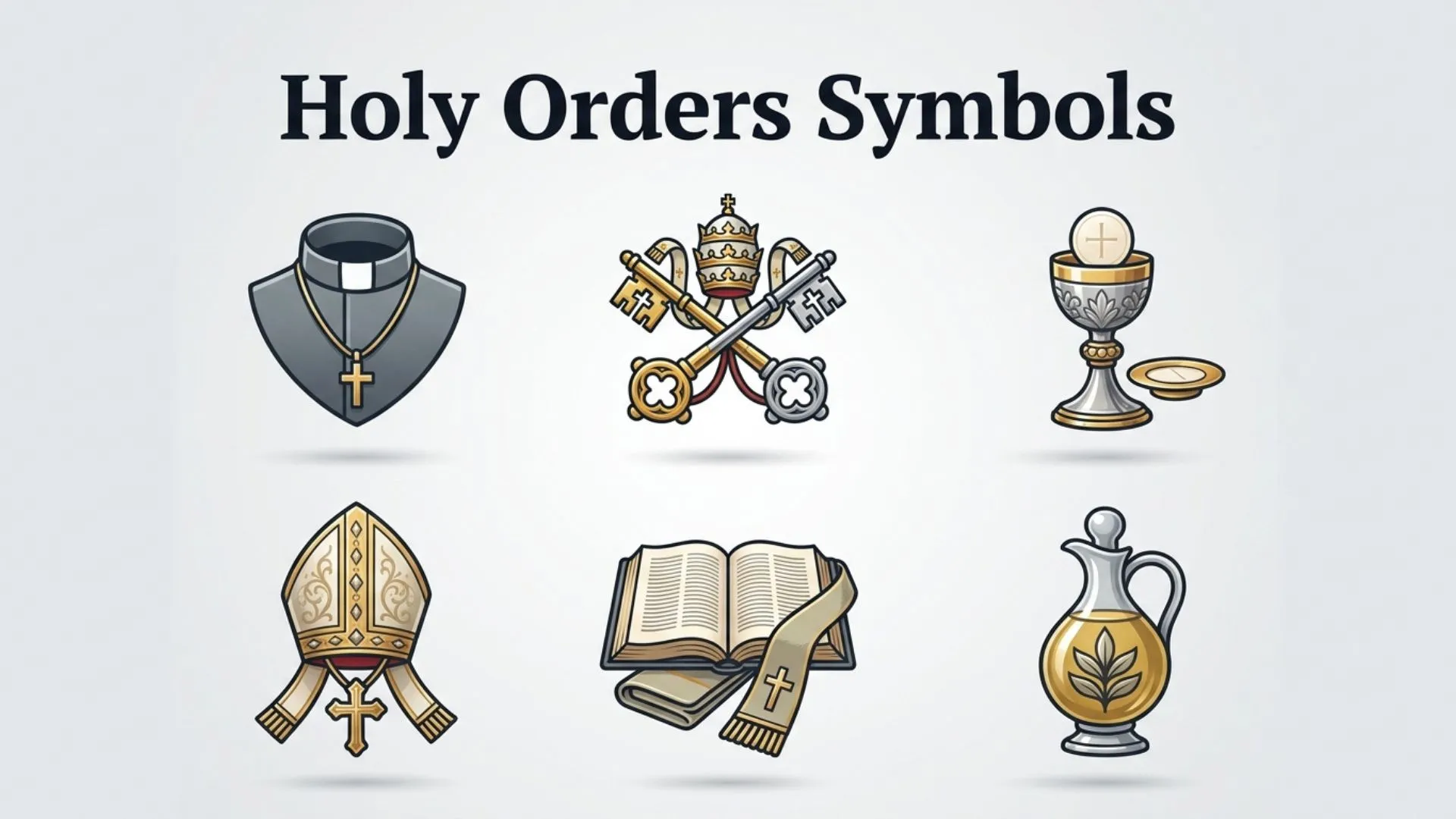
The Sacrament of Holy Orders is one of the seven sacraments in many Christian traditions, particularly within the Catholic, Orthodox, and some Anglican churches. Through Holy Orders, men are ordained to serve the Church as deacons, priests, or bishops. Like every sacrament, Holy Orders is rich in symbolism, with sacred objects, liturgical gestures, and religious icons expressing its spiritual meaning.
Understanding Holy Orders symbols provides valuable insight into Christian worship, the responsibilities of ordained ministers, and the traditions that have shaped the Church for centuries. These symbols are more than decorative elements; they are visual representations of authority, service, sacrifice, and God’s calling.
This comprehensive guide explores the meaning, history, symbolism, and practical significance of Holy Orders symbols, helping readers understand why these sacred signs remain central to Christian faith and ministry.
Holy Orders Symbols (Meaning and Overview)
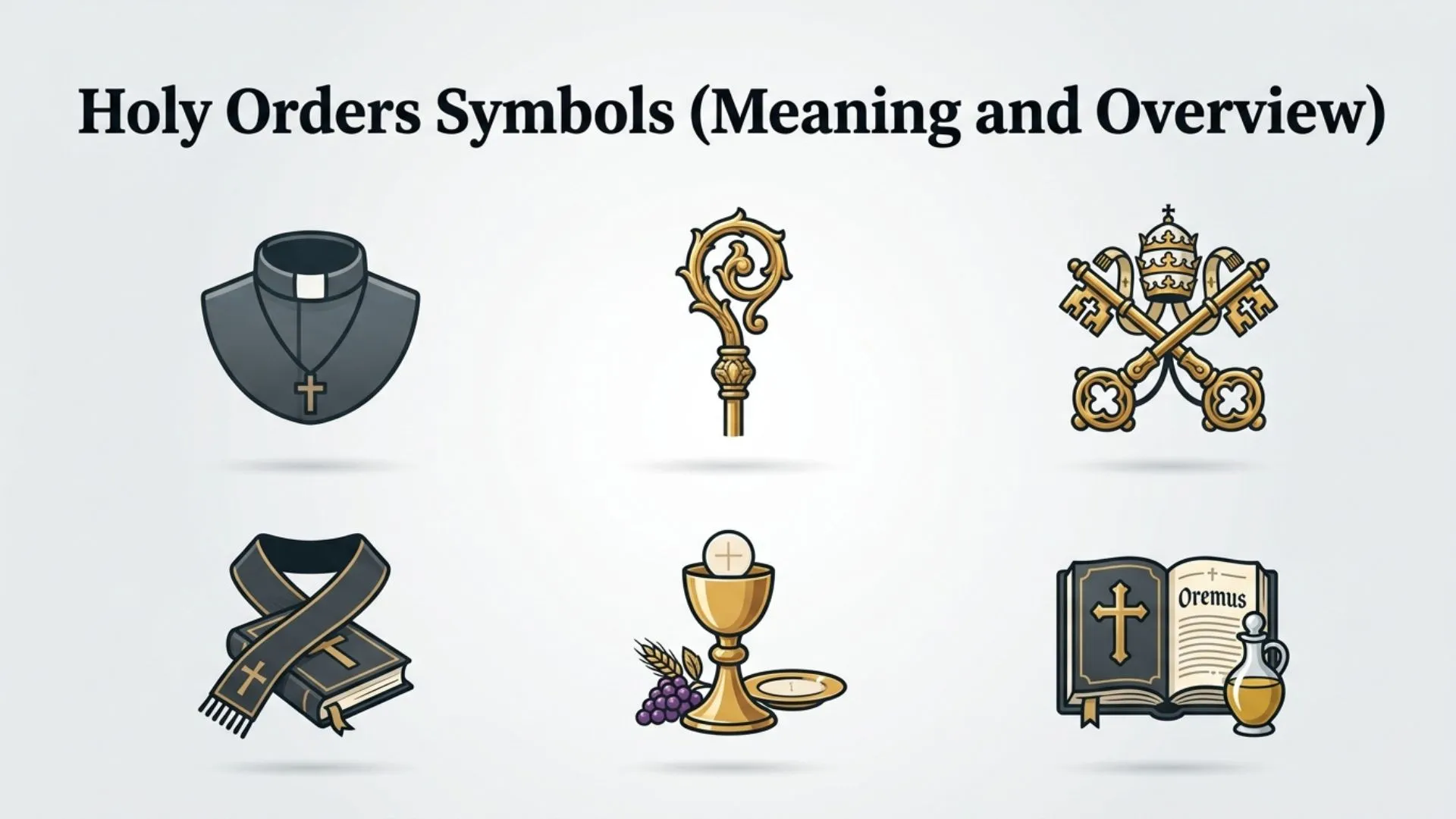
Holy Orders symbols are sacred signs, liturgical objects, ceremonial gestures, and religious icons associated with the ordination of bishops, priests, and deacons. They communicate the spiritual authority and responsibilities given to ordained ministers through the sacrament.
Each symbol has a distinct purpose. Some represent leadership, while others symbolize service, preaching, prayer, or the administration of the sacraments. Together, these symbols remind both clergy and the faithful of the mission entrusted to ordained ministers.
Unlike ordinary decorative symbols, Holy Orders symbols carry profound theological and historical significance. They are commonly seen during ordination ceremonies, church services, liturgical celebrations, religious artwork, and Christian education.
History and Origin
The origins of Holy Orders trace back to the ministry of Jesus Christ and His Apostles. According to Christian tradition, Jesus appointed the Twelve Apostles to preach the Gospel, celebrate the Eucharist, and shepherd the faithful. After Christ’s resurrection, the Apostles continued this mission by ordaining successors through the laying on of hands.
This practice became known as apostolic succession, a foundational belief in many Christian churches. Over the centuries, the ordination ceremony developed into a formal sacrament accompanied by sacred symbols and liturgical rites.
Many Holy Orders symbols have biblical origins, while others developed through centuries of Church tradition. Their historical symbolism reflects the growth of Christianity and the Church’s understanding of ordained ministry.
Types of Holy Orders Symbols
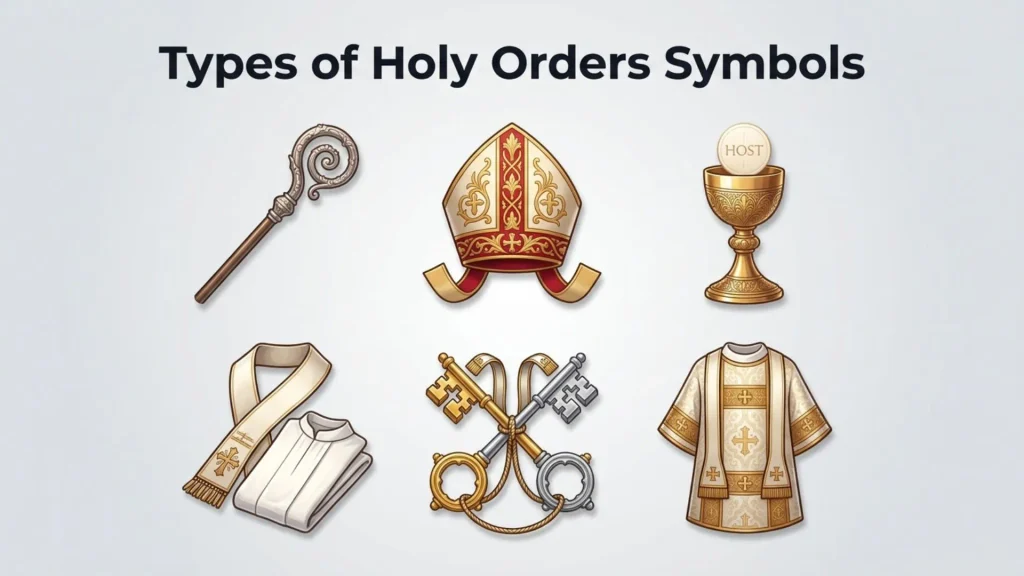
Liturgical Symbols
These are sacred objects used during worship and ordination.
Examples include:
- Chalice
- Paten
- Book of the Gospels
- Crosier
- Mitre
- Stole
These items visually represent the minister’s responsibilities.
Ceremonial Symbols
Ceremonial symbols are used specifically during ordination.
Examples include:
- Laying on of hands
- Anointing with holy oil
- Prayer of consecration
- Investiture with vestments
These sacred actions communicate spiritual authority.
Office Symbols
Certain symbols identify the rank within Holy Orders.
Examples include:
- Bishop’s ring
- Episcopal cross
- Crozier
- Mitre
- Pectoral cross
Each item reflects a different aspect of church leadership.
The Laying on of Hands
The laying on of hands is perhaps the most important Holy Orders symbol.
Symbol Meaning
During ordination, bishops place their hands on the candidate’s head while praying for the Holy Spirit.
This sacred gesture symbolizes:
- Apostolic succession
- Spiritual authority
- Blessing
- Divine calling
- Commission for ministry
The practice dates directly to the New Testament and remains central to Christian ordination today.
Holy Chrism Oil
Holy Chrism is specially blessed oil used during several sacraments, including Holy Orders.
Symbolic Significance
The anointing of hands or head symbolizes:
- Consecration
- Holiness
- Strength through the Holy Spirit
- Spiritual service
- Dedication to God
The fragrant oil also represents the spread of Christ’s presence through ministry.
The Stole
The stole is one of the most recognizable symbols of ordained ministry.
It is a long strip of fabric worn around the neck.
Meaning
The stole symbolizes:
- Priestly authority
- Service
- Responsibility
- Obedience
- Christ’s yoke
Different colors correspond with the Church’s liturgical seasons.
The Chalice
The chalice holds the consecrated wine during the Eucharist.
For priests, it represents one of their primary responsibilities: celebrating the Mass.
Symbolism
The chalice symbolizes:
- Christ’s sacrifice
- The Last Supper
- Salvation
- Eucharistic ministry
- Communion
It remains one of Christianity’s most sacred liturgical objects.
The Paten
The paten is the small plate used to hold the Eucharistic bread.
Although simple in appearance, it carries deep symbolic meaning.
It represents:
- The Body of Christ
- Nourishment
- Sacred worship
- Eucharistic celebration
During priestly ordination, the presentation of the chalice and paten symbolizes the candidate’s future ministry.
The Book of the Gospels
The Book of the Gospels represents God’s Word and the mission to proclaim it faithfully.
Deacons often carry the Gospel Book during Mass, while bishops place it over the head of a bishop-elect during episcopal ordination in some Christian traditions.
Symbol Meaning
The Gospel Book symbolizes:
- Truth
- Teaching
- Evangelization
- Divine wisdom
- Christ’s message
The Crosier
The crosier resembles a shepherd’s staff.
It is carried by bishops as a visible sign of their pastoral responsibility.
Symbolic Representation
The crosier represents:
- Shepherding God’s people
- Spiritual guidance
- Protection
- Leadership
- Care for the faithful
Its design reflects Jesus as the Good Shepherd.
The Mitre
The mitre is the ceremonial headdress worn by bishops.
Its distinctive shape has become an internationally recognized icon of episcopal office.
Meaning
The mitre symbolizes:
- Spiritual authority
- Holiness
- Wisdom
- Teaching ministry
- Episcopal leadership
The mitre is typically worn during liturgical celebrations.
The Bishop’s Ring
The bishop’s ring symbolizes the bishop’s spiritual marriage to the Church.
It also represents:
- Faithfulness
- Commitment
- Unity
- Apostolic authority
Traditionally, Catholics kiss the bishop’s ring as a sign of respect for his office rather than the individual.
The Pectoral Cross
A pectoral cross is worn over the chest by bishops and some other clergy.
Its symbolism includes:
- Faith in Christ
- Sacrifice
- Leadership
- Personal devotion
The cross reminds ordained ministers to imitate Christ in every aspect of their ministry.
Liturgical Vestments
Vestments worn during worship are themselves powerful communication symbols.
Important vestments include:
- Alb
- Chasuble
- Dalmatic
- Stole
- Cope
Each garment reflects different ministries and liturgical functions.
Common Uses and Applications
Holy Orders symbols are regularly used in:
- Ordination ceremonies
- Sunday worship
- Feast day celebrations
- Cathedral services
- Seminary education
- Religious artwork
- Church architecture
- Christian textbooks
- Liturgical processions
- Sacred music events
Many churches also include these visual representations in stained-glass windows, sculptures, paintings, and educational displays.
Digital illustrations and educational graphics increasingly feature these symbols to teach students about Christian ministry.
Symbolism, Significance, and Importance
Holy Orders symbols communicate essential Christian beliefs about ministry and service.
Together, they represent:
- Apostolic succession
- Faithfulness
- Leadership
- Sacrifice
- Humility
- Service
- Teaching
- Worship
- Evangelization
- Unity with Christ
Rather than serving merely as decorative symbols, these sacred signs remind ordained ministers of their lifelong commitment to serving God and the Church.
For believers, they strengthen understanding of the sacrament and its role within Christian life.
How to Understand and Respect Holy Orders Symbols
When learning about Holy Orders symbols, it is helpful to approach them with historical and theological context.
Learn Their Biblical Foundations
Many symbols originate in Scripture and early Christian worship.
Understand Their Liturgical Purpose
Each object serves a practical role while expressing spiritual truths.
Distinguish Between Clergy Offices
Some symbols belong specifically to bishops, while others are used by priests or deacons.
Respect Sacred Use
Many Holy Orders symbols are consecrated objects intended for worship rather than decoration.
Interesting Facts
Apostolic Succession Is Central to Holy Orders
Many Christian churches believe every bishop has been ordained through an unbroken line tracing back to the Apostles.
The Crosier Resembles a Shepherd’s Staff
Its design reflects Christ’s role as the Good Shepherd caring for His flock.
The Stole Has Ancient Origins
Its use developed from garments worn during the early centuries of Christianity.
Holy Chrism Is Used in Multiple Sacraments
The same sacred oil is also used during Baptism, Confirmation, and the consecration of churches.
Vestment Colors Change Throughout the Church Year
Different liturgical colors mark seasons such as Advent, Lent, Easter, and Ordinary Time.
The Mitre Became Common in the Middle Ages
Although bishops existed much earlier, the mitre gradually became a standard symbol of episcopal office.
Common Mistakes and Misconceptions
Assuming Every Cross Represents Holy Orders
Crosses symbolize Christianity generally, while specific liturgical crosses often indicate ordained ministry.
Confusing Priests and Bishops
Certain symbols, including the mitre and crosier, belong specifically to bishops.
Viewing Vestments as Decorative Clothing
Liturgical garments carry theological meaning and reflect sacred responsibilities.
Thinking Holy Orders Symbols Are Only Catholic
Many Orthodox and Anglican traditions also use similar symbols, although styles and ceremonies may differ.
Believing Every Symbol Has Biblical Origins
Some symbols developed through centuries of Church tradition rather than direct biblical instruction.
Frequently Asked Questions
What is the main symbol of Holy Orders?
The laying on of hands is widely regarded as the primary symbol because it signifies the transmission of spiritual authority through apostolic succession.
Why is the stole important in Holy Orders?
The stole represents ordained ministry, service, and the authority to celebrate the sacraments.
What does the bishop’s crosier symbolize?
The crosier symbolizes the bishop’s role as a shepherd guiding and caring for the faithful.
Why is Holy Chrism used during ordination?
Holy Chrism symbolizes consecration, the gift of the Holy Spirit, and dedication to God’s service.
What is the purpose of the chalice in Holy Orders?
The chalice represents the priest’s responsibility to celebrate the Eucharist and share Christ’s sacrifice with the faithful.
Are Holy Orders symbols the same in every Christian denomination?
No. While many churches share common traditions, the symbols, vestments, and ceremonies may vary among Catholic, Orthodox, Anglican, and other Christian communities.
Why do bishops wear a ring?
The bishop’s ring symbolizes his faithfulness, spiritual authority, and commitment to serving the Church.
Conclusion
Holy Orders symbols provide a rich visual language that expresses the sacred responsibilities of ordained ministry within the Christian Church. From the laying on of hands and Holy Chrism to the stole, chalice, crosier, mitre, and Gospel Book, each symbol reflects centuries of biblical tradition, theological meaning, and ecclesiastical heritage.
Understanding these sacred signs deepens appreciation for the Sacrament of Holy Orders and the lifelong vocation of bishops, priests, and deacons. Whether encountered during worship, religious education, or historical study, Holy Orders symbols continue to communicate enduring messages of faith, service, leadership, and devotion that remain central to Christian life.

Daniel Carter is a writer and researcher focused on symbols, their meanings, origins, and practical uses. He enjoys turning complex symbolic concepts into simple, easy-to-understand explanations for everyday readers. Through his work, Daniel explores cultural, technical, historical, and commonly used symbols, helping readers understand what they mean and where they are used.
His work includes The Complete Guide to Symbols, Understanding Symbols and Their Meanings, and A Visual Guide to Common Symbols.