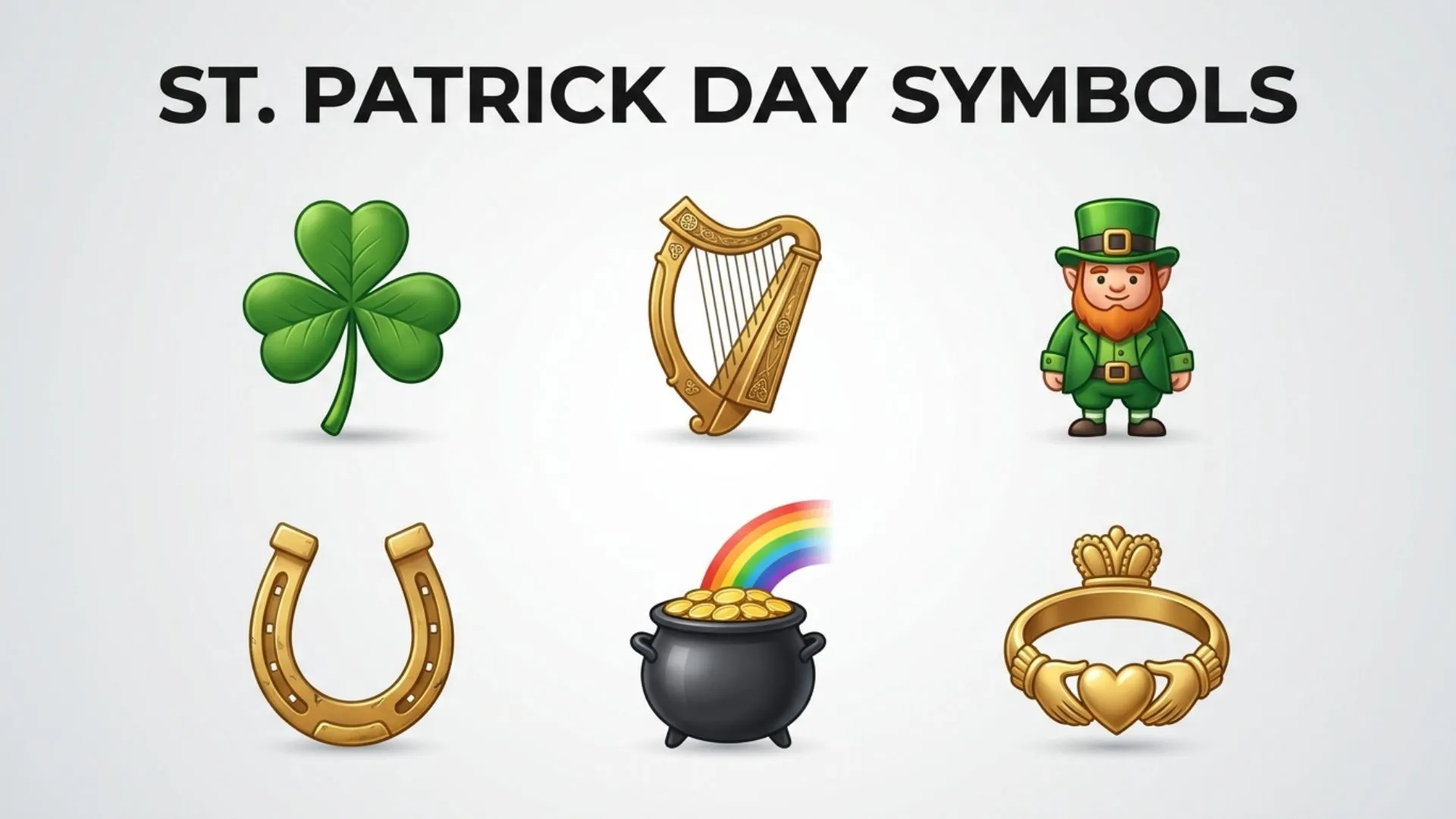
St. Patrick’s Day is one of the world’s most celebrated cultural holidays, observed every year on March 17. While many people associate it with wearing green, lively parades, and festive gatherings, the holiday is also rich in meaningful symbols that reflect Ireland’s history, Christian heritage, and cultural identity.
From the lucky shamrock to the cheerful leprechaun, each St. Patrick Day symbol carries a unique story. Some symbols have deep historical symbolism rooted in ancient Celtic traditions, while others have become modern icons through folklore and popular culture. Understanding these symbols helps you appreciate the holiday beyond the celebrations.
In this guide, you’ll discover the meanings, origins, and symbolic significance of the most popular St. Patrick Day symbols, along with their cultural meaning, modern usage, and fascinating history.
Meaning and Overview of St. Patrick Day Symbols
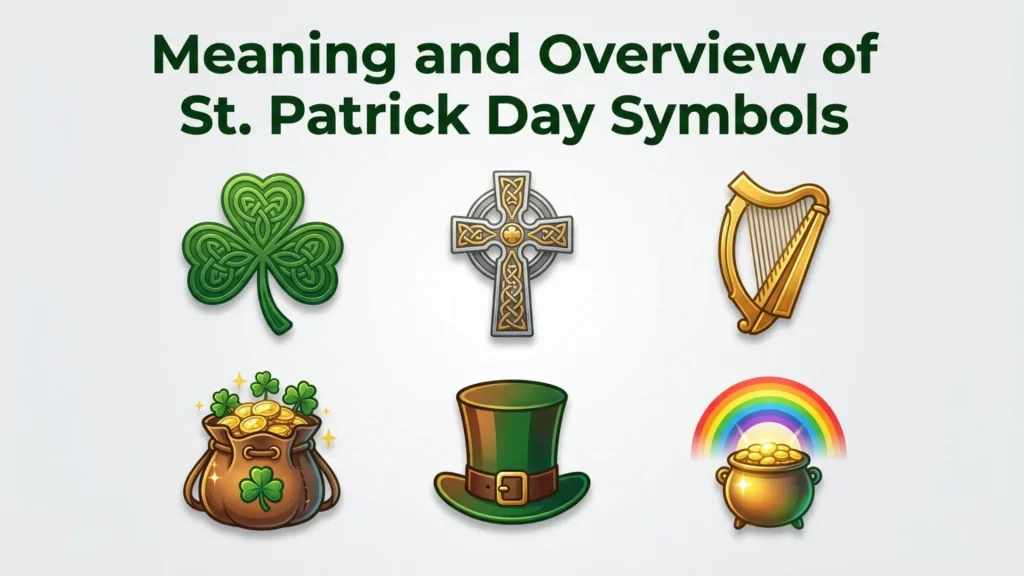
St. Patrick Day symbols are visual representations associated with Ireland, Saint Patrick, Irish traditions, Christianity, Celtic heritage, and good fortune. They serve as communication symbols that instantly connect people to Irish culture and the celebration of March 17.
These symbols appear in decorations, greeting cards, clothing, jewelry, typography designs, digital characters, educational materials, and holiday marketing. While some are historical signs dating back centuries, others evolved into decorative symbols that represent celebration rather than religion.
Popular St. Patrick Day symbols include:
- The shamrock
- Four-leaf clover
- Leprechaun
- Harp
- Celtic cross
- Irish flag
- Pot of gold
- Rainbow
- Snake symbolism
- Green color
- Celtic knot
- Claddagh ring
Each icon tells part of Ireland’s rich cultural story.
History and Origin of St. Patrick’s Day
St. Patrick’s Day honors Saint Patrick, the patron saint of Ireland. Although born in Roman Britain during the late fourth century, Patrick was captured by Irish raiders as a teenager and brought to Ireland as a slave.
After escaping, he later returned as a Christian missionary, dedicating his life to spreading Christianity throughout Ireland. According to tradition, he used the shamrock as a symbolic representation of the Holy Trinity Father, Son, and Holy Spirit.
March 17 marks the anniversary of Saint Patrick’s death. Originally observed as a religious feast day, the celebration gradually evolved into a worldwide festival celebrating Irish culture, music, food, dance, and national pride.
Over centuries, various traditional symbols became closely connected with the holiday, blending Christian teachings with ancient Celtic customs and Irish folklore.
Types of St. Patrick Day Symbols
Religious Symbols
Religious symbols emphasize Saint Patrick’s missionary work and Christian teachings.
Examples include:
- Shamrock
- Celtic cross
- Churches
- Saint Patrick himself
- Crozier (bishop’s staff)
These symbols focus on faith rather than festivities.
Cultural Symbols
These represent Irish identity and heritage.
Examples include:
- Irish harp
- Irish flag
- Celtic knot
- Claddagh ring
- Traditional Irish music instruments
They showcase Ireland’s artistic and historical legacy.
Folklore Symbols
Irish mythology contributed many legendary characters and objects.
Popular examples include:
- Leprechauns
- Pot of gold
- Rainbow
- Fairies
- Lucky charms
These symbols add fun and imagination to modern celebrations.
Nature Symbols
Nature plays a central role in Irish symbolism.
Examples include:
- Shamrocks
- Four-leaf clovers
- Green landscapes
- Oak trees
- Rivers
These natural signs represent growth, prosperity, and renewal.
The Shamrock| The Most Famous Symbol
Meaning
The shamrock is undoubtedly the best-known St. Patrick Day symbol.
Traditionally, Saint Patrick used its three leaves to explain the Christian concept of the Holy Trinity.
Each leaf represents:
- Father
- Son
- Holy Spirit
Together, they form one plant, illustrating unity.
Symbolic Significance
Beyond religion, the shamrock symbolizes:
- Irish identity
- Hope
- Faith
- Renewal
- Good fortune
- National pride
Today, it appears on souvenirs, clothing, logos, decorations, and greeting cards around the world.
Four-Leaf Clover
Many people confuse the shamrock with the four-leaf clover, but they are different.
The traditional shamrock has three leaves.
A four-leaf clover is a rare natural variation believed to bring extraordinary luck.
According to folklore, each leaf represents:
- Faith
- Hope
- Love
- Luck
Although not an official St. Patrick’s Day icon, it has become strongly associated with the holiday because of its connection to Irish folklore.
Leprechauns
Leprechauns are legendary fairy shoemakers from Irish mythology.
According to folklore, they hide pots of gold at the end of rainbows and spend their time repairing fairy shoes.
Characteristics
Leprechauns are often shown wearing:
- Green coats
- Buckled shoes
- Tall hats
- Red or orange beards
- Mischievous smiles
Although largely fictional, they have become one of the most recognizable visual representations of St. Patrick’s Day celebrations.
Pot of Gold and Rainbow
The pot of gold is another famous Irish folklore symbol.
Legend says that leprechauns hide their treasure where a rainbow touches the earth—a place impossible to reach.
Together, the rainbow and pot of gold symbolize:
- Hope
- Dreams
- Fortune
- Opportunity
- Adventure
These decorative symbols are especially popular in children’s activities and holiday decorations.
The Irish Harp
The harp is Ireland’s official national symbol.
Unlike many countries that use animals, Ireland has long used the harp as its official emblem.
Historical Importance
The harp has represented Irish culture since medieval times.
It symbolizes:
- Music
- Poetry
- Heritage
- National identity
- Artistic excellence
Today, it appears on Irish government documents, coins, passports, and official seals.
Celtic Cross
The Celtic cross combines the traditional Christian cross with a circular ring.
The ring is believed to represent:
- Eternity
- God’s endless love
- The sun
- Unity
Its exact historical origin is debated, but it remains one of Ireland’s most respected religious symbols.
Many churches, cemeteries, and monuments throughout Ireland feature beautifully carved Celtic crosses.
Celtic Knot
The Celtic knot consists of endless interwoven lines with no beginning or end.
Its continuous design symbolizes:
- Eternal life
- Unity
- Love
- Spiritual growth
- Connection
The knot remains popular in jewelry, tattoos, artwork, and decorative designs during St. Patrick’s Day.
The Color Green
Green wasn’t always associated with Saint Patrick.
Historically, blue was linked to the saint. Over time, green became dominant because of:
- Ireland’s lush countryside
- The shamrock
- Irish nationalism
- Celtic traditions
Today, wearing green has become one of the holiday’s most recognized traditions.
Many landmarks worldwide are illuminated in green every March 17 to honor Irish culture.
Irish Flag
The Irish flag contains three vertical colors:
- Green
- White
- Orange
Each color carries symbolic meaning.
Green represents Irish Catholics and Gaelic traditions.
Orange represents Protestants and followers of William of Orange.
White symbolizes peace and unity between the two communities.
During St. Patrick’s Day, the flag reminds people of Ireland’s hope for harmony.
Claddagh Ring
The Claddagh ring is a traditional Irish symbol of love and friendship.
Its design includes:
- Two hands
- A heart
- A crown
Each element has symbolic significance.
Hands represent friendship.
Heart symbolizes love.
Crown stands for loyalty.
Many people exchange Claddagh rings during engagements, weddings, and family celebrations.
Snake Symbolism
A famous legend claims Saint Patrick drove all snakes out of Ireland.
Scientists agree that snakes likely never lived in post-Ice Age Ireland.
Instead, historians believe the snakes were a symbolic representation of pagan beliefs that declined as Christianity spread across the island.
This story highlights how symbolism can communicate historical and spiritual transformation.
Common Uses and Applications of St. Patrick Day Symbols
Today, St. Patrick Day symbols appear across many settings.
Common uses include:
- Holiday decorations
- Greeting cards
- Educational materials
- Social media graphics
- Event branding
- Party supplies
- Clothing and accessories
- Digital stickers and emoji combinations
- Typography-inspired decorative designs
- Community festivals
Designers often combine these icons into festive visual representations that instantly communicate Irish celebration.
Symbolism and Cultural Importance
Each St. Patrick Day symbol represents more than decoration.
Collectively, they celebrate:
- Irish history
- Faith
- National identity
- Family traditions
- Cultural pride
- Good fortune
- Community
- Hope
These symbols also preserve stories that have been passed from generation to generation through folklore and history.
Their enduring popularity demonstrates how visual communication symbols can unite people across cultures.
How to Use St. Patrick Day Symbols Respectfully
Using these symbols thoughtfully helps honor their cultural meaning.
Here are some practical tips:
- Learn the historical background before using religious symbols.
- Distinguish between shamrocks and four-leaf clovers.
- Respect Irish traditions instead of relying only on stereotypes.
- Use authentic Celtic designs when creating artwork.
- Teach children the stories behind each symbol.
- Incorporate symbols into educational projects about Irish history.
Understanding the traditional meaning behind each icon adds depth to holiday celebrations.
Interesting Facts About St. Patrick Day Symbols
Saint Patrick Wasn’t Irish
He was born in Roman Britain before becoming Ireland’s patron saint.
The Shamrock Has Three Leaves
Many people mistakenly call a four-leaf clover a shamrock.
Ireland’s National Symbol Is the Harp
It is one of the few countries represented by a musical instrument.
Green Became Popular Later
Blue was originally linked with Saint Patrick before green became the dominant holiday color.
No Native Snakes
Ireland has no native snake population, making the famous legend symbolic rather than literal.
Leprechauns Come from Ancient Folklore
These mythical figures existed long before modern St. Patrick’s Day celebrations.
Common Mistakes and Misconceptions
Shamrock and Four-Leaf Clover Are the Same
They are different plants with different symbolic meanings.
Leprechauns Are Historical Figures
They belong to Irish folklore rather than recorded history.
St. Patrick Invented Every Irish Symbol
Many symbols existed centuries before Saint Patrick.
Every Green Symbol Is Irish
Green is widely associated with Ireland, but not every green decorative symbol has Irish origins.
The Holiday Is Only About Parties
St. Patrick’s Day began as a Christian feast day honoring Ireland’s patron saint.
Frequently Asked Questions
What is the most important St. Patrick Day symbol?
The shamrock is considered the most important symbol because Saint Patrick reportedly used it to explain the Holy Trinity.
Why do people wear green on St. Patrick’s Day?
Green represents Ireland’s landscape, the shamrock, Irish identity, and centuries of cultural tradition.
Is the four-leaf clover the official St. Patrick’s Day symbol?
No. The shamrock is the traditional symbol. The four-leaf clover is associated with luck rather than Saint Patrick.
What does the Celtic knot symbolize?
The Celtic knot symbolizes eternity, unity, interconnectedness, and the endless cycle of life.
Why is the harp important to Ireland?
The harp is Ireland’s official national emblem and represents music, culture, history, and artistic heritage.
What does the Claddagh ring represent?
The Claddagh ring symbolizes love, loyalty, and friendship through its heart, crown, and hands.
Are leprechauns part of Irish history?
No. Leprechauns are mythical characters from Irish folklore and legends.
Conclusion
St. Patrick Day symbols represent far more than festive decorations. They tell stories of faith, history, mythology, culture, and national identity that have shaped Ireland for centuries. Whether it’s the humble shamrock symbolizing the Holy Trinity, the elegant harp representing Irish heritage, or the playful leprechaun reflecting ancient folklore, each symbol carries lasting cultural and historical significance.
Learning the meaning behind these symbols transforms St. Patrick’s Day from a simple celebration into an appreciation of Ireland’s remarkable traditions. By understanding their origins, symbolic representation, and modern usage, you can celebrate the holiday with greater respect and deeper cultural awareness.

Daniel Carter is a writer and researcher focused on symbols, their meanings, origins, and practical uses. He enjoys turning complex symbolic concepts into simple, easy-to-understand explanations for everyday readers. Through his work, Daniel explores cultural, technical, historical, and commonly used symbols, helping readers understand what they mean and where they are used.
His work includes The Complete Guide to Symbols, Understanding Symbols and Their Meanings, and A Visual Guide to Common Symbols.