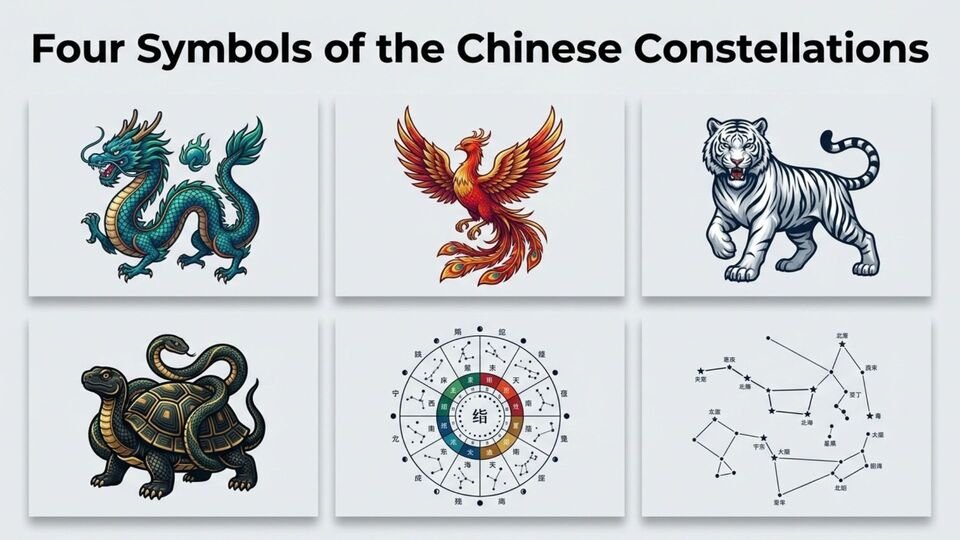
The four symbols of the Chinese constellations are among the most fascinating celestial representations in ancient Chinese astronomy. Known as the Four Symbols or Four Guardians, these legendary creatures represent the four directions of the sky and have played an important role in Chinese mythology, astrology, philosophy, and traditional culture for thousands of years.
Unlike simple decorative icons, these symbols carry deep layers of meaning. Each creature represents a specific direction, season, element, color, and cosmic energy. The four symbols of the Chinese constellations are the Azure Dragon of the East, Vermilion Bird of the South, White Tiger of the West, and Black Tortoise of the North.
These celestial figures were not only used to map the night sky but also served as a symbolic representation of balance, protection, and harmony between humans and the universe. Their influence can still be seen today in Chinese art, architecture, martial arts, literature, astrology, and modern designs.
Understanding these ancient constellation symbols provides insight into how early civilizations connected astronomy with cultural meaning and spiritual beliefs.
Meaning and Overview of the Four Symbols of the Chinese Constellations
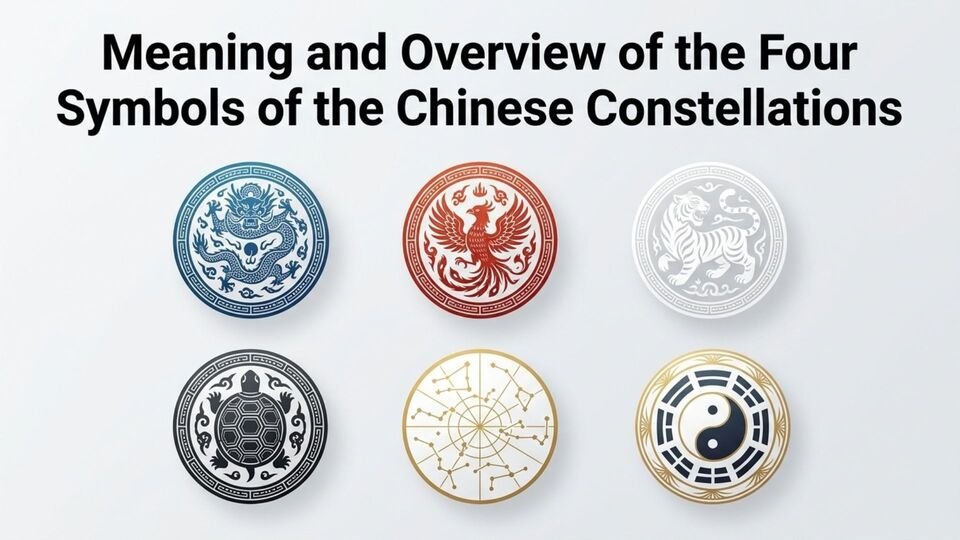
The four symbols of the Chinese constellations are four mythological creatures that divide the sky into four regions. In traditional Chinese astronomy, the heavens were separated into four celestial quadrants, each guarded by a powerful creature.
These guardians are sometimes called the Four Divine Beasts or Four Heavenly Emblems. Each one is associated with:
- A cardinal direction
- A season
- One of the five Chinese elements
- A specific color
- A particular type of energy or influence
The four symbols are:
- Azure Dragon (Qinglong) – East
- Vermilion Bird (Zhuque) – South
- White Tiger (Baihu) – West
- Black Tortoise (Xuanwu) – North
Together, they form a cosmic system that represents universal balance. They are not merely fictional creatures but powerful cultural symbols connected to ancient observations of stars and planetary movements.
History and Origin of the Four Chinese Constellation Symbols
The origins of the four symbols can be traced back thousands of years to ancient Chinese astronomy during the early development of star mapping. Chinese astronomers carefully observed the movement of celestial bodies and divided the sky into sections to better understand seasonal changes and agricultural cycles.
The concept became more organized during the Han Dynasty (206 BCE–220 CE), when these celestial guardians became closely connected with the Twenty-Eight Lunar Mansions, a system used to track the Moon’s movement through the sky.
Each guardian controlled seven lunar mansions, creating a complete celestial map. This system helped ancient astronomers identify the position of stars and predict important seasonal events.
Over time, these astronomical figures became connected with Chinese philosophy, especially ideas from Taoism, where balance between opposing forces is essential. The four symbols became a visual representation of cosmic order and harmony.
Their historical symbolism expanded beyond astronomy. They appeared on royal buildings, military banners, burial objects, paintings, and protective charms.
Azure Dragon of the East (Qinglong)
The Azure Dragon, also known as Qinglong, represents the eastern region of the sky. It is one of the most respected creatures in Chinese mythology and is often associated with power, growth, and good fortune.
Unlike the Western image of dragons as destructive creatures, the Chinese dragon is usually viewed as a positive symbol. It represents wisdom, strength, authority, and control over water and weather.
Symbolic Meaning of the Azure Dragon
The Azure Dragon is connected with:
- East direction
- Spring season
- Wood element
- Green or blue color
- Growth and renewal
Because spring represents new beginnings, the dragon became a symbol of life, transformation, and prosperity.
In traditional Chinese culture, dragons were often linked with emperors because they represented divine authority and leadership. The dragon symbol appeared on imperial clothing, architecture, and official objects.
Today, the Azure Dragon remains a popular decorative symbol in Chinese festivals, artwork, tattoos, and cultural designs.
Vermilion Bird of the South (Zhuque)
The Vermilion Bird, called Zhuque in Chinese, represents the southern sky. It is often compared to a phoenix, although it has its own unique identity within Chinese mythology.
This celestial bird symbolizes transformation, beauty, passion, and renewal. Its connection with fire gives it a strong association with energy and movement.
Symbolic Meaning of the Vermilion Bird
The Vermilion Bird represents:
- South direction
- Summer season
- Fire element
- Red color
- Energy and transformation
The bird’s association with flames reflects the idea of rebirth and continuous change. Like a phoenix rising from ashes, the Vermilion Bird represents overcoming challenges and beginning again.
In ancient Chinese art, the Vermilion Bird was often shown with elegant feathers and surrounded by flames. It appeared on temples, ceremonial objects, and protective symbols.
Modern interpretations often use this creature as a decorative symbol representing creativity, courage, and personal transformation.
White Tiger of the West (Baihu)
The White Tiger, known as Baihu, is the guardian of the western sky. In Chinese tradition, the tiger has long represented courage, strength, and military power.
The White Tiger is considered a protector who fights against harmful forces. Unlike the gentle symbolism sometimes associated with other animals, the tiger represents action, bravery, and defense.
Symbolic Meaning of the White Tiger
The White Tiger is associated with:
- West direction
- Autumn season
- Metal element
- White color
- Protection and strength
Historically, warriors and military leaders respected the tiger as a symbol of courage and victory. Its image was used on weapons, banners, and protective objects.
The White Tiger continues to appear in Chinese martial arts, architecture, and popular culture. Its visual representation often communicates power and authority.
Black Tortoise of the North (Xuanwu)
The Black Tortoise, or Xuanwu, represents the northern sky. It is unique because it combines two animals: a tortoise and a snake.
The tortoise represents stability, longevity, and wisdom, while the snake represents transformation and flexibility. Together, they create a symbol of balance between strength and adaptability.
Symbolic Meaning of the Black Tortoise
The Black Tortoise represents:
- North direction
- Winter season
- Water element
- Black color
- Protection and endurance
Because the tortoise was believed to live for a very long time, it became associated with immortality and lasting strength.
The Black Tortoise also became connected with Taoist traditions and was sometimes worshiped as a powerful protective deity.
The Relationship Between the Four Symbols and Chinese Philosophy
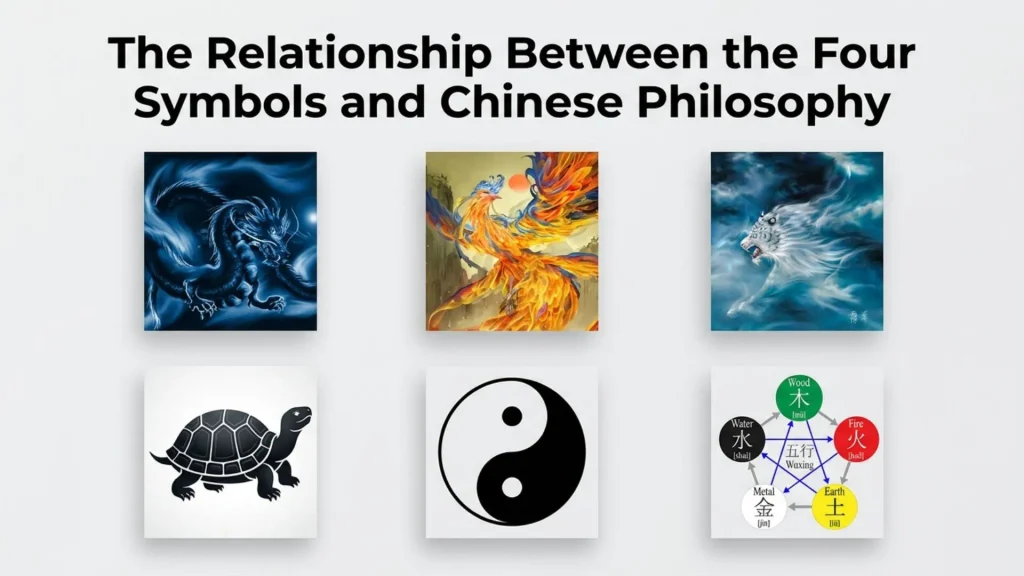
The four symbols are closely connected with traditional Chinese concepts of harmony and balance. They reflect the belief that nature operates through interconnected forces.
Each creature represents a different part of the universe, but none exists independently. Together, they create a balanced system.
The four symbols also connect with:
- Yin and Yang philosophy
- The Five Elements theory
- Seasonal cycles
- Directional energy
- Traditional Chinese cosmology
Their meaning goes beyond mythology because they demonstrate how ancient Chinese thinkers understood relationships between humans, nature, and the cosmos.
Common Uses and Applications of the Four Symbols
Throughout history, the four symbols of the Chinese constellations have appeared in many areas of life.
Architecture and Feng Shui
In traditional Chinese architecture, these symbols were used to create harmony between buildings and their surroundings. Feng Shui practices often reference the four guardians when discussing spatial arrangement and protection.
Art and Decorative Designs
Artists frequently use these creatures in paintings, sculptures, pottery, clothing, and jewelry. Their detailed designs serve as both artistic expressions and cultural symbols.
Military and Protection Symbols
The White Tiger and Black Tortoise especially appeared in military traditions because they represented defense, courage, and protection.
Modern Media and Popular Culture
Today, the four symbols appear in:
- Video games
- Movies
- Fantasy artwork
- Tattoos
- Logos
- Digital designs
Their recognizable imagery continues to inspire modern creators.
Symbolism and Importance in Modern Culture
The four symbols remain meaningful because they represent universal ideas that people still value today.
The Azure Dragon represents ambition and growth. The Vermilion Bird symbolizes renewal and creativity. The White Tiger represents courage and protection. The Black Tortoise represents wisdom and stability.
Their symbolic significance allows them to function as more than historical images. They are cultural icons that connect ancient traditions with modern identity.
Although they are not Unicode symbols in the same way as common text symbols or special characters used in digital communication, their images are frequently recreated through illustrations, emojis, artwork, and typography-inspired designs.
How to Use the Four Symbols Meaningfully
People interested in these symbols can explore them in several ways:
Cultural Learning
Studying the four guardians provides insight into Chinese history, astronomy, mythology, and philosophy.
Artistic Inspiration
Artists and designers often use these symbols because of their powerful visual representation and deep meanings.
Personal Reflection
Some people connect with specific guardians based on their symbolic qualities, such as courage, transformation, wisdom, or protection.
However, it is important to understand their traditional meanings rather than using them only as decoration without cultural awareness.
Interesting Facts About the Four Symbols
- The four symbols are connected to the ancient Chinese star system called the Twenty-Eight Lunar Mansions.
- They are thousands of years old and existed before many modern astronomical systems.
- The Azure Dragon is considered one of the most important creatures in Chinese mythology.
- The Black Tortoise is unique because it combines two animals into one celestial guardian.
- These symbols influenced Japanese, Korean, and other East Asian traditions.
- The four guardians are sometimes compared with Western zodiac traditions, although their meanings and purposes are different.
Common Mistakes and Misconceptions
Mistake 1: Thinking They Are Chinese Zodiac Animals
The four symbols are not the same as the twelve Chinese zodiac animals. The zodiac system is based on years, while the four symbols represent sections of the sky.
Mistake 2: Assuming the Dragon Has a Negative Meaning
In Chinese culture, dragons are usually positive symbols associated with wisdom, power, and good fortune.
Mistake 3: Believing They Are Only Mythical Creatures
Although they are mythological beings, they originated from real astronomical observations and star groupings.
Mistake 4: Ignoring Their Cultural Context
Using these symbols without understanding their history can reduce their deeper cultural meaning.
Frequently Asked Questions
What are the four symbols of the Chinese constellations?
The four symbols are the Azure Dragon, Vermilion Bird, White Tiger, and Black Tortoise. They represent the four directions of the sky in ancient Chinese astronomy.
What does the Azure Dragon symbolize?
The Azure Dragon symbolizes strength, growth, prosperity, and renewal. It represents the eastern direction and the spring season.
Are the four symbols part of Chinese astrology?
They are related to Chinese cosmology and astronomy but are different from the Chinese zodiac system based on twelve animals.
Why is the Black Tortoise combined with a snake?
The Black Tortoise combines a tortoise and snake because together they represent stability, transformation, and balance.
What do the four symbols represent in Feng Shui?
In Feng Shui traditions, the four symbols represent protective forces and help describe the relationship between space, direction, and natural energy.
Are the four symbols still used today?
Yes. They appear in art, entertainment, architecture, cultural celebrations, and modern designs.
Which four symbols are associated with the seasons?
The Azure Dragon represents spring, the Vermilion Bird represents summer, the White Tiger represents autumn, and the Black Tortoise represents winter.
Conclusion
The four symbols of the Chinese constellations represent one of the most meaningful connections between astronomy, mythology, and cultural philosophy. These ancient guardians transformed observations of the night sky into powerful symbols of balance, protection, and harmony.
The Azure Dragon, Vermilion Bird, White Tiger, and Black Tortoise each carry unique meanings, but together they represent the complete order of the universe. Their influence continues through traditional art, modern design, spiritual practices, and popular culture.
Learning about these symbols offers more than knowledge of ancient creatures. It provides a deeper understanding of how Chinese civilization viewed the relationship between humans, nature, and the cosmos.

Daniel Carter is a writer and researcher focused on symbols, their meanings, origins, and practical uses. He enjoys turning complex symbolic concepts into simple, easy-to-understand explanations for everyday readers. Through his work, Daniel explores cultural, technical, historical, and commonly used symbols, helping readers understand what they mean and where they are used.
His work includes The Complete Guide to Symbols, Understanding Symbols and Their Meanings, and A Visual Guide to Common Symbols.