The 5 Gospel symbols are among the most meaningful visual representations in Christian tradition. They help believers understand the message of Jesus Christ, the mission of the four Gospel writers, and the central themes of the New Testament.
While many people are familiar with the Cross or the fish symbol, fewer know about the traditional symbols connected to the four Evangelists or why these sacred icons have appeared in churches, manuscripts, stained glass windows, and religious artwork for nearly two thousand years.
These Gospel symbols are far more than decorative designs. Each one carries a rich spiritual message rooted in Scripture and Christian theology. They communicate the unique perspective of each Gospel while reminding believers of Christ’s life, ministry, sacrifice, and resurrection.
This guide explains the meanings, history, symbolism, and modern uses of the five Gospel symbols. Whether you’re studying Christianity, preparing for a Bible lesson, exploring Christian art, or simply curious about these ancient symbols, you’ll find a complete and easy-to-understand explanation here.
5 Gospel Symbols (Meaning and Overview)
The phrase 5 Gospel symbols generally refers to the four traditional symbols of the Evangelists Matthew, Mark, Luke, and John plus the Cross, which represents the Gospel message as a whole. These symbols are widely used in Christian art, architecture, liturgy, and religious education.
The four Evangelist symbols originate from the visions described in the books of Ezekiel and Revelation, where four living creatures surround God’s heavenly throne. Early Christian theologians associated each creature with one of the Gospel writers because of the themes emphasized in their writings.
Unlike a Unicode symbol, text symbol, or typography symbol used in digital communication, Gospel symbols are sacred visual representations with profound theological meaning. They communicate spiritual truths through imagery rather than written words.
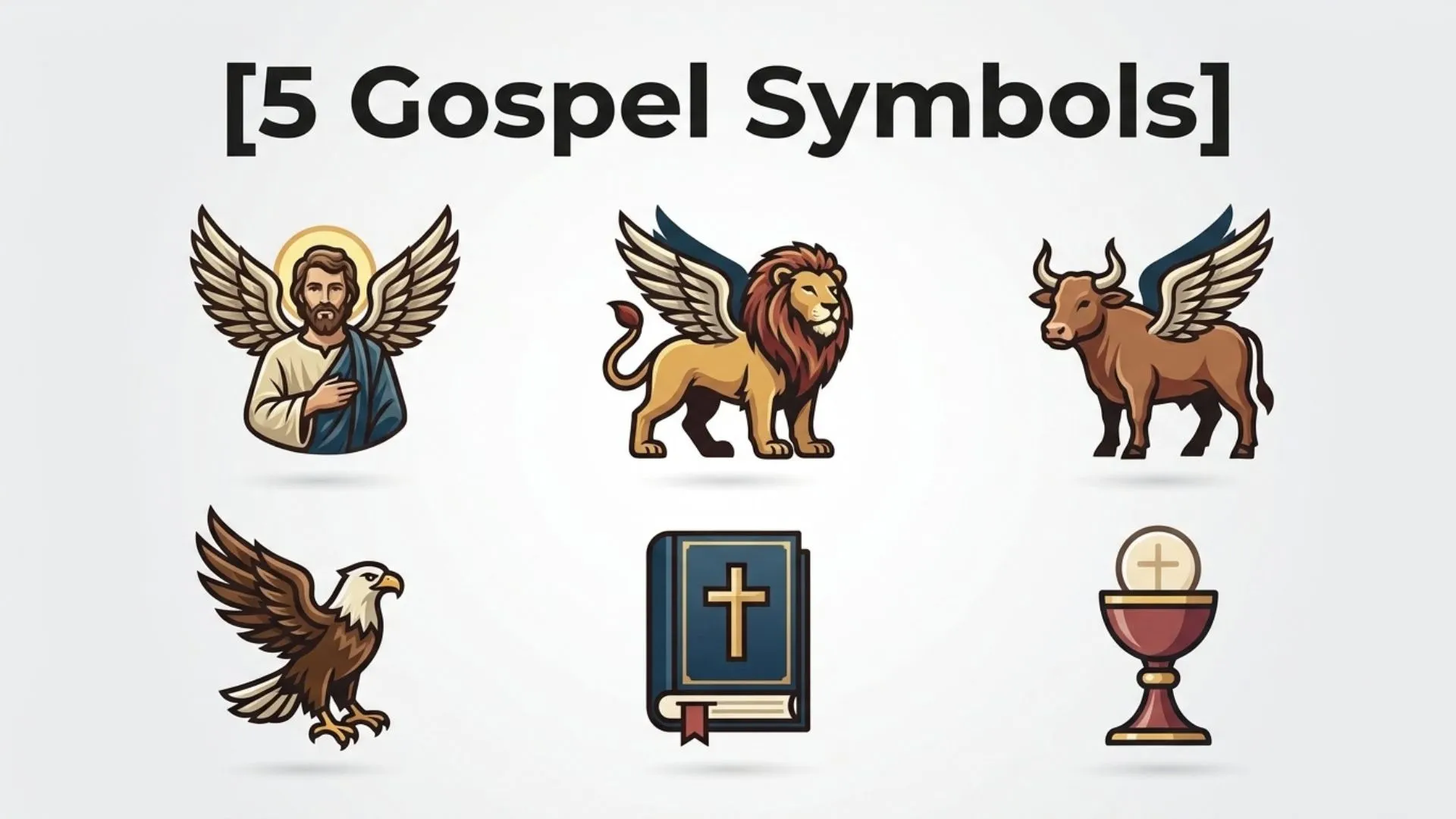
The five Gospel symbols include:
- The Angel (Matthew)
- The Lion (Mark)
- The Ox or Bull (Luke)
- The Eagle (John)
- The Cross (The Gospel of Jesus Christ)
Together, these symbols summarize the life, mission, sacrifice, divinity, and teachings of Christ.
History and Origin
The origins of the Gospel symbols date back to the early centuries of Christianity.
The prophet Ezekiel described a vision of four living creatures with the faces of a man, lion, ox, and eagle (Ezekiel 1). Later, the Book of Revelation described four heavenly creatures surrounding God’s throne (Revelation 4).
Early Christian scholars recognized symbolic connections between these creatures and the four Gospel accounts. Around the second century, church leaders such as St. Irenaeus began associating each Gospel writer with one of these creatures. By the fourth century, St. Jerome established the symbolic assignments that remain the standard today.
Throughout the Middle Ages, these symbols appeared in:
- Illuminated manuscripts
- Church mosaics
- Cathedral sculptures
- Frescoes
- Stained glass windows
- Religious carvings
The Cross, meanwhile, became Christianity’s central symbol because it represents Jesus’ crucifixion, resurrection, redemption, and victory over sin and death.
Today, all five symbols continue to appear in churches, Christian schools, Bible study materials, and religious artwork around the world.
Types, Variations, or Categories
The five Gospel symbols can be grouped into several categories.
Evangelist Symbols
These four symbols represent the individual Gospel writers:
- Angel
- Lion
- Ox
- Eagle
Each reflects the distinctive message of one Gospel.
Christ-Centered Symbol
The Cross represents the Gospel itself and the saving work of Jesus Christ.
Artistic Variations
Artists have portrayed these symbols in different styles, including:
- Medieval illustrations
- Byzantine mosaics
- Renaissance paintings
- Modern church logos
- Digital Christian artwork
Although artistic details vary, their traditional meanings remain consistent.
The Angel: Symbol of Matthew
Matthew’s Gospel begins with the genealogy and human ancestry of Jesus Christ.
Because of this emphasis on Christ’s humanity, Matthew is represented by the Angel (sometimes shown as a winged man).
Symbol Meaning
The Angel represents:
- Humanity
- Incarnation
- Hope
- Divine message
- Fulfillment of prophecy
Its symbolic significance reminds believers that Jesus became fully human while remaining fully divine.
In Christian art, the angel often appears holding a scroll or Gospel book, emphasizing Matthew’s focus on prophecy and teaching.
The Lion: Symbol of Mark
Mark’s Gospel opens with John the Baptist calling people to repentance in the wilderness.
His powerful voice was compared to the roar of a lion.
Symbol Meaning
The Lion represents:
- Courage
- Royal authority
- Resurrection
- Strength
- Leadership
The lion also symbolizes Christ as the “Lion of Judah.”
Many early Christians believed lion cubs were born lifeless and awakened after three days by their father’s roar. Although this belief is not biologically accurate, it became a symbolic representation of Christ’s resurrection.
The Ox (Bull): Symbol of Luke
Luke begins his Gospel with the priest Zechariah offering sacrifices in the Temple.
For this reason, Luke is symbolized by the Ox or Bull, an animal commonly used in ancient sacrifices.
Symbol Meaning
The Ox represents:
- Service
- Sacrifice
- Strength
- Compassion
- Faithfulness
Luke’s Gospel particularly emphasizes Christ’s mercy, healing ministry, and care for the poor and marginalized.
The ox reminds Christians that Jesus willingly offered Himself as the ultimate sacrifice for humanity.
The Eagle: Symbol of John
John’s Gospel differs from the other three by focusing deeply on Christ’s divine nature.
Because the eagle flies higher than other birds and sees farther, it became John’s traditional symbol.
Symbol Meaning
The Eagle represents:
- Divinity
- Spiritual vision
- Wisdom
- Eternal life
- Heavenly perspective
John begins with the famous words:
“In the beginning was the Word.”
This theological introduction reflects the eagle’s elevated viewpoint, looking beyond earthly events toward eternal truth.
The Cross: Symbol of the Gospel
The fifth Gospel symbol is the Cross, the universal symbol of Christianity.
Although it is not assigned to one Evangelist, it represents the heart of the Gospel message.
Symbol Meaning
The Cross symbolizes:
- Salvation
- Redemption
- Forgiveness
- Love
- Victory over death
- Hope
It serves as the central communication symbol of the Christian faith and appears more frequently than any other Christian icon.
The Cross reminds believers of Christ’s sacrificial death and His resurrection, which Christians believe offer reconciliation between God and humanity.
Common Uses and Applications
The five Gospel symbols remain widely used throughout Christianity.
Church Architecture
Many churches display the Evangelist symbols in:
- Domes
- Altars
- Pulpits
- Stained glass
- Stone carvings
These visual representations help teach biblical themes through art.
Religious Books
Bibles, hymnals, and liturgical books often feature Gospel symbols on their covers or chapter headings.
Christian Education
Sunday schools, seminaries, and Bible study groups use these symbols to help students remember the characteristics of each Gospel.
Christian Art
Artists incorporate Gospel symbols into:
- Paintings
- Sculptures
- Icons
- Murals
- Digital illustrations
They continue to inspire both traditional and contemporary religious artwork.
Church Logos
Many churches include one or more Gospel symbols in their official logos or branding to reflect their Christian identity.
Symbolism, Significance, and Importance
The five Gospel symbols communicate profound theological truths without relying on written language.
Each symbol highlights a different aspect of Christ’s identity:
- Matthew emphasizes Jesus’ humanity.
- Mark highlights His authority and power.
- Luke focuses on sacrifice and compassion.
- John reveals His divine nature.
- The Cross summarizes His saving mission.
These symbols have preserved Christian teachings across generations, especially during times when many believers could not read.
Today, they continue to strengthen faith, enrich worship, and connect Christians with centuries of church history.
How to Use Gospel Symbols Respectfully
If you use Gospel symbols in artwork, education, or personal devotion, consider these guidelines.
Learn Their Biblical Background
Understanding their scriptural origins adds deeper appreciation.
Respect Their Sacred Meaning
These symbols hold religious significance for millions of Christians around the world.
Use Them for Education
Teachers and Bible study leaders often use the symbols to explain the unique themes of each Gospel.
Appreciate Their Artistic Heritage
Many masterpieces of Christian art feature these symbols in meaningful and beautiful ways.
Interesting Facts
- The four Evangelist symbols are collectively known as the Tetramorph.
- Medieval artists often painted the symbols around images of Christ in church ceilings.
- The symbols appear in some of the world’s oldest illuminated Bible manuscripts.
- The eagle is traditionally shown holding John’s Gospel.
- The lion frequently appears with wings in Christian artwork.
- The ox symbolizes patient service and sacrificial love.
- The Cross became Christianity’s primary symbol several centuries after Christ’s resurrection.
- Many cathedrals place all four Evangelist symbols around Christ to emphasize the unity of the Gospel message.
Common Mistakes or Misconceptions
Believing the Symbols Were Invented During the Middle Ages
Their origins come from biblical visions in Ezekiel and Revelation and were recognized by early Christian theologians centuries before the medieval period.
Confusing the Evangelist Symbols
The traditional assignments are:
- Matthew — Angel
- Mark — Lion
- Luke — Ox
- John — Eagle
Thinking the Cross Represents Only Suffering
The Cross also symbolizes resurrection, hope, forgiveness, redemption, and eternal life.
Assuming Every Christian Tradition Uses the Same Artistic Style
Different churches portray these symbols differently while preserving their traditional meanings.
Treating Them as Decorative Icons Only
Each symbol communicates important biblical teachings and theological themes.
Frequently Asked Questions
What are the 5 Gospel symbols?
The five Gospel symbols are the Angel, Lion, Ox, Eagle, and Cross. The first four represent the Evangelists Matthew, Mark, Luke, and John, while the Cross represents the Gospel of Jesus Christ.
Why does Matthew have the Angel symbol?
Matthew begins with Jesus’ human genealogy, so the Angel or winged man emphasizes Christ’s humanity and incarnation.
What does the Lion symbolize in Mark’s Gospel?
The Lion represents courage, authority, kingship, and resurrection, reflecting the powerful message of Mark’s Gospel.
Why is Luke represented by an Ox?
The Ox symbolizes sacrifice, faithful service, and compassion because Luke begins with Temple worship and emphasizes Christ’s sacrificial mission.
Why is John symbolized by an Eagle?
The Eagle represents spiritual insight and Christ’s divine nature, which are central themes in John’s Gospel.
What is the Tetramorph?
The Tetramorph is the traditional name for the four living creatures—the Angel, Lion, Ox, and Eagle—that symbolize the four Evangelists.
Are Gospel symbols Unicode symbols?
No. Gospel symbols are sacred Christian visual representations rather than standardized Unicode characters or digital text symbols.
Conclusion
The five Gospel symbols have inspired Christians for nearly two thousand years through their rich biblical symbolism and timeless spiritual meaning. The Angel, Lion, Ox, Eagle, and Cross each communicate a unique aspect of Christ’s life, ministry, and message while helping believers understand the distinct perspective of each Gospel writer.
Whether encountered in cathedral windows, ancient manuscripts, church architecture, or modern Christian artwork, these symbols continue to preserve the heart of the Gospel in a powerful visual form. Learning their meanings deepens appreciation for Scripture, Christian history, and the enduring message of hope found in the life, death, and resurrection of Jesus Christ.

Ryan Mitchell is an independent writer with a strong interest in symbols, visual communication, and the meanings behind different signs and icons. His writing focuses on providing clear, accurate, and useful information that helps readers quickly understand unfamiliar symbols. Ethan covers a wide range of topics, from everyday and cultural symbols to technical and professional symbol systems.
His books include The World of Symbols, Symbols Explained Simply, and The Essential Symbol Reference Guide.