
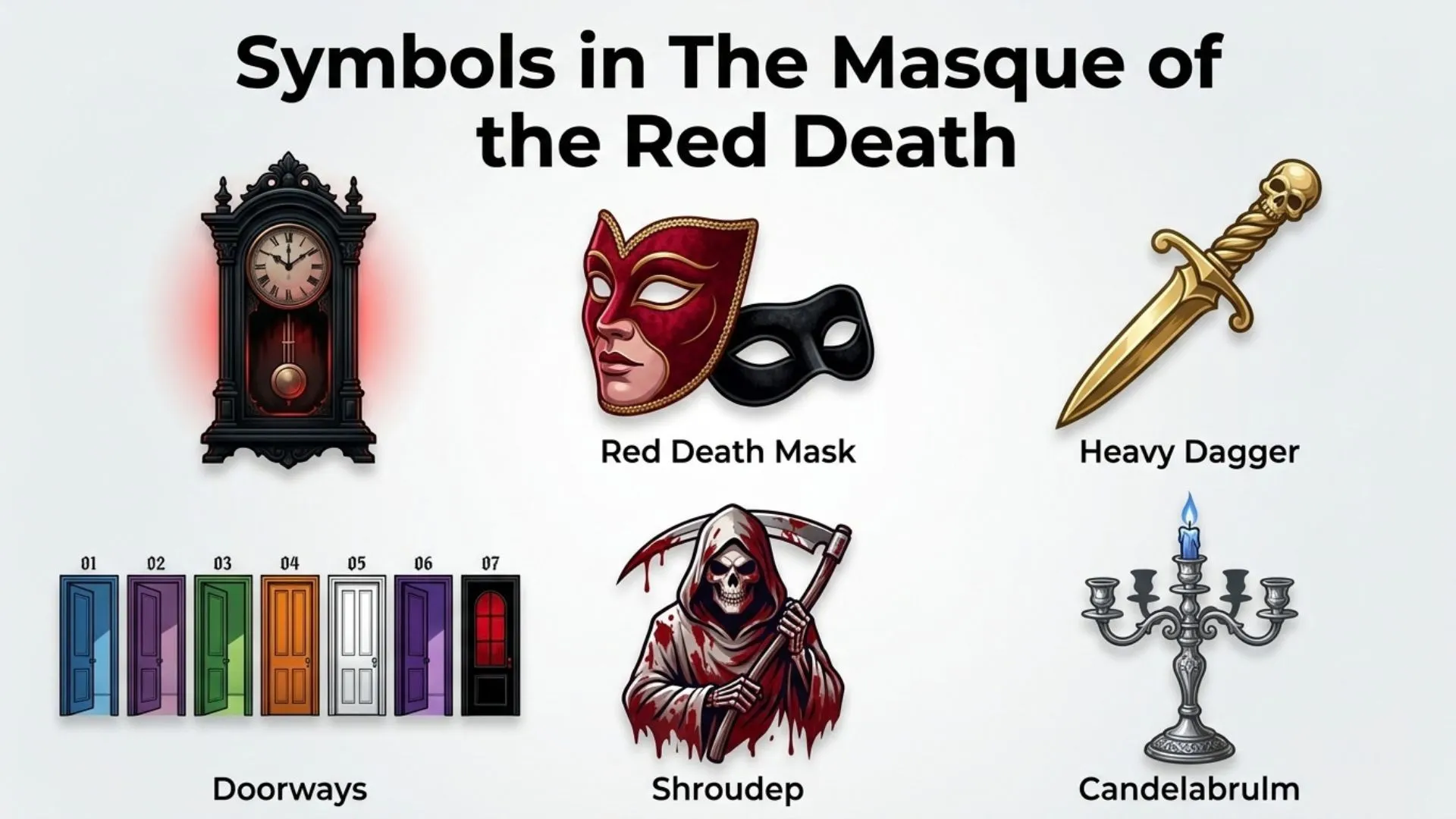
Edgar Allan Poe’s The Masque of the Red Death is one of the most symbolic short stories in American literature. Although the story is brief, it is packed with visual representation, historical symbolism, and layered meanings that continue to fascinate readers, students, and literary scholars. Every room, object, color, and character in the tale functions as more than a simple detail. These elements act as communication symbols that reveal deeper truths about mortality, fear, pride, and the inevitability of death.
Published in 1842, the story follows Prince Prospero, a wealthy nobleman who attempts to escape a devastating plague known as the Red Death. He isolates himself and his privileged guests inside a fortified abbey and hosts an extravagant masquerade ball while the outside world suffers. What begins as a celebration gradually turns into a terrifying confrontation with the very fate Prospero believed he could avoid.
Understanding the symbols in The Masque of the Red Death is essential because symbolism is the foundation of the story. Poe uses symbolic representation rather than direct explanation, allowing readers to uncover meaning through imagery and interpretation. The result is a timeless tale that explores universal human fears and raises questions that remain relevant today.
Meaning and Overview of Symbolism in The Masque of the Red Death
A symbol is an object, person, place, sign, or image that represents a deeper idea beyond its literal meaning. In literature, symbols often function as a communication device that helps authors express abstract concepts such as love, fear, death, power, or morality.
In The Masque of the Red Death, symbolism drives the narrative. Nearly every major detail serves as an icon or symbolic character that points to a broader theme. The story is not simply about a plague. It is about humanity’s inability to escape death, regardless of wealth, status, or intelligence.
The central symbols in the story include:
- The Red Death itself
- Prince Prospero
- The seven colored rooms
- The black room with the scarlet windows
- The ebony clock
- The masquerade ball
- The masked figure
- The abbey walls
Together, these symbols create a powerful system of meaning that explores mortality and the illusion of control.
History and Origin of the Story’s Symbolism
Edgar Allan Poe wrote The Masque of the Red Death during a period when disease outbreaks were common and deadly. Epidemics such as cholera, yellow fever, and tuberculosis frequently devastated communities in the nineteenth century. Poe himself experienced significant personal loss due to illness, including the deaths of several loved ones.
These experiences likely influenced the story’s historical symbolism. Death was not an abstract idea for Poe; it was a recurring reality.
The concept of the “dance of death” or danse macabre also appears to influence the narrative. This medieval artistic tradition portrayed death as an equalizer that ultimately claims kings, nobles, and common people alike. The symbolic significance of the Red Death echoes this idea perfectly.
Additionally, Gothic literature often relied on visual representation, dark imagery, and symbolic settings to explore psychological and philosophical themes. Poe mastered this technique, using decorative symbols and dramatic environments to create both horror and meaning.
Types and Categories of Symbols in the Story
The symbols in The Masque of the Red Death can be grouped into several categories.
Physical Symbols
These are tangible objects that carry deeper meaning.
Examples include:
- The ebony clock
- The colored rooms
- The abbey walls
- The masquerade costumes
Character Symbols
Some characters act as symbolic representations rather than fully developed individuals.
Examples include:
- Prince Prospero
- The masked stranger
- The party guests
Color Symbols
Colors function as powerful signs throughout the story.
Examples include:
- Blue
- Purple
- Green
- Orange
- White
- Violet
- Black and red
Spatial Symbols
Even the architecture carries symbolic significance.
Examples include:
- The sequence of rooms
- The isolated abbey
- The final chamber
Understanding these categories helps readers recognize how carefully Poe constructed the narrative.
The Red Death as the Ultimate Symbol
The Red Death is the story’s most obvious and powerful symbol.
On a literal level, it is a deadly plague that causes rapid death and horrifying symptoms. Symbolically, however, it represents the inevitability of mortality. Death is unavoidable, impartial, and beyond human control.
The disease does not discriminate based on wealth or social status. Prince Prospero believes his resources can shield him from danger, but the Red Death eventually enters the abbey despite all precautions.
This symbolic representation reflects one of the story’s core messages: no amount of power can defeat death.
The Red Death also symbolizes fear itself. People often try to ignore mortality, distract themselves, or build barriers against uncomfortable truths. Prospero’s actions mirror this universal human tendency.
Prince Prospero as a Symbol
Prince Prospero represents arrogance, denial, and misplaced confidence.
His name is significant. “Prospero” suggests prosperity and success. He possesses wealth, influence, and authority. Yet these advantages cannot protect him from mortality.
Prospero symbolizes humanity’s belief that intelligence, privilege, or technology can provide complete control over life. Instead of helping his suffering kingdom, he retreats into luxury and entertainment.
His refusal to acknowledge death ultimately becomes his downfall.
This makes Prospero a symbolic character rather than merely a fictional prince. He embodies pride and the dangerous illusion that some people are exempt from universal realities.
The Seven Colored Rooms and the Journey of Life
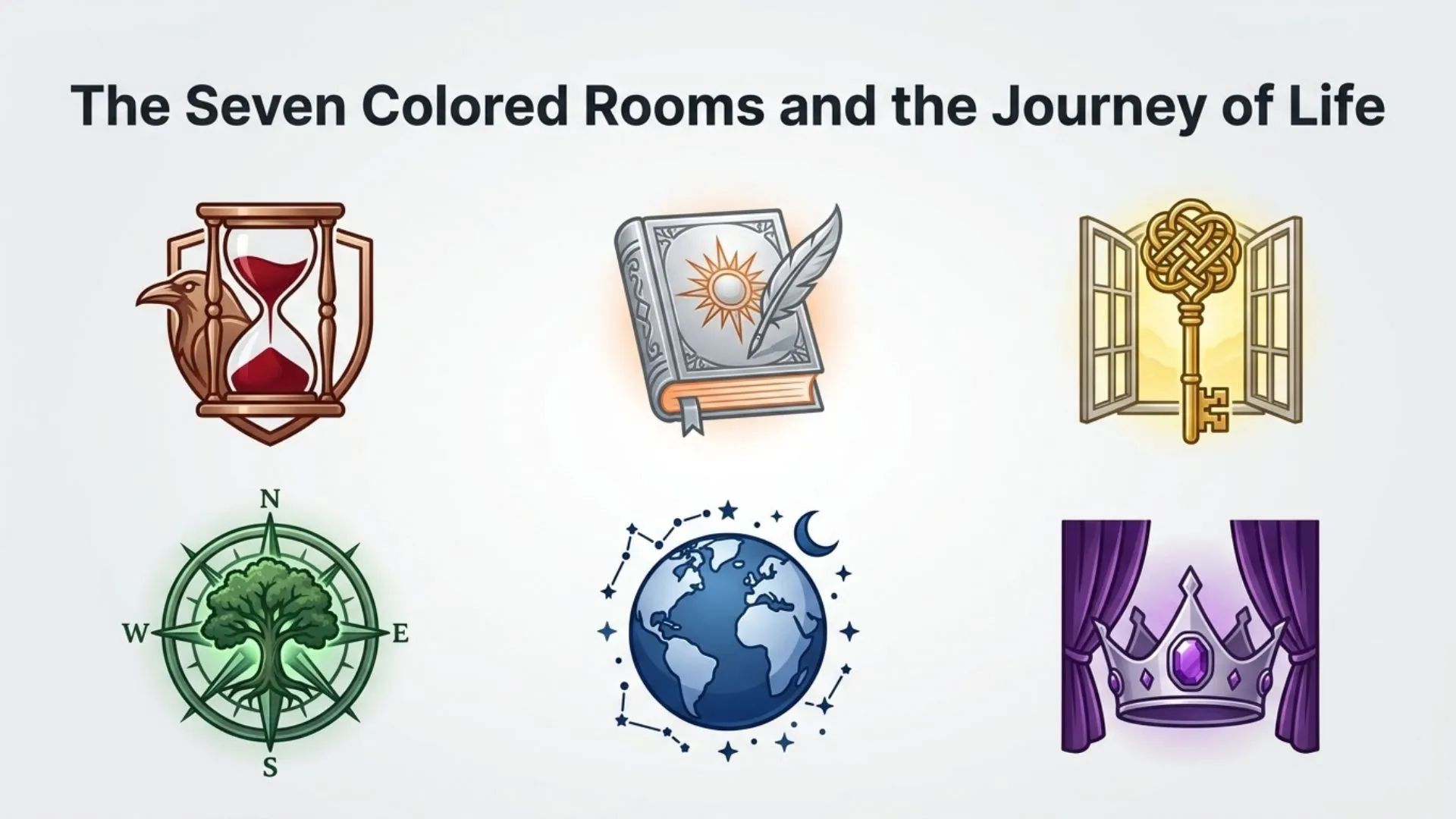
The seven rooms are among the most discussed symbols in literary analysis.
Each chamber has a distinct color:
- Blue
- Purple
- Green
- Orange
- White
- Violet
- Black with scarlet windows
Many scholars interpret the rooms as symbolic representations of the stages of human life.
Blue Room
The blue room is often associated with birth and beginnings. Blue can symbolize dawn, innocence, and early life.
Purple Room
Purple traditionally represents growth, ambition, and developing maturity.
Green Room
Green frequently symbolizes youth, vitality, and the flourishing period of life.
Orange Room
Orange may represent adulthood, energy, and the height of worldly activity.
White Room
White often symbolizes aging, wisdom, or the fading of vitality.
Violet Room
Violet can represent the later stages of life and the approach of death.
Black Room with Scarlet Windows
The final room symbolizes death itself.
The progression from east to west further reinforces this interpretation. Just as the sun rises in the east and sets in the west, human life moves toward its inevitable conclusion.
This sequence creates one of the most memorable examples of historical symbolism and visual storytelling in Gothic literature.
The Black Room and Scarlet Windows
The seventh chamber deserves special attention because it contains some of the story’s most terrifying imagery.
The room is black, while the windows are blood red. Together, these colors create a disturbing visual representation of death and suffering.
Black traditionally symbolizes darkness, endings, mourning, and the unknown. Red symbolizes blood, violence, and mortality.
Most guests avoid entering this room because they instinctively fear what it represents. Their behavior mirrors humanity’s tendency to avoid confronting death.
The room acts as both a decorative symbol and a philosophical statement. We can ignore death, but we cannot eliminate it.
The Ebony Clock as a Symbol of Time
The ebony clock is one of the story’s most effective communication symbols.
Every hour, its loud chime interrupts the festivities. The musicians stop playing, the dancers freeze, and the guests become visibly uneasy.
The clock symbolizes:
- The passage of time
- The approach of death
- Human mortality
- The inability to stop time
No matter how extravagant the celebration becomes, the clock reminds everyone that life is limited.
The clock’s symbolism remains powerful because time itself is an unstoppable force. Wealth cannot buy more of it, and denial cannot slow it.
The Masquerade Ball and Masks
The masquerade ball symbolizes illusion and escapism.
Masks allow people to hide their identities. Symbolically, they represent humanity’s attempts to conceal fear, vulnerability, and mortality.
The guests distract themselves with entertainment, costumes, and luxury. They create an artificial world where suffering appears absent.
Yet beneath every mask stands a mortal human being.
This symbolic significance remains relevant in modern society. People often use distractions, status, or material success to avoid confronting difficult realities.
The Mysterious Figure as Death Personified
The masked stranger functions as the personification of death.
Unlike the guests’ costumes, the figure does not merely imitate death. It is death.
The stranger moves through every room without resistance, emphasizing that death reaches every stage of life. When Prospero confronts the figure, he dies instantly.
This moment reinforces the story’s central message: death cannot be challenged, imprisoned, or defeated.
The figure serves as a symbolic icon of fate itself.
The Abbey Walls and False Security
Prince Prospero seals the abbey to keep danger outside.
These walls symbolize the illusion of security.
Humans frequently build physical, emotional, or social barriers to protect themselves from fear. While such defenses may provide temporary comfort, they cannot eliminate mortality.
The abbey appears safe, but its protection is ultimately meaningless.
Poe uses the fortress as a symbolic sign that isolation cannot solve existential problems.
Common Uses and Applications of Symbolism Analysis
Understanding the symbols in The Masque of the Red Death has practical applications beyond literature classes.
Students often analyze the story to:
- Explore themes of mortality.
- Understand Gothic fiction.
- Learn how symbolism functions in literature.
- Develop critical thinking skills.
- Examine historical attitudes toward disease and death.
Teachers also use the story as an example of how visual representation and symbolic meaning can communicate complex philosophical ideas without directly stating them.
Symbolism, Significance, and Importance
The symbols in The Masque of the Red Death remain important because they address universal human experiences.
Everyone faces:
- Mortality
- Fear
- Loss
- The passage of time
- The limits of power
Poe’s symbols endure because they speak to readers across cultures and generations.
The story reminds us that life is temporary and that denying this truth can lead to arrogance, selfishness, and moral failure.
How to Analyze Symbols in the Story
If you are studying the story, use this simple approach:
- Identify repeated objects or images.
- Consider their literal meaning.
- Examine emotional reactions connected to them.
- Connect the symbols to major themes.
- Look for historical or cultural meaning.
For example, the ebony clock is literally a clock, but symbolically it represents time and mortality.
This method can help readers interpret symbolism in other literary works as well.
Interesting Facts About the Symbols
- The story contains only a few pages, yet it has inspired centuries of literary criticism.
- The seven rooms may also correspond to the seven ages of humanity.
- The black and red color combination remains one of the most recognizable visual symbols in Gothic fiction.
- The story became especially relevant during modern global pandemics because of its exploration of denial and isolation.
- The masked figure is often considered one of literature’s most memorable symbolic characters.
Common Mistakes and Misconceptions
Thinking Every Symbol Has Only One Meaning
Literary symbols often have multiple valid interpretations. The rooms, for example, may symbolize both life stages and the passage of a single day.
Believing the Story Is Only About Disease
The plague is important, but the deeper message concerns mortality and human behavior.
Assuming Prospero Is the Hero
Prospero is not a traditional hero. He represents arrogance and denial.
Ignoring the Importance of Color
The color symbolism is central to understanding the story’s deeper meaning.
Viewing the Ending as Random Horror
The ending is carefully prepared through symbolism from the very beginning.
Frequently Asked Questions
What does the Red Death symbolize?
The Red Death symbolizes mortality, the inevitability of death, and humanity’s inability to escape fate.
What do the seven rooms represent in The Masque of the Red Death?
Many readers interpret the seven rooms as the stages of human life, moving from birth to death.
What is the meaning of the ebony clock?
The ebony clock symbolizes the passage of time and serves as a reminder that death approaches everyone.
Why is the final room black and red?
Black symbolizes death and darkness, while red symbolizes blood and suffering. Together they represent mortality.
Who does Prince Prospero symbolize?
Prince Prospero symbolizes pride, denial, wealth, and the mistaken belief that power can conquer death.
What does the masquerade symbolize?
The masquerade symbolizes illusion, escapism, and humanity’s attempts to hide from difficult truths.
Is the masked figure actually the Red Death?
Yes. The figure is generally understood as the personification or physical embodiment of the Red Death.
Conclusion
The symbols in The Masque of the Red Death transform a short Gothic tale into a profound exploration of human existence. The Red Death, the seven rooms, the ebony clock, Prince Prospero, and the masked stranger all function as powerful symbolic representations that reveal the story’s central truth: death is inevitable, and no amount of wealth or status can prevent it.
Poe’s mastery of symbolism is one reason the story remains relevant nearly two centuries after its publication. By using color, setting, characters, and imagery as meaningful signs, he created a work that speaks to every generation. Understanding these symbols does more than improve literary analysis; it encourages readers to reflect on life, time, and the universal realities that connect all human beings.

Ryan Mitchell is an independent writer with a strong interest in symbols, visual communication, and the meanings behind different signs and icons. His writing focuses on providing clear, accurate, and useful information that helps readers quickly understand unfamiliar symbols. Ethan covers a wide range of topics, from everyday and cultural symbols to technical and professional symbol systems.
His books include The World of Symbols, Symbols Explained Simply, and The Essential Symbol Reference Guide.