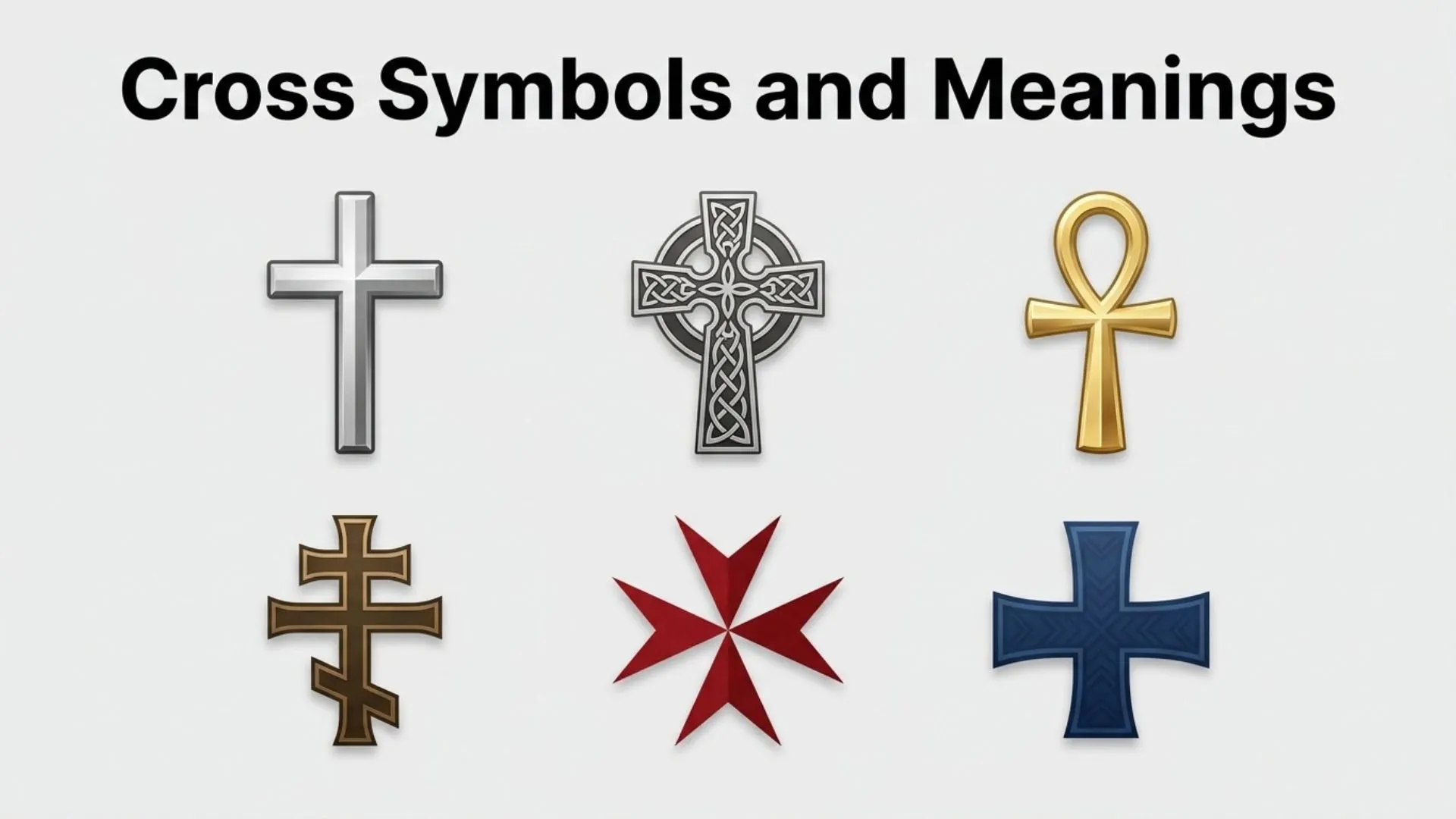
Cross symbols are among the most recognized and meaningful symbols in human history. Found in religions, cultures, art, architecture, medicine, mathematics, and everyday communication, crosses can carry many different meanings depending on their design, location, and cultural background.
For many people, the cross is strongly associated with Christianity and represents faith, sacrifice, and salvation. However, cross symbols existed long before Christianity and have been used by various civilizations as representations of balance, protection, life, direction, and spiritual beliefs.
Understanding cross symbols and meanings requires looking beyond a single interpretation. Different cross designs have unique histories, traditional meanings, and modern uses. From the Latin Cross and Celtic Cross to the Ankh and Maltese Cross, each variation tells a different story.
This guide explores the history, symbolism, types, and applications of cross symbols to help you understand their deeper significance.
Meaning and Overview of Cross Symbols
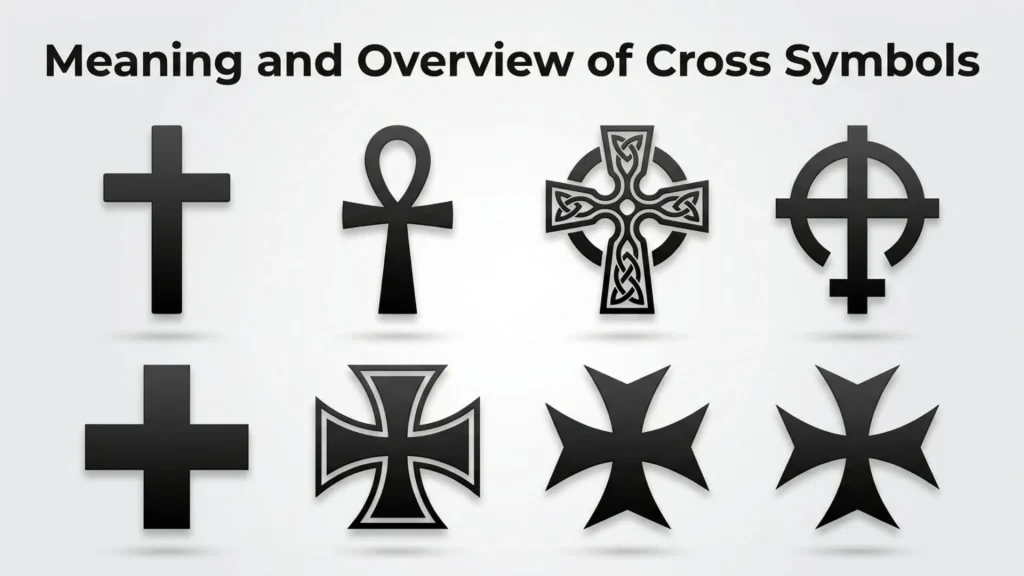
A cross symbol is a geometric design created by two intersecting lines, usually placed vertically and horizontally. While simple in appearance, this shape has developed countless interpretations throughout history.
The basic cross is often considered a symbolic representation of:
- Connection between physical and spiritual worlds
- Balance and harmony
- Direction and guidance
- Faith and devotion
- Protection
- Life and renewal
- Sacrifice and transformation
The exact symbol meaning depends on cultural background, religious beliefs, historical context, and the specific type of cross being used.
Cross symbols appear as:
- Religious icons
- Jewelry designs
- Architectural elements
- Flags and emblems
- Decorative symbols
- Tattoos
- Typography symbols
- Digital characters
History and Origin of Cross Symbols
The history of cross symbols reaches thousands of years before modern religious traditions.
Ancient civilizations used cross-shaped designs in different ways. Archaeological discoveries show cross patterns appearing in ancient Egypt, Mesopotamia, Europe, and Asia.
Early cross forms were often connected to:
- The sun
- Four directions
- Natural cycles
- Fertility
- Cosmic balance
- Protection
The Christian cross became one of the most influential symbolic forms after the crucifixion of Jesus Christ. Over time, it developed into a central religious symbol representing Christianity, redemption, and faith.
However, Christianity did not create the cross shape itself. Instead, it adopted and transformed an already existing geometric symbol into a new religious representation.
Throughout history, different cultures and organizations developed their own cross variations, each with distinct symbolism.
Types of Cross Symbols and Their Meanings
Latin Cross
The Latin Cross is the most widely recognized Christian cross symbol.
It features a longer vertical line crossed by a shorter horizontal line near the upper section.
Meaning of the Latin Cross
The Latin Cross traditionally represents:
- Jesus Christ’s crucifixion
- Sacrifice
- Salvation
- Resurrection
- Christian faith
It is commonly seen in churches, cemeteries, religious artwork, and Christian jewelry.
Greek Cross
The Greek Cross has four equal arms.
Unlike the Latin Cross, all sections are the same length.
Symbolism of the Greek Cross
It represents:
- Equality
- Balance
- Unity
- The four directions
- The four elements in some traditions
The Greek Cross has been used in early Christianity and appears in various historical symbols and national emblems.
Celtic Cross
The Celtic Cross combines a traditional cross with a circular ring around the intersection.
It is strongly associated with Celtic culture and Christianity.
Meaning of the Celtic Cross
The circle may symbolize:
- Eternity
- The sun
- The cycle of life
- Spiritual connection
The Celtic Cross is commonly found in Ireland, Scotland, and other regions influenced by Celtic traditions.
Ankh (Egyptian Cross)
The Ankh is an ancient Egyptian symbol shaped like a cross with a loop at the top.
Symbol Meaning of the Ankh
The Ankh represents:
- Life
- Immortality
- Divine energy
- Creation
Ancient Egyptian artwork often shows gods and pharaohs holding the Ankh as a symbol of eternal life.
St. Andrew’s Cross
The St. Andrew’s Cross is shaped like an “X.”
It is traditionally associated with Saint Andrew, who was believed to have been crucified on a diagonal cross.
Meaning of St. Andrew’s Cross
It represents:
- Christian devotion
- Humility
- Martyrdom
- Scottish heritage
The symbol appears on the flag of Scotland.
Maltese Cross
The Maltese Cross has four V-shaped arms that meet at the center.
It has historical connections with the Knights Hospitaller.
Symbolism of the Maltese Cross
It represents:
- Courage
- Protection
- Service
- Honor
- Sacrifice
Today, it appears in military, emergency services, and organizational symbols.
Iron Cross
The Iron Cross originated as a military decoration in Prussia and later Germany.
Meaning and Historical Context
It has represented:
- Military achievement
- Bravery
- Service
Because of its historical associations, its meaning depends heavily on context and usage.
Tau Cross
The Tau Cross resembles the letter “T.”
It is named after the Greek letter tau.
Symbolic Significance
It has been associated with:
- Protection
- Religious devotion
- Simplicity
- Spiritual commitment
The Tau Cross appears in several Christian traditions.
Cultural and Religious Cross Symbols
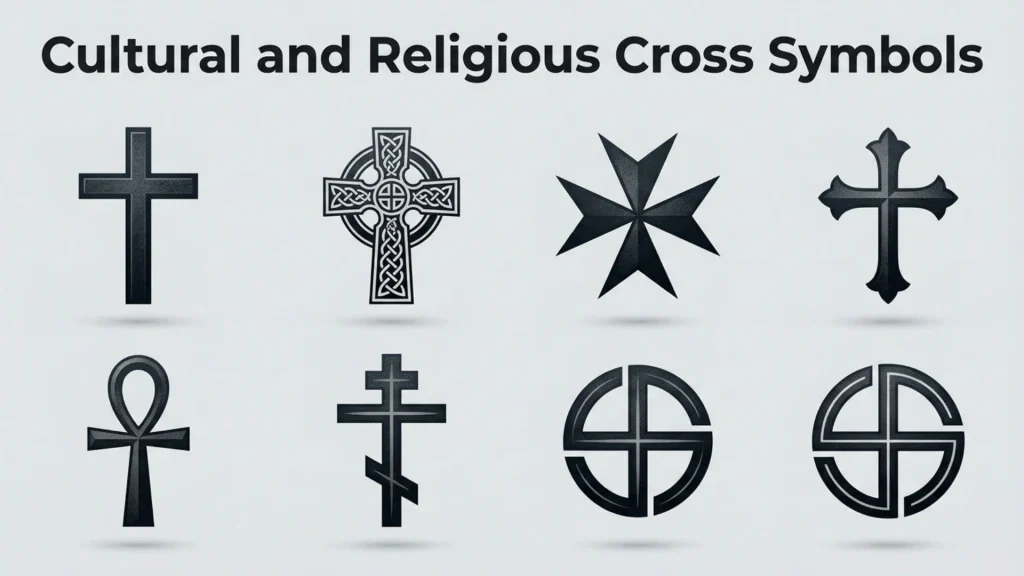
Cross designs appear in many traditions around the world.
Solar Cross
The Solar Cross is a circle divided by a cross.
It represents:
- The sun
- Seasons
- Cosmic cycles
- Natural balance
Four Directions Cross
Some Indigenous traditions use cross-like designs to represent:
- North, south, east, and west
- Connection with nature
- Spiritual balance
Nordic Cross
The Nordic Cross is commonly found on Scandinavian flags.
Examples include:
- Denmark
- Sweden
- Norway
- Finland
- Iceland
It represents national identity and cultural heritage.
Cross Symbols in Modern Usage
Today, cross symbols appear in many areas beyond religion.
Jewelry and Fashion
Cross necklaces, rings, and bracelets are popular worldwide.
They may represent:
- Religious faith
- Personal identity
- Family heritage
- Fashion preferences
Healthcare Symbols
The cross is commonly associated with medical organizations.
Examples include:
- Red Cross symbol
- First aid signs
- Emergency services
However, specific healthcare symbols may have legal protections and should be used appropriately.
Digital Communication
Some cross symbols are available as Unicode symbols and text characters.
Examples include:
- ✝
- ✞
- ✚
- ✖
These digital characters are used in messages, websites, social media posts, and graphic design.
Art and Design
Artists often use crosses as visual elements because of their strong cultural meaning and recognizable shape.
They may represent:
- Identity
- History
- Spiritual themes
- Personal beliefs
- Artistic expression
Symbolism and Significance of Cross Symbols
The symbolic significance of crosses changes across cultures, but several themes appear repeatedly.
Faith and Spirituality
For Christians, the cross is a powerful sign of belief, sacrifice, and hope.
Balance and Connection
The crossing lines can represent the meeting point between different forces, such as:
- Heaven and earth
- Physical and spiritual worlds
- Human and divine
Protection
Many cultures have viewed cross-shaped symbols as protective signs.
They have appeared on:
- Amulets
- Buildings
- Clothing
- Religious objects
Transformation
The cross often symbolizes change, renewal, and overcoming challenges.
How to Use Cross Symbols Respectfully
Because many cross symbols have deep cultural and religious meanings, understanding their background is important.
Learn the Context
A cross used in a church has a different meaning from a cross used as a decorative pattern.
Consider Cultural Meaning
Some designs are connected to specific communities, traditions, or historical events.
Use Appropriate Symbols
When creating artwork, logos, or designs, choose symbols that align with their intended meaning.
Avoid Misrepresentation
Using sacred symbols without understanding their importance may unintentionally cause offense.
Interesting Facts About Cross Symbols
- The cross is one of the oldest geometric symbols used by humans.
- The Christian cross became widely recognized after the Roman Empire’s adoption of Christianity.
- The Celtic Cross combines Christian symbolism with older Celtic traditions.
- The Ankh predates Christianity by thousands of years.
- Many national flags contain cross designs.
- Cross symbols are available as Unicode characters for digital communication.
- The Red Cross symbol is internationally recognized for humanitarian work.
Common Mistakes and Misconceptions
Thinking All Crosses Have the Same Meaning
Different cross designs represent different beliefs, cultures, and historical periods.
Assuming the Cross Is Only Christian
Although strongly associated with Christianity, cross-shaped symbols existed in many cultures before Christianity.
Ignoring Historical Context
A symbol’s meaning can change depending on when and where it is used.
Confusing Similar-Looking Symbols
Some cross designs may appear similar but have completely different origins and meanings.
Treating Sacred Symbols as Simple Decorations
Many crosses hold deep spiritual and cultural importance for communities worldwide.
Frequently Asked Questions
What is the most common cross symbol?
The Latin Cross is the most widely recognized cross symbol and is primarily associated with Christianity.
What does a cross symbol represent?
A cross may represent faith, sacrifice, balance, protection, life, spirituality, or cultural identity depending on its context.
What is the difference between a Latin Cross and a Greek Cross?
A Latin Cross has a longer vertical section, while a Greek Cross has four equal arms.
What does the Celtic Cross mean?
The Celtic Cross represents Christian faith combined with Celtic cultural traditions and often symbolizes eternity and spiritual connection.
Is the Ankh considered a cross symbol?
Yes, the Ankh is often described as an ancient Egyptian cross-like symbol representing life and immortality.
Are cross symbols available as text symbols?
Yes. Many cross designs exist as Unicode symbols and special characters used in digital communication.
Why are crosses used in jewelry?
People wear cross jewelry to express faith, personal beliefs, cultural identity, remembrance, or appreciation of the design.
Conclusion
Cross symbols and meanings are deeply connected to human history, spirituality, culture, and communication. Although the basic cross shape is simple, its interpretations are incredibly diverse. From the Christian Latin Cross and Celtic Cross to ancient symbols like the Ankh, each design carries unique historical symbolism and cultural meaning.
Understanding different cross symbols allows us to appreciate their importance beyond appearance. Whether used as a religious icon, artistic element, communication symbol, or personal expression, crosses continue to hold powerful meanings across the world.

Ryan Mitchell is an independent writer with a strong interest in symbols, visual communication, and the meanings behind different signs and icons. His writing focuses on providing clear, accurate, and useful information that helps readers quickly understand unfamiliar symbols. Ethan covers a wide range of topics, from everyday and cultural symbols to technical and professional symbol systems.
His books include The World of Symbols, Symbols Explained Simply, and The Essential Symbol Reference Guide.